Keywords
How to Cite
Abstract
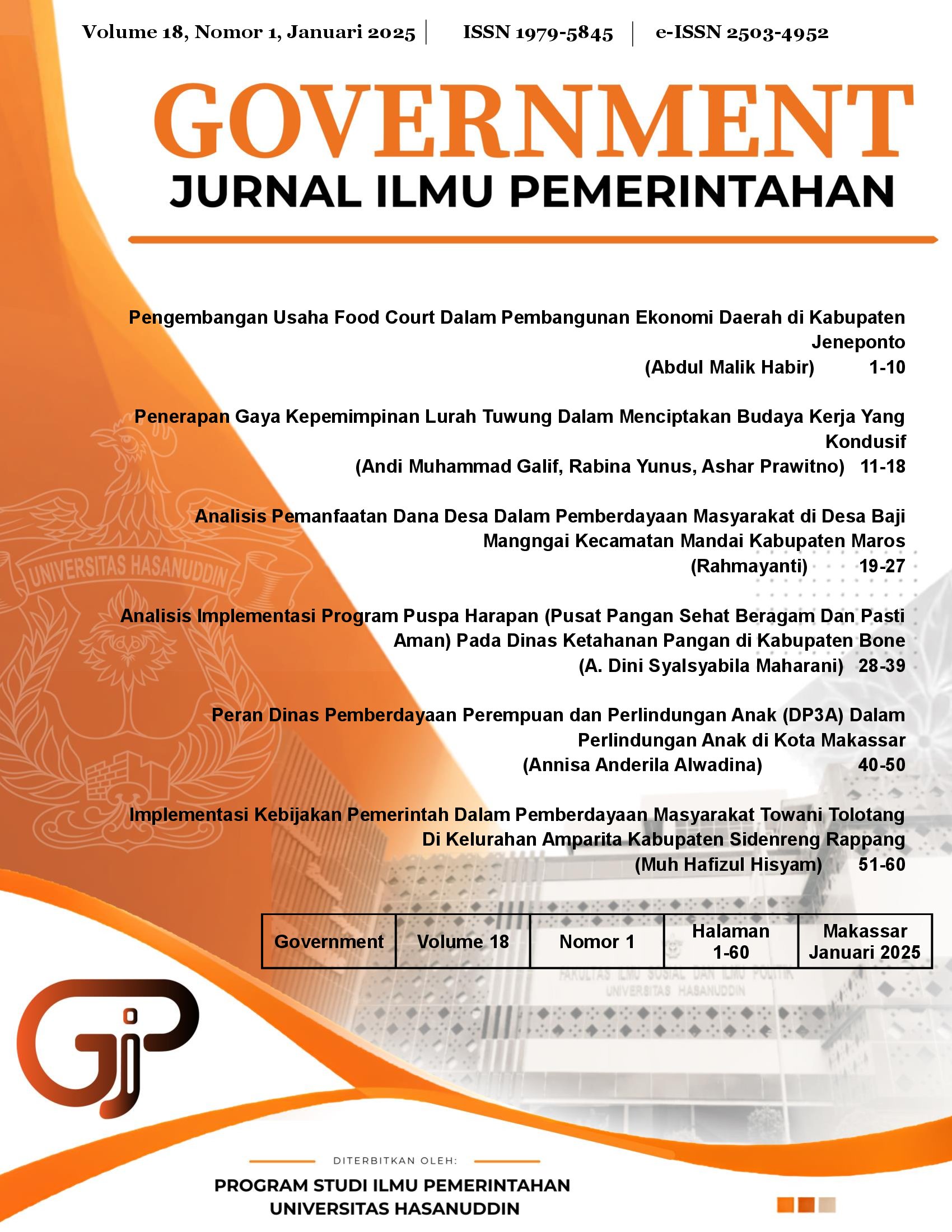
This study aims to analyze the implementation of the village head’s leadership style in creating a conducive work culture at the Tuwung Village Office, Barru District, Barru Regency. This research employed a qualitative approach with a descriptive research design. Data were collected through interviews, observations, and documentation and were analyzed using data reduction, data display, and conclusion drawing techniques. The findings reveal that the Head of Tuwung Village applies a combination of consultative, participative, delegative, and directive leadership styles as proposed in Gatto’s Leadership Theory. However, participative and consultative leadership styles are the most dominant approaches in leading the organization. The consultative leadership style is reflected in the village head’s openness to receiving suggestions and input from staff members and the community before making decisions. Meanwhile, the participative leadership style is demonstrated through the involvement of staff and community members in decision-making processes, planning activities, and the implementation of development programs. In addition, the delegative leadership style is implemented by granting authority to staff members according to their respective duties and functions, while the directive leadership style is reflected in the village head’s role in providing direction, guidance, and making decisions on issues that require certainty and prompt action. The implementation of these leadership styles has contributed to effective communication, increased employee participation, strengthened organizational cooperation, and the development of a conducive work culture within the Tuwung Village Office.
References
Nanda, I. G. A. A. Y., & Putri, I. G. A. M. A. D. (2021). Good Government Governance, gaya kepemimpinan dan kinerja manajerial penyelenggara pemerintahan desa. E-Jurnal Akuntansi, 31(8). https://doi.org/10.24843/EJA.2021.v31.i08.p10
Tahar, A., & Abdillah, M. A. (2021). The influence of leadership style on managerial performance of village governments with motivation as mediation. Journal of Economics and Business, 4(1), 157–169. https://doi.org/10.31014/aior.1992.04.01.328
Andayani, I., & Tirtayasa, S. (2019). Pengaruh kepemimpinan, budaya organisasi, dan motivasi terhadap kinerja pegawai. Maneggio: Jurnal Ilmiah Magister Manajemen, 2(1), 45–54. https://doi.org/10.30596/maneggio.v2i1.3367
Dunggio, S. (2020). Pengaruh budaya organisasi terhadap kinerja pegawai di Kantor Camat Dungingi Kota Gorontalo. Publik: Jurnal Manajemen Sumber Daya Manusia, Administrasi dan Pelayanan Publik, 7(1), 1–9. https://doi.org/10.37606/publik.v7i1.114
Anggoro, M. Y. A. R. (2022). Job satisfaction among civil servants: How organizational culture and work environment inspire performance. Jurnal Minds: Manajemen Ide dan Inspirasi, 9(2). https://doi.org/10.24252/minds.v9i2.28676
Sujito, N. L. A., & Firdaus, V. (2022). Analysis of discipline, organizational culture and public service performance. Indonesian Journal of Law and Economics Review, 17. https://doi.org/10.21070/ijler.v17i0.867
Widanti, N. P. T. (2023). The implementation of Sewakadharma work culture to improve public service quality in Denpasar City, Indonesia. Otoritas: Jurnal Ilmu Pemerintahan, 13(1), 80–91. https://doi.org/10.26618/ojip.v13i1.9975
Widyawati, W., Sulmiah, S., & Nurlaela, N. (2021). Organizational culture and employee performance: Assessing the influence on the implementation of public services during the Covid-19 pandemic. Jurnal Ilmu Administrasi, 18(2), 176–187. https://doi.org/10.31113/jia.v18i2.754
Pratikto, A. (2020). Pengaruh gaya kepemimpinan dan budaya organisasi terhadap kinerja karyawan pada Kantor Kecamatan Panggungrejo Kabupaten Blitar. Otonomi, 20(1), 1–9. https://doi.org/10.32503/otonomi.v20i1.1218
Azizah, S. N. (2021). Gaya kepemimpinan Path Goal Theory dan produktivitas pamong desa. Jurnal E-Bis, 5(1). https://doi.org/10.37339/e-bis.v5i1.460
Zuhenda, R., Darmawanto, Ariyanto, M., Syahwami, & Rusnaini, S. (2021). Gaya kepemimpinan untuk kinerja karyawan pada Koperasi Unit Desa Karya Mukti Kecamatan Pelepat Ilir. Jurnal Akuntansi, Manajemen, Bisnis dan Teknologi, 1(2), 241–250. https://doi.org/10.56870/ambitek.v1i2.27
Makatita, M., Hendry, Y. I., Soselisa, C., Amin, M., Wattiheluw, S. Y., & Amin, M. (2024). The influence of leadership style, organizational culture, policy implementation, and community participation on public service efficiency and employee satisfaction in Indonesian local government. West Science Social and Humanities Studies, 2(7). https://doi.org/10.58812/wsshs.v2i07.1124
Chang, Y.-Y., Chang, C.-Y., Chen, C.-W., Chen, Y. C. K., & Chang, S.-Y. (2019). Firm-level participative leadership and individual-level employee ambidexterity: A multilevel moderated mediation analysis. Leadership & Organization Development Journal, 40(5), 561–582. https://doi.org/10.1108/LODJ-08-2018-0308
Suwandana, A., & Dwipayanti, D. (2021). The effect of participatory leadership styles and organizational culture on employee performance with employee engagement as an intervening variable. Jurnal Pendidikan Ekonomi Undiksha, 13(2). https://doi.org/10.23887/jjpe.v13i2.41608
Wulandari, W., Hermanu, D. H., & Bernarto, I. (2020). Pengaruh gaya kepemimpinan dan optimisme karyawan terhadap employee performance. Jurnal Ilmiah Manajemen, Ekonomi, & Akuntansi, 4(3), 1685–1710. https://doi.org/10.31955/mea.v4i3.649
Zulfikar, Z., Sundari, S., & Adnan, A. A. (2024). Analysis of the village head's leadership style in management of digital-based services at the village office. Jurnal Studi Ilmu Pemerintahan, 5(1). https://doi.org/10.35326/jsip.v5i1.4979
Setiawan, S. A. (2019). The implications of leadership style, human resources practices, and organizational culture on employee performance in PT Kansai Prakarsa Coatings. Binus Business Review, 10(3). https://doi.org/10.21512/bbr.v10i3.5808
Purnomo, B. R., Eliyana, A., & Pramesti, E. D. (2020). The effect of leadership style, organizational culture and job satisfaction on employee performance with organizational commitment as the intervening variable. Systematic Reviews in Pharmacy, 11(10), 446–458. https://doi.org/10.31838/srp.2020.10.68
Jaenudin, D. A., Fitriati, A., & Astuti, H. J. (2020). The effect of leadership style, culture and organizational commitment to employee performance. Proceedings of ICBAE 2020. https://doi.org/10.4108/eai.5-8-2020.2301149
Andayani, A., & Soehari, T. D. (2019). The effect of organizational culture, organizational commitment and leadership style on employee performance. Akademika, 8(2). https://doi.org/10.34005/akademika.v8i02.366

This work is licensed under a Creative Commons Attribution 4.0 International License.