Keywords
How to Cite
Abstract
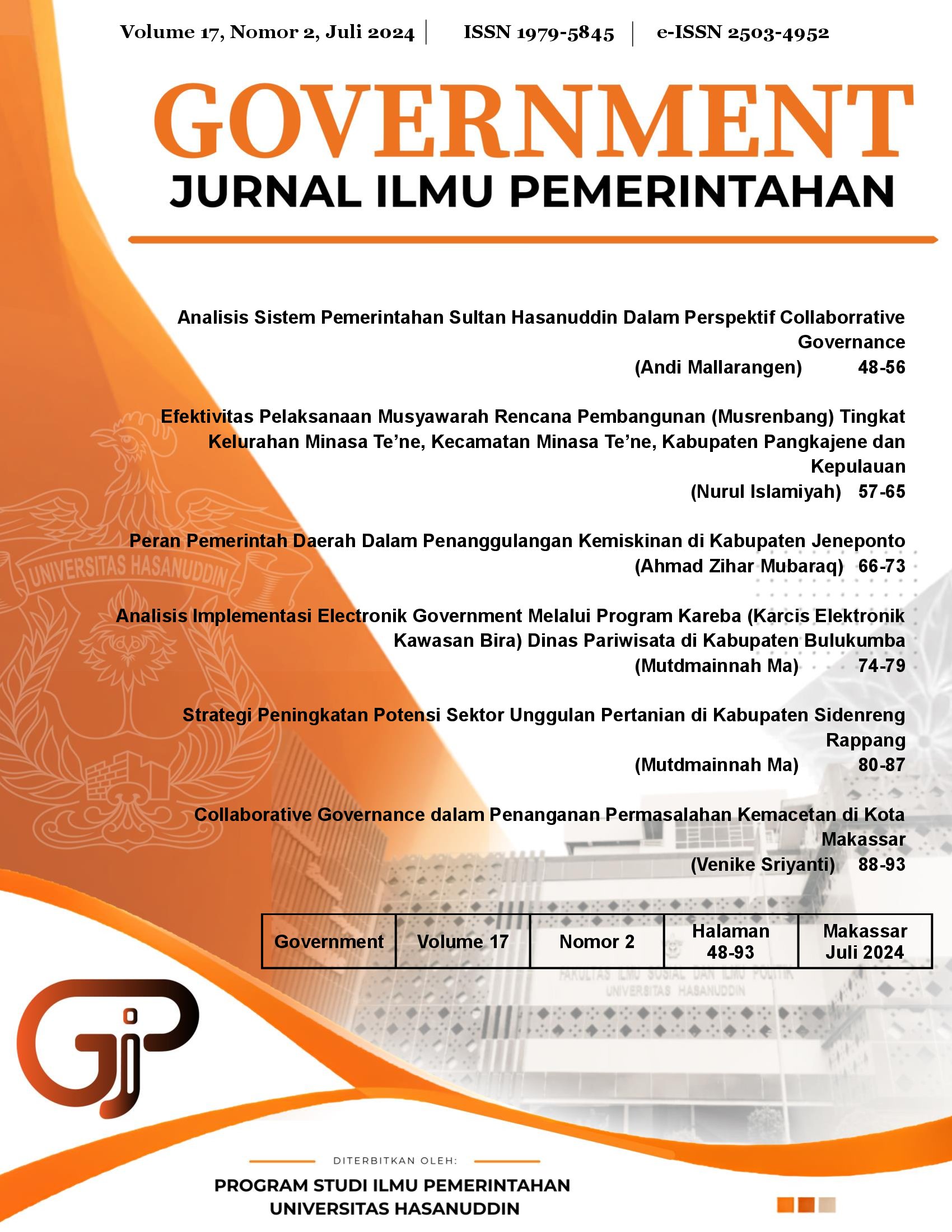
A major challenge in the development planning process is the ineffectiveness of the implementation of the Development Planning Deliberation (Musrenbang) at the village level. Musrenbang is intended to explore community aspirations, determine priorities, and allocate resources for development, but several factors have made it ineffective. The ineffectiveness of the Development Planning Deliberation (Musrenbang) at the village level has a significant impact and can hinder community growth and good governance. Failure in the Musrenbang process can also result in greater inequality, and ultimately, public dissatisfaction with the government. However, as is known, not all proposals submitted by the community can be realized. Some proposals must be considered for realization, and some proposals are prioritized in the coming year, especially related to flooding, which is a major problem in Minasa Te'ne Village. Therefore, this study aims to determine the effectiveness of the Musrenbang implementation by reviewing the opinions of Nugroho and Wrihatmolo, who explain that good and effective planning has four elements: systematic, integrated, transparent, and accountable. In collecting data, the author employed qualitative research methods, including interviews, direct observation, and data analysis and text analysis. The results indicate that the implementation of the Musrenbang in Minasa Te'ne Village remains ineffective. Furthermore, in terms of transparency, budgeting issues remain unclear and incomplete to the public. Furthermore, accountability, community participation, and government oversight are still lacking in its implementation.
References
Bennett, L. (2004). Governance, Community, and Participatory Planning in the United States. Planning Theory & Practice, 5(2), 187-214.
Cleaver, F. (2002). Reinventing Institutions: Bricolage and the Social Embeddedness of Natural Resource Management. European Journal of Development Research, 14(2), 11-30.
Freina, L., Bottino, R., Ott, M., & Costa, F. (2015). Social empowerment of intellectually impaired through a cloud mobile system. Future Internet, 7(4), 429-444. https://doi.org/10.3390/fi7040429
Muluk, 2008. Panduan Penyelenggaraan Musyawarah Perencanaan Pembangunan Kelurahan, Perpustakaan Nasional, Bandung.
Reis, C., Rodríguez, C., Macaulay, A., & Bedos, C. (2014). Dental students’ perceptions of and attitudes about poverty: a canadian participatory case study. Journal of Dental Education, 78(12), 1604-1614. https://doi.org/10.1002/j.0022-0337.2014.78.12.tb05838.x
Sabel, C. (2005). Redeeming local government: Judicial and popular reform of public services. California Law Review, 93(2), 337-446.
Stiglitz, J. E. (2002). Participation and Development: Perspectives from the Comprehensive Development Paradigm. Review of Development Economics, 6(2), 163-182.

This work is licensed under a Creative Commons Attribution 4.0 International License.