
Time Series Forecasting for Container Throughput Using SARIMA and LSTM: A Case Study of Tanjung Emas Port, Semarang
Article Sidebar
Main Article Content
Abstract
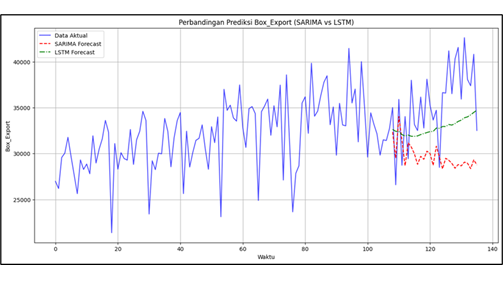
Abstract: Accurate forecasting of container throughput is vital for enhancing strategic planning and operational efficiency in seaport management. This study compares the performance of two time series forecasting models Seasonal Autoregressive Integrated Moving Average (SARIMA) and Long Short-Term Memory (LSTM) in predicting container throughput at Tanjung Emas Port, Semarang, Indonesia. Monthly throughput data from January 2014 to April 2025 were preprocessed using stationarity transformation and normalization techniques. Model performance was evaluated using Mean Absolute Percentage Error (MAPE), Root Mean Squared Error (RMSE), and Mean Absolute Error (MAE). The SARIMA model effectively captured seasonal patterns and produced accurate short-term forecasts. Conversely, the LSTM model exhibited notable significant deviation from the actual data , indicating lower predictive performance in this context. The findings indicate that SARIMA currently provides a more reliable forecasting approach for the port. Future research should consider hybrid models (e.g., SARIMA-LSTM) and incorporate exogenous variables to improve forecasting accuracy and support data-driven decision-making in port operations.
Article Details
Issue
Section

This work is licensed under a Creative Commons Attribution 4.0 International License.
How to Cite
References
[1] M. Intihar, T. Kramberger, and D. Dragan, “Container Throughput Forecasting Using Dynamic Factor Analysis and ARIMAX Model,” Promet-traffic & Transportation, vol. 29, pp. 529–542, 2017, [Online]. Available: https://api.semanticscholar.org/CorpusID:158288688
[2] C. Zhang, L. Huang, and Z. Zhao, “Research on combination forecast of port cargo throughput based on time series and causality analysis,” Journal of Industrial Engineering and Management, vol. 6, pp. 124–134, 2013, [Online]. Available: https://api.semanticscholar.org/CorpusID:30869984
[3] N. D. Tan, H. C. Yu, L. N. B. Long, and S.-S. You, “Time series forecasting for port throughput using recurrent neural network algorithm,” Journal of International Maritime Safety, Environmental Affairs, and Shipping, vol. 5, pp. 175–183, 2021, [Online]. Available: https://api.semanticscholar.org/CorpusID:245243718
[4] S. Xu, S. Zou, J. Huang, W. Yang, and F. Zeng, “Comparison of Different Approaches of Machine Learning Methods with Conventional Approaches on Container Throughput Forecasting,” Applied Sciences, 2022, [Online]. Available: https://api.semanticscholar.org/CorpusID:252619691
[5] C.-H. Yang and P.-Y. Chang, “Forecasting the Demand for Container Throughput Using a Mixed-Precision Neural Architecture Based on CNN–LSTM,” Mathematics, 2020, [Online]. Available: https://api.semanticscholar.org/CorpusID:225173433
[6] F. Zeng and S. Xu, “A hybrid container throughput forecasting approach using bi-directional hinterland data of port,” Sci Rep, vol. 14, 2024, [Online]. Available: https://api.semanticscholar.org/CorpusID:273644523
[7] D. Huang, M. Grifoll, J. A. Sánchez, P. Zheng, and H. X. Feng, “Hybrid approaches for container traffic forecasting in the context of anomalous events: The case of the Yangtze River Delta region in the COVID-19 pandemic,” Transp Policy (Oxf), vol. 128, pp. 1–12, 2022, [Online]. Available: https://api.semanticscholar.org/CorpusID:252112026
[8] P. C. Awah, H. Nam, and S. Kim, “Short Term Forecast of Container Throughput: New Variables Application for the Port of Douala,” J Mar Sci Eng, 2021, [Online]. Available: https://api.semanticscholar.org/CorpusID:237905359
[9] F. Parola, G. Satta, T. E. Notteboom, and L. Persico, “Revisiting traffic forecasting by port authorities in the context of port planning and development,” Maritime Economics & Logistics, vol. 23, pp. 444–494, 2020, [Online]. Available: https://api.semanticscholar.org/CorpusID:222344415
[10] A. Huang, X. Liu, C. Rao, Y. Zhang, and Y. He, “A New Container Throughput Forecasting Paradigm under COVID-19,” Sustainability, 2022, [Online]. Available: https://api.semanticscholar.org/CorpusID:247277688
[11] M. Fung, “Forecasting Hong Kong’s container throughput: an error-correction model,” J Forecast, vol. 21, pp. 69–80, 2002, [Online]. Available: https://api.semanticscholar.org/CorpusID:154776140
[12] M. Ferretti, U. Fiore, F. Perla, M. Risitano, and S. Scognamiglio, “Deep Learning Forecasting for Supporting Terminal Operators in Port Business Development,” Future Internet, vol. 14, p. 221, 2022, [Online]. Available: https://api.semanticscholar.org/CorpusID:251123891
[13] X. Liang, Y. Wang, and M. Yang, “Systemic Modeling and Prediction of Port Container Throughput Using Hybrid Link Analysis in Complex Networks,” Syst., vol. 12, p. 23, 2024, [Online]. Available: https://api.semanticscholar.org/CorpusID:267158951
[14] Y. Zhang, Y. Fu, and G. T. Li, “Research on Container Throughput Forecast Based on ARIMA-BP Neural Network,” J Phys Conf Ser, vol. 1634, 2020, [Online]. Available: https://api.semanticscholar.org/CorpusID:234981921
[15] F. Huang, D. Liu, T. J. an, and J. Cao, “Port Container Throughput Forecast Based on ABC Optimized BP Neural Network,” IOP Conf Ser Earth Environ Sci, vol. 571, 2020, [Online]. Available: https://api.semanticscholar.org/CorpusID:229392997
[16] Ch. Martius, L. Kretschmann, M. Zacharias, C. Jahn, and O. John, “Forecasting worldwide empty container availability with machine learning techniques,” Journal of Shipping and Trade, vol. 7, 2022, [Online]. Available: https://api.semanticscholar.org/CorpusID:251109089
[17] X. Jin, L. Bo, and H. Jing, “Research on Time Series Forecast of Container Throughput Based on Selective Deep-Ensemble Model,” J Phys Conf Ser, vol. 2010, 2021, [Online]. Available: https://api.semanticscholar.org/CorpusID:237500252
[18] C. He and H. Wang, “Container Throughput Forecasting of Tianjin-Hebei Port Group Based on Grey Combination Model,” Journal of Mathematics, 2021, [Online]. Available: https://api.semanticscholar.org/CorpusID:238679024
[19] J. J. Ruíz-Aguilar, J. A. Moscoso-López, D. Urda, J. González-Enrique, and I. J. Turias, “A Clustering-Based Hybrid Support Vector Regression Model to Predict Container Volume at Seaport Sanitary Facilities,” Applied Sciences, 2020, [Online]. Available: https://api.semanticscholar.org/CorpusID:229462887
[20] M. Milenković, N. Milosavljević, N. J. Bojovic, and S. Val, “Container flow forecasting through neural networks based on metaheuristics,” Operational Research, vol. 21, pp. 965–997, 2019, [Online]. Available: https://api.semanticscholar.org/CorpusID:159338537
[21] N. S. Gargari, R. Panahi, H. Akbari, and A. K. Y. Ng, “Long-Term Traffic Forecast Using Neural Network and Seasonal Autoregressive Integrated Moving Average: Case of a Container Port,” Transp Res Rec, vol. 2676, pp. 236–252, 2022, [Online]. Available: https://api.semanticscholar.org/CorpusID:247608398
[22] H. K. Chan, S. Xu, and X. Qi, “A comparison of time series methods for forecasting container throughput,” International Journal of Logistics Research and Applications, vol. 22, pp. 294–303, 2018, [Online]. Available: https://api.semanticscholar.org/CorpusID:169278470