
Ship Crew Behavior, Maritime Safety Culture, and Shipping Operational Performance
Article Sidebar
Main Article Content
Abstract
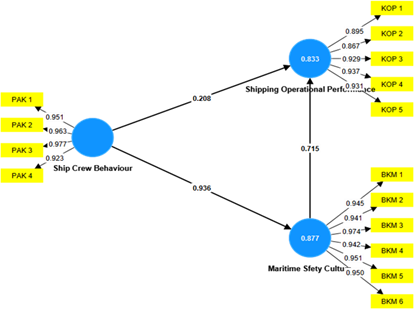
The purpose of this study is to examine how crew behavior affects shipping operational performance when maritime safety culture is used as a mediating variable. Using Flin's (2008) crew behavior instrument, Xi et al.'s (2025) safety culture instrument, and BIMCO Shipping's (2020) operational performance KPIs, data were collected through a questionnaire survey of 343 commercial ship crews in Indonesia, using a 1–5 Likert scale. External model testing (validity and reliability) and internal model testing (R2, f2, SRMR, and hypotheses) were conducted with SEM-PLS using SmartPLS 4. The results show that crew behavior has a significant impact on maritime safety culture (β = 0.936; p < 0.001). However, the direct impact on operational performance was small (β = 0.208; p < 0.018). These findings confirm that crew behavior only has an optimal impact when it is internalized into the organization's safety culture, so shipping companies need to strengthen safety policies, continuous training, safety-based leadership, and non-punitive reporting systems. Theoretically, this study expands the literature on safety management by showing that the ever-changing interaction between human elements and organizational culture determines how effective maritime organizations are.
Article Details
Issue
Section

This work is licensed under a Creative Commons Attribution 4.0 International License.