
The Effect of Shore Leave Crew on Watch Duty on Passenger Ships
Article Sidebar
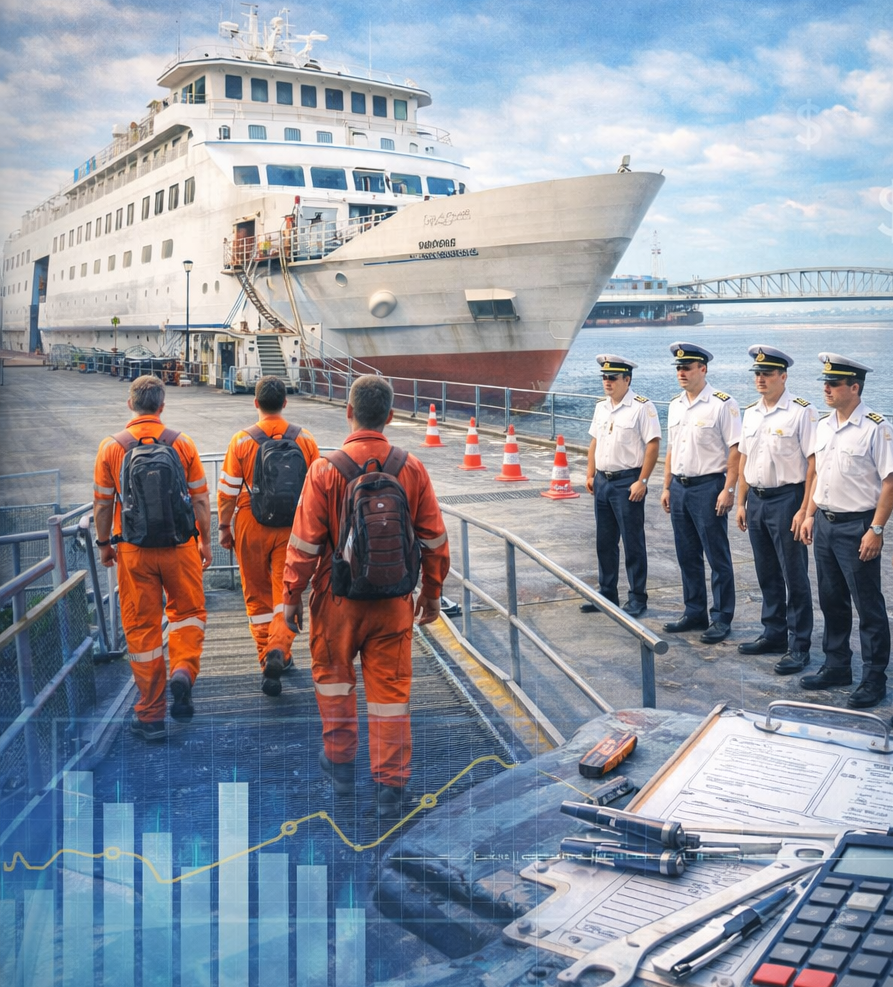
Main Article Content
Abstract
The shipping industry plays a vital role in supporting passenger mobility and goods distribution in Indonesia. However, one of the challenges faced is the management of crew working hours and rest periods, particularly in relation to shore leave activities. This study aims to analyze the effect of crew shore leave on the effectiveness of watchkeeping duties on passenger ships and the impact of crew shore leave on the readiness and performance of watchkeeping crews. The research method used is a quantitative approach with an instrument in the form of a questionnaire distributed to 35 passenger ship crew members on duty at PT Pelni Makassar. The data were analyzed using descriptive statistics, regression tests, and ANOVA. The results of the study indicate that shore leave crew has a significant effect on the quality of watchkeeping, particularly in terms of physical readiness, mental readiness, and reduction of fatigue risk. These findings emphasize the importance of good shore leave schedule management to support shipping safety.
Downloads
Article Details

This work is licensed under a Creative Commons Attribution 4.0 International License.
Allow anyone to modify, improve, and make derivative works, even for commercial purposes, as long as they credit to you for the original work.
Accepted 2026-03-23
Published 2026-03-29
References
[1] G. Adam Farhandika and R. Modjo, “Kelelahan Kerja di Kalangan Awak Kapal: Systematic Literature Review,” Jurnal Ilmiah Kedokteran dan Kesehatan, vol. 4, no. 3, pp. 95–100, Jun. 2025, doi: 10.55606/klinik.v4i3.4336.
[2] Ö. Uğurlu, F. Sana, H. Uğurlu, and N. Şenbursa, “Analysis of the Impact of Officers of the Watch’s Mental and Physical Health Issues on Collision and Grounding Accidents,” Inquiry, vol. 62, p. 00469580251371875, Jan. 2025, doi: 10.1177/00469580251371875.
[3] O. : Imanuel, K. Sampelan, D. J. Paseki, and F. J. M. M. Karisoh, “Pengaturan Sarana Bantu Navigasi Pelayaran Menurut Undang-Undang Nomor 17 Tahun 2008 Tentang Pelayaran,” LEX ADMINISTRATUM, vol. 10, no. 6, Oct. 2022, Accessed: Feb. 02, 2026. [Online]. Available: https://ejournal.unsrat.ac.id/v2/index.php/administratum/article/view/44126
[4] P. M. Dinas Jaga Anjungan untuk Menghindari Bahaya Tubrukan di Tanto Subur et al., “Implementation of Bridge Watchkeeping to Avoid Collision Hazards on the MV. Tanto Bersinar 1,” Jurnal Transportasi dan Bahari, vol. 1, no. 2, pp. 15–23, 2024.
[5] S. Xu and N. G. Hall, “Fatigue, personnel scheduling and operations: Review and research opportunities,” Eur. J. Oper. Res., vol. 295, no. 3, pp. 807–822, Dec. 2021, doi: 10.1016/j.ejor.2021.03.036.
[6] S. Mutmainnah, A. Purba, B. Utoyo, I. Sukmana, and S. Suharno, “Karakteristik Penumpang Dalam Pemilihan Moda Transportasi Kereta Api Menuju Pelabuhan Bakauheni,” Jurnal Profesi Insinyur Universitas Lampung, vol. 3, no. 2, pp. 50–54, Nov. 2022, doi: 10.23960/jpi.v3n2.80.
[7] W. Mulyono et al., “Faktor-Faktor yang Mempengaruhi Kinerja Awak Kapal pada PT. Pelni (Persero) di Pelabuhan Tanjung Wangi,” Jurnal Ekonomi Manajemen Akuntansi, vol. 31, no. 1, pp. 177–191, Jan. 2025, doi: 10.59725/ema.v31i1.244.
[8] P. Smith, K. Rice, N. Schutte, and K. Usher, “Development and validation of the Cultural Responsiveness Assessment Measure (CRAM): A self-reflection tool for mental health practitioners when working with First Nations people,” International Journal of Social Psychiatry, vol. 70, no. 1, pp. 190–200, Feb. 2024, doi: 10.1177/00207640231204211;PAGEGROUP:STRING:PUBLICATION.
[9] P. Smith, K. Rice, N. Schutte, and K. Usher, “Reflexivity: a model for teaching and learning cultural responsiveness in mental health,” Aust. Psychol., vol. 57, no. 4, pp. 209–214, Jul. 2022, doi: 10.1080/00050067.2022.2078648;JOURNAL:JOURNAL:RAPY20;SUBPAGE:STRING:ACCESS.
[10] M. A. Al Imran, F. Nasirzadeh, and C. Karmakar, “Designing a practical fatigue detection system: A review on recent developments and challenges,” J. Safety Res., vol. 90, pp. 100–114, Sep. 2024, doi: 10.1016/J.JSR.2024.05.015.
[11] J. An, W. Gao, R. Liu, and Z. Liu, “Empirical Study on the Relationship Between Vacation Schedule and Seafarers’ Fatigue in Chinese Seafarer Population,” Front. Psychol., vol. 13, p. 838811, Mar. 2022, doi: 10.3389/FPSYG.2022.838811/BIBTEX.