
Soil Fertility Management in Coastal Areas through the Application of Organic Amendments with Different C/N Ratios: A Study on Lembah Palu Shallot
Article Sidebar
Main Article Content
Abstract
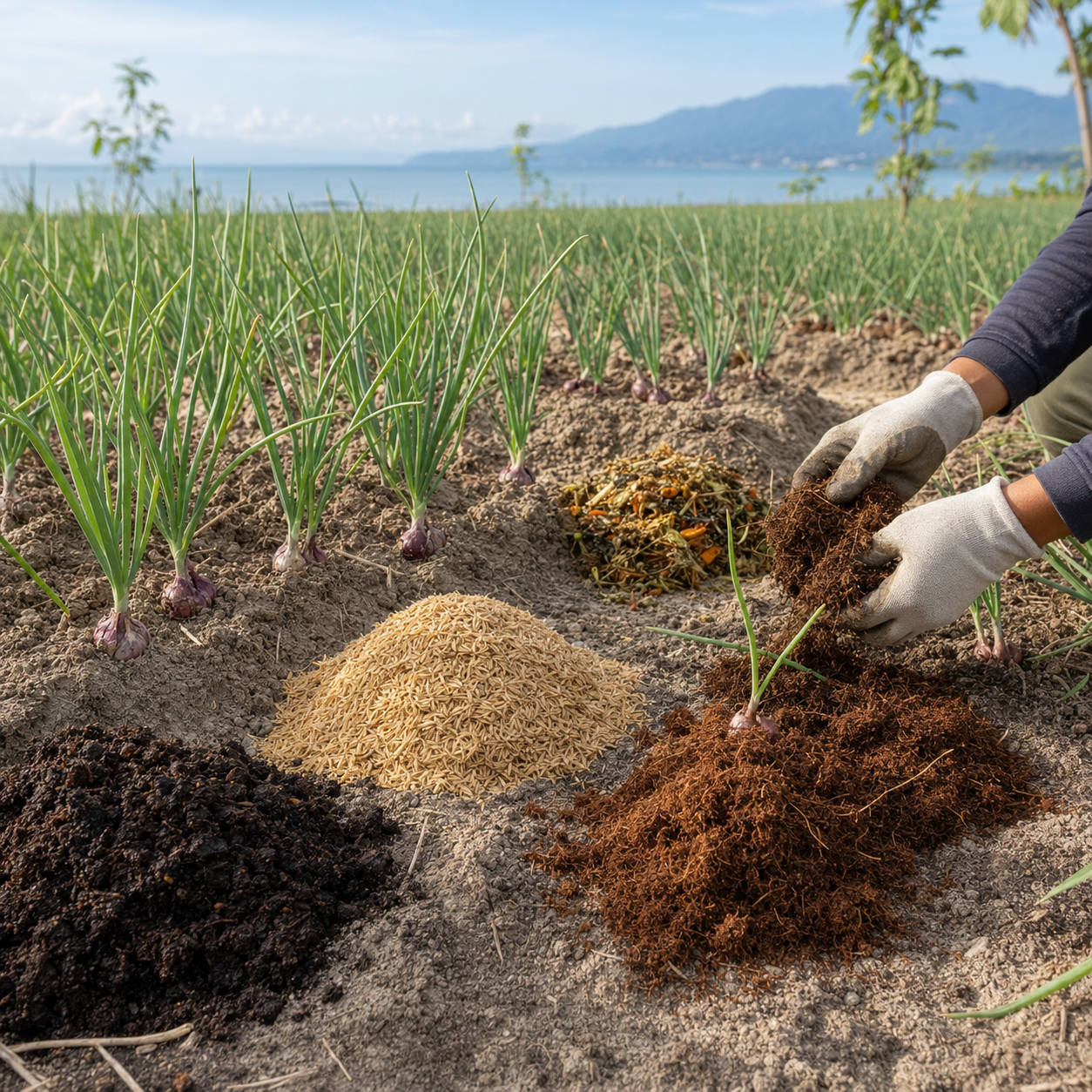
Lembah Palu shallot is a high-value local horticultural commodity of Central Sulawesi, its adapted to the dry lowland climates makes it a promising crop for coastal agriculture. Agricultural development in coastal areas requires soil-management technologies that improve nutrient availability, enhance the rhizosphere environment, and sustain crop productivity. This study evaluated the effects of organic amendments with different carbon-to-nitrogen ratio (C/N ratio) on soil pH, rhizosphere microorganism populations, nitrogen (N), phosphorus (P), and potassium (K) acquisition, and the yield of Lembah Palu shallot. A one-factor randomized block design was used with five treatments: unamended control, cattle manure (C/N 19.8), rice husk (C/N 40.7), cocopeat (C/N 90.6), and vegetable compost (C/N 13.5). The measured variables included soil N, P, and K; plant-tissue N, P, and K acquisition; rhizosphere microorganism colony numbers; bulb numbers; fresh and oven-dry bulb weights; and yields per hectare. The results demonstrate organic amendments with different C/N ratio influenced soil nutrient dynamics, rhizosphere microorganism abundance, plant-tissue nutrient concentrations, and yield of Lembah Palu shallot. Among the amendments evaluated, cocopeat (C/N 90.6) produced the highest tissue N concentration (3.57%), bulb number (8.50 bulbs clump⁻¹), bulb dry weight (0.09 g clump-1), numerical fresh bulb yield (5.87 t ha⁻¹), and oven-dry bulb yield (0.05 t ha⁻¹), significantly higher than cattle manure and vegetable compost treatments. The favorable performance and characteristics of cocopeat could associated with gradual nutrient release and improved root-zone conditions, particularly water retention and aeration, which can enhance nutrient acquisition in porous coastal soils. Because cocopeat is derived from locally available coconut residues, its use may also support agricultural-waste utilization and sustainable agriculture in coastal areas.
Article Details
Section

This work is licensed under a Creative Commons Attribution 4.0 International License.
Allow anyone to modify, improve, and make derivative works, even for commercial purposes, as long as they credit to you for the original work.
How to Cite
References
Ayangbenro, A. S., Chukwuneme, C. F., Ayilara, M. S., Kutu, F. R., Khantsi, M., Adeleke, B. S., ... Babalola, O. O. (2022). Harnessing the rhizosphere soil microbiome of organically amended soil for plant productivity. Agronomy, 12(12), Artikel 3179. https://doi.org/10.3390/agronomy12123179
Dalias, P., & Christou, A. (2022). Secondary immobilization as a phase of N mineralization dynamics of soil organic inputs. Nitrogen, 3(4), 600–607. https://doi.org/10.3390/nitrogen3040039
Gbollie, S. N., Mwonga, S. M., & Kibe, A. M. (2021). Effects of calcium nitrate levels and soaking durations on cocopeat nutrient content. Journal of Agricultural Chemistry and Environment, 10(3), 372–388. https://doi.org/10.4236/jacen.2021.103024
Idris, Basir, M., & Wahyudi, I. (2018). Pengaruh berbagai jenis dan dosis pupuk kandang terhadap pertumbuhan dan hasil tanaman bawang merah varietas Lembah Palu. Jurnal Agrotech, 8(2), 40–49.
Liu, W., Yang, Z., Ye, Q., Peng, Z., Zhu, S., Chen, H., ... Zhou, J. (2023). Positive effects of organic amendments on soil microbes and their functionality in agro-ecosystems. Plants, 12(22), Artikel 3790. https://doi.org/10.3390/plants12223790
Mautuka. (2022). Peran rasio C/N bahan organik terhadap dinamika dekomposisi tanah. Soil and Environment Journal, 10(2), 67–75.
Munir. (2024). Peran nitrogen dalam pembentukan klorofil dan hasil tanaman hortikultura. Jurnal Ilmu Tanaman, 15(1), 12–20.
Pradiksa, A. (2022). Rasio C/N bahan organik dan implikasinya terhadap ketersediaan nitrogen tanah. Soil Science Journal, 11(2), 55–64.
Rahim, A. (2012). Produktivitas, kualitas dan potensi pengembangan agroindustri bawang merah varietas Lembah Palu, Palu Sulawesi Tengah (Disertasi doktoral, Universitas Hasanuddin).
Sasmita, N., & Haryanto, T. (2021). Rasio C/N dan implikasinya terhadap aktivitas mikroba tanah. Jurnal Ekologi Tanah, 9(2), 122–130.
Suci, H. (2023). Gejala defisiensi nitrogen pada tanaman hortikultura. Agrohort Journal, 7(1), 34–41.
Suherman, R. (2024). Peran rasio C/N pupuk organik terhadap ketersediaan nitrogen di tanah. Jurnal Kesuburan Tanah, 14(2), 145–154.
Minhal, F., Ma’as, A., Hanudin, E., et al. (2020). Improvement of the chemical properties and buffering capacity of coastal sandy soil as affected by clay and organic by-product application. Soil & Water Research. http://swr.agriculturejournals.cz/pdfs/swr/2020/02/04.pdf
van der Sloot, M. A., Kleijn, D., De Deyn, G. B., & Limpens, J. (2022). Carbon to nitrogen ratio and quantity of organic amendment interactively affect crop growth and soil mineral N retention. Crop and Environment, 1(3), 161–167. https://doi.org/10.1016/j.crope.2022.08.001