
Desain Konseptual PLTN Terapung di Indonesia Timur: Aspek Kelayakan dan Implikasi Ekonomi
Article Sidebar
Main Article Content
Abstract
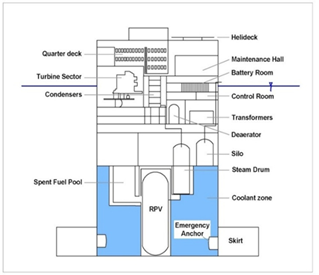
Indonesia is a vast archipelagic country with thousands of islands stretching from west to east; however, the distribution and accessibility of electricity supply remain uneven across regions. This challenge necessitates reliable, sustainable, and affordable energy solutions, particularly in the eastern part of the country. To address the energy crisis and climate change mitigation, the Floating Nuclear Power Plant (FNPP) has emerged as a potential alternative due to its ability to generate large-scale electricity with low emissions, more efficient construction compared to land-based plants, and accessible cooling processes. This study evaluates the feasibility of implementing the FNPP design in the waters surrounding Halmahera Island, North Maluku Province. In addition to technical feasibility, the study also highlights economic implications, where the proposed 300 MW capacity not only has the potential to reduce energy disparities but also to provide affordable electricity (SDGs 7), support sustainable infrastructure development (SDGs 9), and promote the blue economy through enhanced access to electricity, strengthened fisheries, port activities, and the maritime industry. Accordingly, the conceptual design of the FNPP is expected to serve as a strategic solution to improve national energy security while supporting Indonesia’s sustainable development agenda. Furthermore, this design recommendation is anticipated to serve as a strategic reference to reduce energy disparities in remote areas, strengthen national energy resilience, and contribute to the global development agenda.
Article Details
Section
How to Cite
References
[1] Statistics Indonesia (BPS) Central Halmahera Regency, Kabupaten Halmahera Tengah Dalam Angka 2024 [Central Halmahera Regency in Figures 2024]. Weda, Indonesia: BPS Kabupaten Halmahera Tengah, 2024.
[2] Statistics Indonesia (BPS), “Listrik yang didistribusikan menurut provinsi (GWh)” [Electricity distributed by province (GWh)], Energy Statistics Tables, 2026.
[3] Ministry of Energy and Mineral Resources of the Republic of Indonesia, Rencana Umum Ketenagalistrikan Nasional 2025–2060: Bahan Diseminasi [National Electricity General Plan 2025–2060: Dissemination Materials]. Jakarta, Indonesia: Directorate General of Electricity, 2025.
[4] International Atomic Energy Agency, Deployment of Floating Nuclear Power Plants: Benefits and Challenges, Proceedings Series STI/PUB/2145. Vienna, Austria: IAEA, 2026.
[5] International Atomic Energy Agency, Small Modular Reactors: Advances in SMR Developments 2024. Vienna, Austria: IAEA, 2024.
[6] International Atomic Energy Agency, Preparation of a Feasibility Study for a New Nuclear Power Plant Project, Nuclear Energy Series. Vienna, Austria: IAEA, 2025.
[7] International Atomic Energy Agency, Economic Assessment of the Long-Term Operation of Nuclear Power Plants: Approaches and Experience, Nuclear Energy Series No. NP-T-3.25. Vienna, Austria: IAEA, 2018.
[8] International Atomic Energy Agency, Approaches to Cost–Benefit Analysis of New Nuclear Power Programmes. Vienna, Austria: IAEA, 2023.
[9] International Atomic Energy Agency, Site Evaluation for Nuclear Installations, IAEA Safety Standards Series No. SSR-1. Vienna, Austria: IAEA, 2019.
[10] International Atomic Energy Agency, Site Survey and Site Selection for Nuclear Installations, IAEA Safety Standards Series No. SSG-35. Vienna, Austria: IAEA, 2015.
[11] International Atomic Energy Agency, Seismic Hazards in Site Evaluation for Nuclear Installations, IAEA Safety Standards Series No. SSG-9 (Rev. 1). Vienna, Austria: IAEA, 2022.
[12] International Atomic Energy Agency and World Meteorological Organization, Meteorological and Hydrological Hazards in Site Evaluation for Nuclear Installations, IAEA Safety Standards Series No. SSG-18. Vienna, Austria: IAEA, 2011.
[13] Government of the Republic of Indonesia, Peraturan Pemerintah Nomor 2 Tahun 2014 tentang Perizinan Instalasi Nuklir dan Pemanfaatan Bahan Nuklir [Government Regulation No. 2 of 2014 on Licensing of Nuclear Installations and Utilization of Nuclear Materials]. Jakarta, Indonesia, 2014.
[14] Nuclear Energy Regulatory Agency (BAPETEN), Peraturan BAPETEN Nomor 4 Tahun 2019 tentang Evaluasi Tapak Instalasi Nuklir untuk Aspek Dispersi Zat Radioaktif di Udara dan Air [BAPETEN Regulation No. 4 of 2019 on Site Evaluation of Nuclear Installations for Aspects of Radioactive Substance Dispersion in Air and Water]. Jakarta, Indonesia, 2019.
[15] Nuclear Energy Regulatory Agency (BAPETEN), “Konsultasi publik perubahan Peraturan BAPETEN Nomor 4 Tahun 2018 tentang keselamatan tapak instalasi nuklir” [Public consultation on the amendment of BAPETEN Regulation No. 4 of 2018 on site safety of nuclear installations], Jakarta, Indonesia, 2026.
[16] Nuclear Energy Regulatory Agency (BAPETEN), “Discussion of evaluation results of PT ThorCon Power Indonesia’s site evaluation approval documents,” Jakarta, Indonesia, Apr. 2025.
[17] J. Buongiorno, J. Jurewicz, M. Golay, and N. Todreas, “The offshore floating nuclear plant concept,” Nuclear Technology, vol. 194, no. 1, pp. 1–14, 2016, doi: 10.13182/NT15-49.
[18] International Maritime Organization, Code of Safety for Nuclear Merchant Ships, Resolution A.491(XII). London, U.K.: IMO, 1981.
[19] International Maritime Organization, International Convention for the Safety of Life at Sea (SOLAS), 1974, as amended. London, U.K.: IMO.
[20] International Maritime Organization, International Code for the Safe Carriage of Packaged Irradiated Nuclear Fuel, Plutonium and High-Level Radioactive Wastes on Board Ships (INF Code). London, U.K.: IMO, 2022.
[21] American Bureau of Shipping, Requirements for Nuclear Power Systems for Marine and Offshore Applications. Houston, TX, USA: ABS, 2024.
[22] International Atomic Energy Agency, Legal and Institutional Issues of Transportable Nuclear Power Plants: A Preliminary Study, Nuclear Energy Series No. NG-T-3.5. Vienna, Austria: IAEA, 2013.
[23] International Atomic Energy Agency, Technology Roadmap for Small Modular Reactor Deployment, Nuclear Energy Series. Vienna, Austria: IAEA, 2021.
[24] ThorCon Power, “ThorCon power plant design overview,” Technical Information, 2025.
[25] World Nuclear Association, “Nuclear power in Indonesia,” Information Library, updated Apr. 2026.
[26] Ministry of Energy and Mineral Resources of the Republic of Indonesia, “Nuklir komponen penting dalam transisi energi” [Nuclear as an important component of the energy transition], Jakarta, Indonesia, Dec. 2025.
[27] I. N. Pujawan, Ekonomi Teknik [Engineering Economics], 3rd ed. Yogyakarta, Indonesia: Lautan Pustaka, 2019.
[28] International Energy Agency and OECD Nuclear Energy Agency, Projected Costs of Generating Electricity 2020. Paris, France: OECD Publishing, 2020.
[29] DNV, DNV-RP-C205: Environmental Conditions and Environmental Loads. Høvik, Norway: DNV, 2021.
[30] American Petroleum Institute, API Recommended Practice 2SK: Design and Analysis of Stationkeeping Systems for Floating Structures, 4th ed. Washington, DC, USA: API, 2023.