Creating Commons: Reflections on Creating Natural Resource Management Regimes in South Sulawesi, Indonesia
DOI:
https://doi.org/10.24259/fs.v5i2.14768Keywords:
Commons, Commoning, National Park, Collective action, South Sulawesi, IndonesiaAbstract
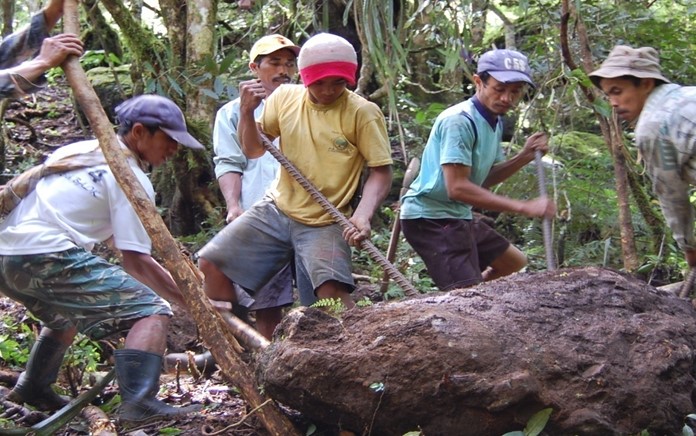
Thirteen years ago, PAYOPAYO Peasant School Network, an Indonesian community organizing network based in Sulawesi, facilitated Participatory Action Research (PAR) that eventually culminated in a creation of a common resource management regime around an irrigation system for agricultural use in Tompobulu, a village within a national park in upland South Sulawesi. This note from the field presents a reflection on collective action experiences of a community in building the commons in 2008 to 2009, and revisits the extent to which the commons has been managed, how management regimes changed over time, and how it survives as a commons today. The initial factors allowing for establishment of the commons, understood here as a social practice toward common goals, were a shared need for water (local needs & conditions), and the success to make use of the irrigation commons as a means to initiate other collective actions. Drawing from concerted engagement and analysis conducted in 2021, this note revisits the key factors and highlights different ways the commons continues to persist, namely due to the distinct benefits felt by participants, the existence of institutions that regulate the use and maintenance of the commons, the existence of a monitoring system among members, participation of members in formulating and modifying the rules, and the recognition of National Park authorities on the commons and its rules.
References
Euler, J. (2018). Conceptualizing the commons: Moving beyond the goods-based definition by introducing the social practices of commoning as vital determinant. Ecological Economics, 143, 10-16. https://doi.org/10.1016/j.ecolecon.2017.06.020
Ostrom, E (1990). Governing the Commons: The Evolution of Institutions for Collective Action. New York, USA: Cambridge University Press.
Prabowo, A., Batiran, K., Mansyur, M.A., (2011). Melawan Ketergantungan Kebijakan Pangan. Yogyakarta: InsistPress
Sirimorok, N., & Hawi, S. (2014). Melacak Kerja Kolektif di Dua Desa Sulawesi Selatan. Makassar: Penerbit Ininnawa.
Vaccaro, I., & Beltran, O. (2019). What Do We Mean by “the Commons?” An Examination of Conceptual Blurring Over Time. Human Ecology, 47(3), 331-340. https://doi.org/10.1007/s10745-019-00081-z
Additional Files
Published
Issue
Section
Categories
License
Copyright (c) 2021 Forest and Society

This work is licensed under a Creative Commons Attribution 4.0 International License.
This is an open access journal which means that all contents is freely available without charge to the user or his/her institution. Users are allowed to read, download, copy, distribute, print, search, or link to the full texts of the articles in this journal without asking prior permission from the publisher or the author. This is in accordance with the BOAI definition of open access.
Submission of an article implies that the work described has not been published previously (except in the form of an abstract or as part of a published lecture or academic thesis), that it is not under consideration for publication elsewhere, that its publication is approved by all authors and tacitly or explicitly by the responsible authorities where the work was carried out, and that, if accepted, will not be published elsewhere in the same form, in English or in any other language, without the written consent of the Publisher. An article based on a section from a completed graduate dissertation may be published in Forest and Society, but only if this is allowed by author's(s') university rules. The Editors reserve the right to edit or otherwise alter all contributions, but authors will receive proofs for approval before publication.
Forest and Society operates a CC-BY 4.0 © license for journal papers. Copyright remains with the author, but Forest and Society is licensed to publish the paper, and the author agrees to make the article available with the CC-BY 4.0 license. Reproduction as another journal article in whole or in part would be plagiarism. Forest and Society reserves all rights except those granted in this copyright notice

