
Assessing Integration of Science in Policy-Making Process of the Utilization of Abandoned Lands in Indonesia: Case of Bogor Regency
DOI:
https://doi.org/10.24259/fs.v6i2.19295Keywords:
Abandoned Lands, Landuse Policy, Policy Adoption, Product of Knowledge, Science-Policy InterfaceAbstract
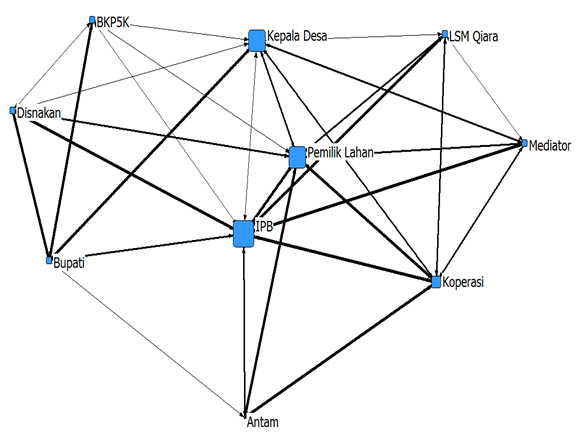
Science cannot directly influence policy without a process of knowledge transfer and integration into policy-making called the science-policy interface. On the other hand, not all scientists intend to use their knowledge and findings to influence policy-makers. This condition causes a gap between science and policy. The main objective of this study is to identify various "knowledge products" that have varying amounts of policy space, understand the power relations between actors, and identify and analyze the process of integrating knowledge products into the policy-making process for abandoned land in Bogor Regency. The primary method used in this study is the RAPID (Research and Policy in Development) analytical framework. The study indicates that policy-makers will adopt the scientific evidence if they follow their organization's Main Performance Indicators (KPI) or gain political or economic benefits. The role of the lower-level bureaucracy as the implementing agency is crucial in the policy adoption process. The people "behind the organization" and "policy intrapreneurs" have an essential role in integrating scientific knowledge and policy. Scientific products, such as modeling, are often more effective in convincing policy-makers. The scientific evidence will become good advice and have a more significant impact when they meet policy-makers' interests. The study concludes that it is challenging to integrate science into policy-making without mutual trust amongst formal and informal network actors who have access to policy-makers to utilize abandoned lands in Bogor Regency.
References
Ascher, W. (2000). Understanding why government in developing countries waste natural resources. Environment: Science and Policy for Sustainable Development, 42(2), 8-18. https://doi.org/10.1080/00139150009604864
Böcher, M. (2016). How does science-based policy advice matter in policy making? The RIU model as a framework for analyzing and explaining processes of scientific knowledge transfer. Forest Policy and Economics, 68, 65-72. https://doi.org/ 10.1016/j.forpol.2016.04.001
Böcher, M., & Krott, M. (2016). Science makes the world go round: Successful Scientific Knowledge Transfer for the Environment. Springer.
Böcher, M., & Elisabeth Töller, A. (2012). Eigendynamik und Zufall als Triebkräfte der Umweltpolitik?-Ein Ansatz zum Erklären umweltpolitischer Entscheidungen. Zeitschrift fur Umweltpolitik und Umweltrecht, 35(4), 450-479.
Box, L., de la Rive Box, L., & Engelhard, R. (Eds.). (2006). Science and technology policy for development: dialogues at the interface. Anthem Press.
Badan Pusat Statistik (BPS). (2013). Jawa Barat dalam Angka. Badan Pusat Statistik
Braun, D., & Benninghoff, M. (2003). Policy learning in Swiss research policy—the case of the National Centres of Competence in Research. Research Policy, 32(10), 1849-1863. https://doi.org/10.1016/S0048-7333(03)00063-5
Carden, F., & Neilson, S. (2004). Confluence and influence: building policy capacities in research networks. In Carden, F., & Neilson, S. (Eds.), Global knowledge networks and international development (pp. 159-175). Routledge.
Cash, D. W., Clark, W. C., Alcock, F., Dickson, N. M., Eckley, N., Guston, D. H., ... & Mitchell, R. B. (2003). Knowledge systems for sustainable development. Proceedings of the national academy of sciences, 100(14), 8086-8091. https://doi.org/10.1073/pnas.1231332100
Choi, B. C., Pang, T., Lin, V., Puska, P., Sherman, G., Goddard, M., ... & Clottey, C. (2005). Can scientists and policy makers work together?. Journal of Epidemiology & Community Health, 59(8), 632-637. http://dx.doi.org/10.1136/jech.2004.031765
Court, J., & Young, J. (2006). Bridging research and policy in international development: an analytical and practical framework. Development in Practice, 16(1), 85-90. https://doi.org/10.1080/09614520500450925
Direktorat Kajian Strategis dan Kebijakan Pertanian IPB. (2013). Pemetaan Lahan Non Produktif di Kabupaten Bogor [Project Report]. Institut Pertanian Bogor. Unpublished.
deLeon, P., & Vogenbeck, D. M. (2007). The Policy Sciences at the Crossroads. In deLeon, P., & Vogenbeck, D. M (Eds.), Handbook of Public Policy Analysis (pp. 29-40). Routledge.
Ekayani, M., Nurrochmat, D. R., Saharjo, B. H., & Erbaugh, J. T. (2015). Assessing conformity of scientific voices and local needs to combat forest fire in Indonesia. Jurnal Manajemen Hutan Tropika, 21(2), 83-91. https://doi.org/10.7226/ jtfm.21.2.83
Ekayani, M., Nurrochmat, D. R., & Darusman, D. (2016). The role of scientists in forest fire media discourse and its potential influence for policy-agenda setting in Indonesia. Forest Policy and Economics, 68, 22-29. https://doi.org/ 10.1016/j.forpol.2015.01.001
Erbaugh, J. T., & Nurrochmat, D. R. (2019). Paradigm shift and business as usual through policy layering: Forest-related policy change in Indonesia (1999-2016). Land use policy, 86, 136-146. https://doi.org/10.1016/j.landusepol.2019.04.021
Gill, M., & Johnston, K. (2010). Informing food policy: balancing the evidence. Proceedings of the Nutrition Society, 69(4), 621-627. https://doi.org/10.1017/ S0029665110003861
Godfrey, L., Funke, N., & Mbizvo, C. (2010). Bridging the science-policy interface: a new era for South African research and the role of knowledge brokering. South African journal of science, 106(5), 1-8. https://hdl.handle.net/10520/EJC97040
Green, L. W., Kreuter, M., Deeds, S. G., & Partridge, K. B. (1980). Health education planning: A diagnostic approach. Mayfield Publishing Co.
Harbi, J., Erbaugh, J. T., Sidiq, M., Haasler, B., & Nurrochmat, D. R. (2018). Making a bridge between livelihoods and forest conservation: Lessons from non timber forest products' utilization in South Sumatera, Indonesia. Forest Policy and Economics, 94, 1-10. https://doi.org/10.1016/j.forpol.2018.05.011
Ibrahim, I.S., & Karyanti, R.S. (2007). Kecerdasan Komunikasi: Seni Berkomunikasi Kepada Publik. Simbiosa Rekatama Media.
Institute of Development Studies (IDS). (2006). Understanding Policy Processes: A Review of IDS Research on the Environment. IDS
Jones, N., Jones, H., & Walsh, C. (2008). Political Science? Strengthening Science-Policy Dialogue in Developing Countries. Working Paper 294. Overseas Development Institute (ODI).
Kartodihardjo, H. (2017). Analisis Kebijakan Pengelolaan Sumberdaya Alam. Firdauss Pressindo.
Kartodihardjo, H. (2016). Diskursus dan Kebijakan Institusi–Politik Kawasan Hutan: Menelusuri Studi Kebijakan dan Gerakan Sosial Sumber Daya Alam di Indonesia. Orasi Ilmiah Guru Besar Tetap Fakultas Kehutanan Institut Pertanian Bogor. Institut Pertanian Bogor.
Kasper, W., & Streit, M.E. (1998). Institutional Economics: Social Order and Public Policy. Edward Elgar.
Kingdon, J.W. (1984). Agendas, Alternatives, and Public Policies. Pearson Education Limited.
Krott, M. (2005). Forest Policy Analysis. Springer.
Kusumadewi, S. D. (2018). Knowledge Transfer of Science-bases Advice for Natural Resources Management: The Role Model by Bogor Agricultureal University, Indonesia [Doctoral dissertation]. Georg-August-Universität Göttingen.
Lindquist, E. (2001). Discerning Policy Influence: Framework for a Strategic Evaluation of IDRC Supported Research. IDRC Evaluation Unit
Miller, N. (2009). Environmental Politics Stakeholder and Policy Making (2nd edition). Routledge.
Neilson, S. (2001). IDRC-Supported Research and its Influence on Public Policy: Knowledge Utilization and Public Policy Processes: A Literature Review. IDRC Evaluation Unit
Nigro, F. A., & Nigro, L. (1980). Modern Public Administration. Harper & Roy Publishers.
Nugroho, B. (2016). Kelembagaan, Karakteristik Sumberdaya dan Perilaku Aktor: Analisis Kritis Kebijanakan Pengelolaan Hutan Indonesia. IPB Press.
Nugroho, R. P., Zuiderwijk, A., Janssen, M., & de Jong, M. (2015). A comparison of national open data policies: Lessons learned. Transforming Government: People, Process and Policy, 9(3): 286 ‒ 308. https://doi.org/10.1108/TG-03-2014-0008
Nurrochmat, D. R., Boer, R., Ardiansyah, M., Immanuel, G., & Purwawangsa, H. (2020). Policy forum: Reconciling palm oil targets and reduced deforestation: Landswap and agrarian reform in Indonesia. Forest Policy and Economics, 119, 102291. https://doi.org/10.1016/j.forpol.2020.102291
Nurrochmat, D.R, Darusman, D., & Ekayani, M. (2016). Kebijakan Pembangunan Kehutanan dan Lingkungan Teori dan Implentasi. IPB Press.
Nurrochmat, D. R., Nugroho, I. A., Purwadianto, A., Maryudi, A., & Erbaugh, J. T. (2017). Shifting contestation into cooperation: Strategy to incorporate different interest of actors in medicinal plants in Meru Betiri National Park, Indonesia. Forest Policy and Economics, 83, 162-168. http://dx.doi.org/10.1016/j.forpol.2017.08.005
North, D. C. (1990). Institutions, Institutional Change, and Economic Performance. Cambridge University Press.
Pielke, Jr. R. A. (2007). The Honest Broker: Making Sense of Science in Policy and Politics. Cambridge University Press.
Purwawangsa, H., Kartodihardjo, H., Nurrochmat, D.R., Rustiadi, E. (2021). Potential abandoned land in Bogor Regency for private forest business. Jurnal Manajemen Hutan Tropika, 27(3): 32 ‒ 41. https://doi.org/10.7226/jtfm.27.te.32
Rein, M., & Schön, D. (1991). Frame-reflective policy discourse. In Wagner, P., Weiss, C. H., Wittrock, B., & Wollman, H. (Eds.), Social Sciences and Modern States: National Experiences and Theoretical Crossroads (pp. 262-289). Cambridge University Press
Rodgers, G. (1994). Workers, Institutions and Economic Growth in Asia. International Institute for Labor Studies.
Roe, E. M. (1991). Development narratives, or making the best of blueprint development. World Development, 19(4), 287-300. https://doi.org/10.1016/ 0305-750X(91)90177-J
Sahide, M. A. K., Nurrochmat, D. R., & Giessen, L. (2015). The regime complex for tropical rainforest transformation: Analysing the relevance of multiple global and regional land use regimes in Indonesia. Land Use Policy, 47, 408-425. https://doi.org/ 10.1016/j.landusepol.2015.04.030
Simon, H.A. (1957). Administrative Behavior. Macmillan.
Wonosaputra, E. (2015). Integrating science and politics in development policy: challenges and innovations. Academia. Retrieved from https://www.academia. edu/18051716/Science-Policy_interface_in_Development_Policy
Additional Files
Published
Issue
Section
Categories
License
Copyright (c) 2022 Forest and Society

This work is licensed under a Creative Commons Attribution 4.0 International License.
This is an open access journal which means that all contents is freely available without charge to the user or his/her institution. Users are allowed to read, download, copy, distribute, print, search, or link to the full texts of the articles in this journal without asking prior permission from the publisher or the author. This is in accordance with the BOAI definition of open access.
Submission of an article implies that the work described has not been published previously (except in the form of an abstract or as part of a published lecture or academic thesis), that it is not under consideration for publication elsewhere, that its publication is approved by all authors and tacitly or explicitly by the responsible authorities where the work was carried out, and that, if accepted, will not be published elsewhere in the same form, in English or in any other language, without the written consent of the Publisher. An article based on a section from a completed graduate dissertation may be published in Forest and Society, but only if this is allowed by author's(s') university rules. The Editors reserve the right to edit or otherwise alter all contributions, but authors will receive proofs for approval before publication.
Forest and Society operates a CC-BY 4.0 © license for journal papers. Copyright remains with the author, but Forest and Society is licensed to publish the paper, and the author agrees to make the article available with the CC-BY 4.0 license. Reproduction as another journal article in whole or in part would be plagiarism. Forest and Society reserves all rights except those granted in this copyright notice

