
Analyzing Political Marketing in Indonesia: A Palm Oil Digital Campaign Case Study
DOI:
https://doi.org/10.24259/fs.v4i2.9576Keywords:
political marketing, digital campaign, social network analysis, palm oilAbstract
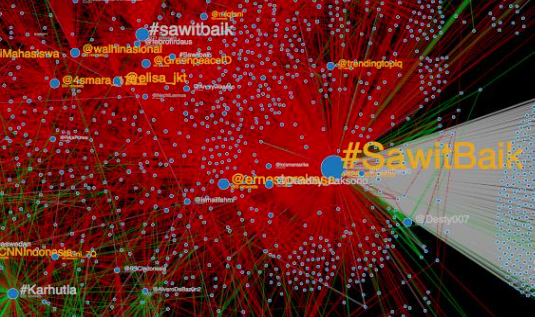
Social media in political marketing is an emerging area of research. This study explains how social networks are constructed in a digital campaign, identifying key actors, and messages involved in modern political marketing. A hotly contested palm oil campaign in Indonesia serves as a case study to analyze and visualize the messaging content found in digital campaigns. Social Network Analysis (SNA) was used to map the social network sites in Twitter and to track social interaction patterns in the #SawitBaik campaign. The results confirmed that state institutions, non-governmental institutions, news media, and individuals were key actors in the digital campaign. The actors’ roles varied from providing information and supporting palm oil activities to criticizing palm oil activities and promoting campaign events. Most tweets were critical of the government, serving as brand advocacy. The #SawitBaik campaign is also an example of political marketing used by a government in order to influence its citizens. In this case, the goal was to shape and win public support by legitimizing palm oil activities in Indonesia.References
Austin, K., Mosnier, A., Pirker, J., McCallum, I., Fritz, S., & Kasibhatla, P. (2017). Shifting patterns of oil palm driven deforestation in Indonesia and implications for zero-deforestation commitments. Land Use Policy, 69, 41-48. doi: https://doi.org/10.1016/j.landusepol.2017.08.036
Barisione, M., Michailidou, A., & Airoldi, M. (2017). Understanding a digital movement of opinion: the case of #RefugeesWelcome. Information, Communication & Society, 22(8), 1145-1164. doi: https://doi.org/10.1080/1369118x.2017.1410204
Borgatti, S., & Ofem, B. (2010). Social Network Theory and Educational Change. Lexington, KY United States: University of Kentucky
Bruns, A., & Burgess, J., Highfield, T., Kirchhoff, L., & Nicolai, T. (2011). Mapping the Australian networked public sphere. Social Science Computer Review, 29(3), 277-287. doi: https://doi.org/10.1177/0894439310382507
Bryson, J. M. (2004). What to do when stakeholder matter. Stakeholder identification and analysis techniques. Public Management Review, 6 (1), 21–53. doi: https://doi.org/10.1080/14719030410001675722
Burger, T. (2015). Use of digital advocacy by German nonprofit foundations on Facebook. Public Relations Review, 41(4), 523-525. doi: https://doi.org/10.1016/j.pubrev.2015.07.007
Casey, J.(2011). Understanding advocacy: A primer on the policy making role of non-profit. New York: Center for Non Profit Strategy and Management, Baruch College
Cook, T. (2010). Governing with the news. Chicago: University of Chicago Press.
Duram, L. A., & K. G. Brown. (1999). Assessing public participation in U.S. watershed planning initiatives. Society Nat. Resources, 12,455–467. doi: https://doi.org/10.1080/089419299279533
Friedrichsen, M. (2013). Handbook of social media management. New York: Springer.
Goldkind, L., & McNutt, J. (2019). We could be unicorns: Human services leaders Moving from Managing Programs to Managing Information Ecosystems. Human Service Organizations: Management, Leadership & Governance, 43(4), 269-277. doi: https://doi.org/10.1080/23303131.2019.1669758
Hänska, M., & Bauchowitz, S. (2018). “#ThisIsACoup: The emergence of an anti-Austerity hashtag across Europe’s twittersphere” in L Basu, S Schifferes, and S Knowles (eds.) The Media and Austerity: Comparative Perspectives. London, United Kingdom: Routledge.
Happer, C., & Philo, G. (2013). The Role of the media in the construction of public belief and social change. Journal of Social and Political Psychology, 1(1), https://doi.org/10.5964/jspp.v1i1.96
Himelboim, I., McCreery, S., & Smith, M. (2013). Birds of a feather tweet together: Integrating network and content analyses to examine cross-ideology exposure on Twitter. Journal of computer-mediated communication, 18(2), 154-174. doi: https://doi.org/10.1111/jcc4.12001
Himelboim, I., Smith, M. A., Rainie, L., Shneiderman, B., & Espina, C. (2017). Classifying Twitter topic-networks using social network analysis. Social media+ society, 3(1), 2056305117691545. doi: https://doi.org/10.1177/2056305117691545
Johansson, H., & Scaramuzzino, G. (2019). The logics of digital advocacy: Between acts of political influence and presence. New Media & Society, 21(7), 1528-1545. doi: https://doi.org/10.1177/1461444818822488
Kurt, H., & Karaduman, S. (2012). Usage of Social Media by Political Actors: An Analysis on the Usage of Twitter by Leaders of Political Parties in Turkey. MediAnali: međunarodni znanstveni časopis za pitanja medija, novinarstva, masovnog komuniciranja i odnosa s javnostima, 6(12), 1-15.
Kavanagh, D. (1995). Election campaigning: the new marketing of politics. Oxford: Blackwell
Lees-Marshment, J. (2011). The political marketing game. Basingstoke: Palgrave Macmillan.
Lewis, D. (2010). Nongovernmental organizations, definition and history. International encyclopedia of civil society, 1056-1062.
Liu, W., Sidhu, A., Beacom, A., & Valente, T. (2017). Social Network Theory. The International Encyclopedia of Media Effects, 1-12.
Lock, A. & Harris, P. (1996). "Political marketing ‐ vive la différence!", European Journal of Marketing, 30(10/11), pp. 14-24. https://doi.org/10.1108/03090569610149764
Maarek, P. J. (1995). Political marketing and communication. London: John Libbey
Marian, C. (2013). Communication and Political Marketing. Res. & Sci. Today, 6, 44.
McNair, B. (1996). Performance in politics and the politics of performance”. In L’Etang, J. and Pieczka, M. (Eds.) Critical perspectives in public relations. London: Thompson International
Negara, F. 2019. Kementerian BUMN. Retrieved 18 December 2019, from http://www.bumn.go.id/ ptpn5/berita/1-Kominfo-Ingin-Sawit-Jadi-Kekuatan-Ekonomi-Indonesia
Newman, B. (1994) The marketing of the president: Political marketing as campaign strategy. London: Sage
Robinson, M. (2006). Budget analysis and policy advocacy: the role of non-governmental public action. Working paper series, 279. Brighton: IDS.
Sabatier, P. (2007). Theories of the policy process (1st ed., pp. 21 - 45). Colorado: Westview Press.
Sandelowski, M. (2000). Focus on research methods: Whatever happened to Qualitative description? Research in Nursing & Health, 23, 334–340. doi: https://doi.org/10.1002/1098-240X(200008)23:4<334::AID-NUR9>3.0.CO;2-G
Saxton, D. I., Brown, P., Seguinot-Medina, S., Eckstein, L., Carpenter, D. O., Miller, P., & Waghiyi, V. (2015). Environmental health and justice and the right to research: institutional review board denials of community-based chemical biomonitoring of breast milk. Environmental Health, 14(1), 90. doi: https://doi.org/10.1186/s12940-015-0076-x
Saxton, G., Niyirora, J., Guo, C., & Waters, R. (2015). #AdvocatingForChange: The strategic use of hashtags in social media advocacy. Advances In Social Work, 16(1), 154-169. doi: https://doi.org/ 10.18060/17952
Scott, J., & Carrington, P. (2012). The SAGE handbook of social network analysis. London: Sage.
Smith, G., & French, A. (2009). The political brand: A consumer perspective. Marketing Theory, 9(2), 209-226. doi: https://doi.org/10.1177/1470593109103068
Suharso, P. (2019). Pemanfataan Drone Emprit dalam melihat trend perkembangan bacaan digital melaui akun Twitter. Anuva, 3(4), 333-346. doi: https://doi.org/10.14710/anuva.3.4.333-346
Suwarno, W. (2019). The Challenge of Indonesian Diplomacy Against Palm Oil Discrimination. Jurnal Ilmiah Hubungan Internasional, 15(2), 197-212. https://doi.org/10.26593/jihi.v15i2.3416.197-212
Thejll-Moller, S. (2013). Social media in traditional political party campaigns: is there a winning formula? European View,12 (1), 33-39. doi: https://doi.org/10.1007/s12290-013-0242-x
Unsicker, J. (2010). Confronting power: The practice of policy advocacy. United States: Kumarian Press.
Vassiliadis, C., Andronikidis, A., Belenioti, Z. (2015). Classifying and Profiling Social Media Users: An Integrated Approach. The European Conference on Media, Communication and Film. 178 – 182.
Wring, D. (1997). Reconciling marketing with political science: theories of political marketing. Journal of Marketing Management, 13(7), 651-663. doi: https://doi.org/10.1080/0267257X.1997.9964502
Yin, Robert K. (2009). Case Study Research: Design and Methods. Thousand Oaks, CA: Sage
Zelenak, L. A. (2013). Using Design Strategy to add Value to a Political Campaign. Canterbury, United Kingdom: Kent State University.
Zheng, Q., & Liu, S. (2017). Crowdfunding as a practice of cultural citizenship in China: A case study of Four NGOs”. Journal of Creative Communications, 12(1), 1-12. doi: https://doi.org/10.1177/0973258616688965
Published
Versions
- 2020-09-13 (2)
- 2020-07-30 (1)
Issue
Section
Categories
License
Copyright (c) 2020 Forest and Society

This work is licensed under a Creative Commons Attribution 4.0 International License.
This is an open access journal which means that all contents is freely available without charge to the user or his/her institution. Users are allowed to read, download, copy, distribute, print, search, or link to the full texts of the articles in this journal without asking prior permission from the publisher or the author. This is in accordance with the BOAI definition of open access.
Submission of an article implies that the work described has not been published previously (except in the form of an abstract or as part of a published lecture or academic thesis), that it is not under consideration for publication elsewhere, that its publication is approved by all authors and tacitly or explicitly by the responsible authorities where the work was carried out, and that, if accepted, will not be published elsewhere in the same form, in English or in any other language, without the written consent of the Publisher. An article based on a section from a completed graduate dissertation may be published in Forest and Society, but only if this is allowed by author's(s') university rules. The Editors reserve the right to edit or otherwise alter all contributions, but authors will receive proofs for approval before publication.
Forest and Society operates a CC-BY 4.0 © license for journal papers. Copyright remains with the author, but Forest and Society is licensed to publish the paper, and the author agrees to make the article available with the CC-BY 4.0 license. Reproduction as another journal article in whole or in part would be plagiarism. Forest and Society reserves all rights except those granted in this copyright notice