
A reflection of Social Forestry in 2019: Towards inclusive and collaborative government approaches
DOI:
https://doi.org/10.24259/fs.v3i1.6099Keywords:
Social Forestry, Ministerial Regulation P.83 of 2016, Policy implementation debate, IndonesiaAbstract
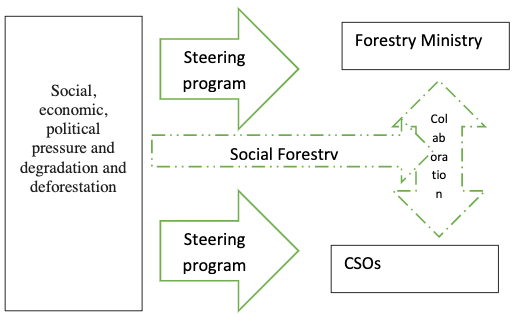
In this policy forum, we seek to engage in a discussion related to the acceleration of social forestry approaches, foremost led by the Ministry of Environment and Forestry (MOEF), and supported by civil society actors. This article thus points to three key areas of reflection being raised among forums at different governing scales at the end of 2018. The first is a reflection of the national level issues discussed in a forum convened by MOEF in partnership with the media organization Tempo Magazine. The second is part of a reflection on a forum conducted by the Lampung province, which was convened by a coalition of NGOs. Finally, the third forum for reflection involved a public consultation about a study on the impacts of social forestry in South Sulawesi. These three forums highlighted that there is a sharp increase in formal social forestry designations by bureaucratically requiring regions to submit proposals, which are then followed up by verification of sites. This has resulted in a large increase in the number of social forestry permits and has also had the consequence of opening up bureaucratic access (in this case by MOEF) to civil society organizations in more inclusive and collaborative ways. However, on the other hand, we also found that amidst these discussions, there was also a strong element of recentralization emerging in the forestry sector related to permits, in which decision-making powers were being redirected to the central government. Another finding that emerged involves the weakening of capacity among communities themselves to benefit from social forestry designations. Therefore, although there are indications of positive engagement by government towards the principles of collaboration, concerns also emerge about the ways community engagement is unfolding. Overall, this highlights important considerations for improving social forestry policy and implementation for the future.
References
Korten, D. C. (1990). Getting to the 21st century: Voluntary action and the global agenda. Kumarian Press
Sahide, M.A.K, Jusuf, Y., Alam, S., Supratman., Millang, S., Mahbub, A.S., Bachtiar, B., Sabar, A., Nasri., Nursaputra, A., Ahmad, M.F., Yahya, N.H. (2018). Kajian Dampak Perhutanan Sosial di Provinsi Sulawesi Selatan. Fakultas Kehutanan Universitas Hasanuddin dan Balai Perhutanan Sosial dan Kemitraan Lingkungan Kementerian Lingkungan Hidup dan Kehutanan, Makassar, Indonesia.
Sahide, M. A. K., & Giessen, L. (2015). The fragmented land use administration in Indonesia–Analysing bureaucratic responsibilities influencing tropical rainforest transformation systems. Land Use Policy, 43, 96-110. doi:https://doi.org/10.1016/j.landusepol.2014.11.005
Additional Files
Published
Versions
- 2019-04-23 (2)
- 2019-04-23 (1)
Issue
Section
Categories
License
Copyright (c) 2019 Forest and Society

This work is licensed under a Creative Commons Attribution 4.0 International License.
This is an open access journal which means that all contents is freely available without charge to the user or his/her institution. Users are allowed to read, download, copy, distribute, print, search, or link to the full texts of the articles in this journal without asking prior permission from the publisher or the author. This is in accordance with the BOAI definition of open access.
Submission of an article implies that the work described has not been published previously (except in the form of an abstract or as part of a published lecture or academic thesis), that it is not under consideration for publication elsewhere, that its publication is approved by all authors and tacitly or explicitly by the responsible authorities where the work was carried out, and that, if accepted, will not be published elsewhere in the same form, in English or in any other language, without the written consent of the Publisher. An article based on a section from a completed graduate dissertation may be published in Forest and Society, but only if this is allowed by author's(s') university rules. The Editors reserve the right to edit or otherwise alter all contributions, but authors will receive proofs for approval before publication.
Forest and Society operates a CC-BY 4.0 © license for journal papers. Copyright remains with the author, but Forest and Society is licensed to publish the paper, and the author agrees to make the article available with the CC-BY 4.0 license. Reproduction as another journal article in whole or in part would be plagiarism. Forest and Society reserves all rights except those granted in this copyright notice

