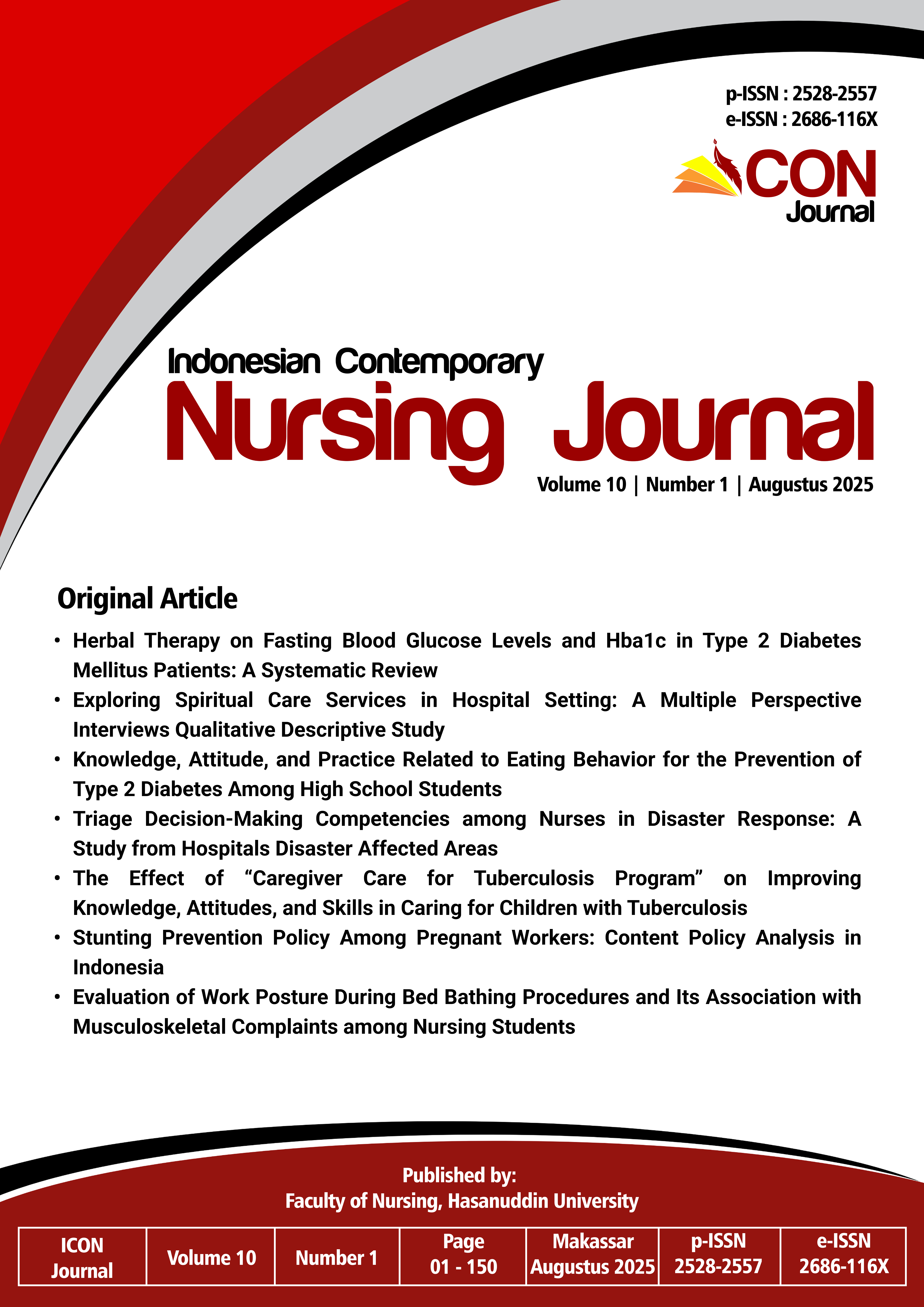
Triage Decision-Making Competencies among Nurses in Disaster Response: A Study from Hospitals Disaster Affected Areas
DOI:
https://doi.org/10.20956/icon.v10i1.44471Keywords:
competency, decision-making, disaster, nurses, triageAbstract
Aims: This study aimed to compare triage decision-making skills among nurses at general hospitals (GH) and maternal and child hospitals (MCH) in Banda Aceh, Indonesia.
Methods: This comparative study used a cross-sectional design. A total sampling technique was used involving all nurses in General Hospital (GH) and Maternal and Child Hospital, comprising 169 nurses with the totally sample in GH and MCH hospitals were 104 and 65 respondents respectively. The sample inclusion criteria were as follows: last education minimum diploma, at least six months of work experience, and working in emergency departments and intensive care. The exclusion criteria were nurses who left or study assignments during the study period. The questionnaire used was the Triage Decision-Making Inventory (TDMI), which consists of three sub-items: cognitive ability, experience, and intuition, totaling 27 items measured on a six-point Likert scale.
Results: Data were analyzed using the Mann-Whitney U-test. The results revealed a significant difference in triage decision-making competencies among nurses in disaster response between GH and MCH hospitals, with the mean and SD (136.98±12.47, 122.66±12.43, p=0.001), respectively. For each variable of the study, there was no significant difference in the cognitive abilities (p=0.180) and experience of nurses (p=0.562) between nurses in GH and MCH hospitals. However, there was a significant difference in nurses’ intuitions (p=0.001).
Conclusion: The differences in triage decision-making skills between nurses in GH and MCH hospitals are related to their perceptions of intuition, clinical experience, and cognitive ability in caring for emergency cases in both hospitals. The cognitive abilities and clinical experience of nurses in caring for patients, particularly in emergency/health crisis/disasters, may help them in triage decision-making. Therefore, it is important for hospitals to have an effective triage information system and nurses with adequate knowledge and skills in triage.
References
Ainiyah, N., Ahsan, A., & Fathoni, M. (2015). The Factors Associated with The Triage Implementation in Emergency Department. Jurnal Ners, 10(1), 147–157. https://doi.org/10.20473/jn.v10i1.2107
Aktaş, Y. Y., & Alemdar, D. K. (2017). Triage decision-making levels of healthcare professionals working in emergency departments. Eurasian Journal of Emergency Medicine, 16(3), 92–96. https://doi.org/10.5152/eajem.2017.96168
Alba, B. (2018). Factors that impact on emergency nurses’ ethical decision-making ability. Nursing Ethics, 25(7), 855–866. https://doi.org/10.1177/0969733016674769
Azizpour, I., Mehri, S., & Soola, A. H. (2022). Disaster preparedness knowledge and its relationship with triage decision-making among hospital and pre-hospital emergency nurses - Ardabil, Iran. BMC Health Services Research, 22(1), 1–10. https://doi.org/10.1186/s12913-022-08311-9
Badan Nasional Penanggulangan Bencana. (2020). Rencana Nasional Penanggulangan Bencana 2020-2024 (National Disaster Management Plan 2020-2024) (pp. 1–173). https://bnpb.go.id/buku/rencana-nasional-penanggulangan-bencana-20202024
Blakeman, J. R., Kim, M. J., Eckhardt, A. L., Stapleton, S. J., & DeVon, H. A. (2024). A nationwide study of emergency nurses’ triage decisions for potential acute coronary syndrome. Journal of Emergency Nursing, 50(1), 72–83. https://doi.org/10.1016/j.jen.2023.08.011
Bosmans, M. W. G., Baliatsas, C., Yzermans, C. J., & Dückers, M. L. A. (2022). A systematic review of rapid needs assessments and their usefulness for disaster decision making : Methods , strengths and weaknesses and value for disaster reliefpolicy. International Journal of Disaster Risk Reduction, 71(July 2021), 102807. https://doi.org/10.1016/j.ijdrr.2022.102807
Chia, J., Chang, C., Lo, S., Yang, C., & Yang, H. (2024). Healthcare failure mode and effect analysis combined service blueprint – mitigating mass casualty triage in emergency units : A qualitative study. International Emergency Nursing, 77(May 2023), 101508. https://doi.org/10.1016/j.ienj.2024.101508
Davidson, L., Vassallo, J., Cowburn, P., Bull, D., Moran, C., & Carter, H. (2024). Evaluation of a new prehospital major incident triage tool : Informing current UK practice. International Journal of Disaster Risk Reduction, 111(January), 104740. https://doi.org/10.1016/j.ijdrr.2024.104740
Febianti, A., Shulthoni, M., Masrur, M., & Aris Safi, M. (2023). Pengaruh tingkat pendidikan, umur, jenis kelamin, dan pengalaman kerja terhadap produktivitas kerja di Indonesia. Jurnal Sahmiyya, 2(1), 198–204.
Ghazali, S. A., Abdullah, K. L., Moy, F. M., Ahmad, R., & Hussin, E. O. D. (2020). The impact of adult trauma triage training on decision-making skills and accuracy of triage decision at emergency departments in Malaysia: A randomized control trial. International Emergency Nursing, 51(100889), 1–5. https://doi.org/10.1016/j.ienj.2020.100889
Handayani, N. S., Haskas, Y., & Sabil, F. A. (2023). Hubungan pengetahuan dan skill perawat dengan pengambilan keputusan triase di RS Kota Parepare (Relationship between nurses’ knowledge and skills and triage decision making at Parepare hospital). JIMPK: Jurnal Ilmiah Mahasiswa & Penelitian Keperawatan, 3(6), 170–175. https://doi.org/http://dx.doi.org/10.20956/ijas
Hinds, A., Kay, S., & Evans, K. (2025). Refresher training for emergency department triage nurses – A scoping review. Australasian Emergency Care, xx(x), 1–9. https://doi.org/10.1016/j.auec.2025.03.006
Husna, C., Firdaus, R., Wardani, E., & Jannah, S. R. (2022). Disaster preparedness among disaster management agency officers: a study from rural and urban areas in Aceh, Indonesia. International Journal of Disaster Resilience in the Built Environment, 13(4), 484–497. https://doi.org/10.1108/IJDRBE-02-2021-0015
Husna, C., Hatthakit, U., & Chaowalit, A. (2011). Do knowledge and clinical experience have specific roles in perceived clinical skills for tsunami care among nurses in Banda Aceh, Indonesia? Australasian Emergency Nursing Journal, 14(2), 95–102. https://doi.org/10.1016/j.aenj.2010.12.001
Husna, C., Miranda, F., Darmawati, D., & Fithria, F. (2022). Emergency preparedness information among nurses in response to disasters. Enfermería Clínica, 32(1), S44–S49. https://doi.org/10.1016/j.enfcli.2022.03.016
Ismail, M., Putra, K. R., & Kristianto, N. H. (2023). Hubungan pengalaman kerja, beban kerja, kompetensi dan fasilitas triase dengan pengambilan keputusan triase perawat instalasi gawat darurat Rumah Sakit tipe B di pulau Lombok [Brawijaya University]. https://repository.ub.ac.id/id/eprint/199014/
Malak, M., Al-Faqeer, N. M., & Yehia, D. B. (2022). Knowledge, skills, and practices of triage among emergency nurses in jordan. International Emergency Nursing, 65(101219), 1–6. https://doi.org/10.1016/j.ienj.2022.101219
McHugh, M. D., & Lake, E. T. (2010). Understanding clinical expertise: nurse education, experience, and the hospital context. Research in Nursing & Health, 33(4), 276–287. https://doi.org/10.1002/nur.20388
Ortiz-barrios, M., Gul, M., Yucesan, M., Alfaro-sarmiento, I., Navarro-jim, E., & Jim, G. (2022). A fuzzy hybrid decision-making framework for increasing the hospital disaster preparedness : The colombian case. International Journal of Disaster Risk Reduction, 72(January). https://doi.org/10.1016/j.ijdrr.2022.102831
Rahmanto, A., Fitri, L. E., & Rini, I. S. (2021). Analysis of nurse personal factors of triage decision-making in emergency installation at University of Muhammadiyah Malang hospital. Indian Journal of Forensic Medicine & Toxicology, 15(4), 994–1002.
Rosciano, A., Lindell, D., Bryer, J., & DiMarco, M. (2016). Nurse Practitioners’ Use of Intuition. Journal for Nurse Practitioners, 12(8), 560–565. https://doi.org/10.1016/j.nurpra.2016.06.007
Smith, A. J. (2012). Assessing confidence in triage decision making: Evaluation of an inventory in a sample of navy and civilian nurses. Journal for Nurses in Staff Development, 28(3), 132–136. https://doi.org/10.1097/NND.0b013e3182551531
Soola, A. H., Mehri, S., & Azizpour, I. (2022). Evaluation of the factors affecting triage decision-making among emergency department nurses and emergency medical technicians in Iran: a study based on Benner’s theory. BMC Emergency Medicine, 22(1), 1–9. https://doi.org/10.1186/s12873-022-00729-y
Wilson, S., Rixon, A., & Brown, C. (2023). Non-clinical intuitions and adaptive heuristics in emergency care : A scoping review. International Emergency Nursing, 71(101371), 1–10. https://doi.org/10.1016/j.ienj.2023.101371
Yang, J., Wan, X., Yu, P., & Li, X. (2023). Factors affecting the triage decision-making ability of emergency nurses in Northern China: A multi-center descriptive survey. International Emergency Nursing, 67(101264), 1–8. https://doi.org/10.1016/j.ienj.2023.101264
Yucesan, M., Ortiz-barrios, M., Gul, M., Pedro, L., & Navarro-jim, E. (2020). Evaluation of hospital disaster preparedness by a multi-criteria decision making approach : The case of Turkish hospitals. International Journal of Disaster Risk Reduction, 49(1), 1–21. https://doi.org/10.1016/j.ijdrr.2020.101748
Yuliandari, K. P. (2019). A Literature Review In Triage Decision Making: Supporting Novice Nurses In Developing Their Expertise. Belitung Nursing Journal, 5(1), 9–15. https://doi.org/https://doi.org/10.33546/bnj.635
Downloads
Published
How to Cite
Issue
Section
License
Authors who publish with this journal agree to the following terms:Authors retain copyright and grant the journal right of first publication with the work simultaneously licensed under a Creative Commons Attribution License that allows others to share the work with an acknowledgement of the work's authorship and initial publication in this journal.
Authors are able to enter into separate, additional contractual arrangements for the non-exclusive distribution of the journal's published version of the work (e.g., post it to an institutional repository or publish it in a book), with an acknowledgement of its initial publication in this journal.
Authors are permitted and encouraged to post their work online (e.g., in institutional repositories or on their website) prior to and during the submission process, as it can lead to productive exchanges, as well as earlier and greater citation of published work (See The Effect of Open Access).
Accepted 2025-07-25
Published 2025-08-17