
Bridging the Digital Marketing Literacy Gap: Capacity Building for Rural MSMEs in Moncongloe, Indonesia
Keywords:
digital marketing literacy; MSME empowerment; community engagement; technology acceptance; rural entrepreneurshipAbstract
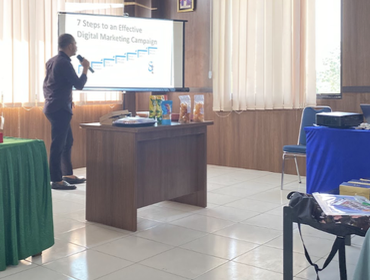
Micro, small and medium enterprises (MSMEs) in peri-urban villages often hold competitive products yet remain invisible to the urban markets next door, because their marketing still travels by word of mouth. This community engagement programme addressed that gap among twenty MSMEs in Moncongloe District, Maros Regency, South Sulawesi, Indonesia. The purpose was to raise digital marketing literacy and managerial capability to a level the partners could sustain without further assistance. The programme followed a participatory action approach in four stages: a door-to-door field assessment of all twenty enterprises, an internal focus group discussion that converted the assessment into a syllabus, a one-day workshop delivered by two university lecturers around a seven-step digital marketing campaign framework, and post-workshop sustainability support consisting of a printed self-study module and two on-site mentoring visits. Capacity was measured with an identical pre-test and post-test instrument built on the Technology Acceptance Model and covering five competencies. Aggregate digital marketing literacy rose from 19 per cent to 92 per cent, and the share of partners reaching comprehensive mastery rose from 5 per cent to 85 per cent, with the sharpest gain in WhatsApp Business and hashtag optimisation, from 0 to 95 per cent. The value of the programme lies in pairing measured diagnosis with hands-on demonstration, which dismantled the perceived difficulty of the tools before any technical instruction began.
References
Anatan, L., & Nur. (2023). Micro, small, and medium enterprises’ readiness for digital transformation in Indonesia. Economies, 11(6), 156. https://doi.org/10.3390/economies11060156
Baum, F., MacDougall, C., & Smith, D. (2006). Participatory action research. Journal of Epidemiology and Community Health, 60(10), 854–857. https://doi.org/10.1136/jech.2004.028662
Bhattacharyya, J. (2004). Theorizing community development. Community Development, 34(2), 5–34. https://doi.org/10.1080/15575330409490110
Cenamor, J., Parida, V., & Wincent, J. (2019). How entrepreneurial SMEs compete through digital platforms: The roles of digital platform capability, network capability and ambidexterity. Journal of Business Research, 100, 196–206. https://doi.org/10.1016/j.jbusres.2019.03.035
Chambers, R. (2013). Rural development: Putting the last first. Routledge.
Chatterjee, S., & Kumar Kar, A. (2020). Why do small and medium enterprises use social media marketing and what is the impact: Empirical insights from India. International Journal of Information Management, 53, 102103. https://doi.org/10.1016/j.ijinfomgt.2020.102103
Davis, F. D. (1989). Perceived usefulness, perceived ease of use, and user acceptance of information technology. MIS Quarterly, 13(3), 319–340. https://doi.org/10.2307/249008
Eller, R., Alford, P., Kallmünzer, A., & Peters, M. (2020). Antecedents, consequences, and challenges of small and medium-sized enterprise digitalization. Journal of Business Research, 112, 119–127. https://doi.org/10.1016/j.jbusres.2020.03.004
Freire, P. (2000). Pedagogy of the oppressed (30th anniversary ed.). Continuum.
Israel, B. A., Schulz, A. J., Parker, E. A., & Becker, A. B. (1998). Review of community-based research: Assessing partnership approaches to improve public health. Annual Review of Public Health, 19, 173–202. https://doi.org/10.1146/annurev.publhealth.19.1.173
Pergelova, A., Manolova, T., Simeonova-Ganeva, R., & Yordanova, D. (2019). Democratizing entrepreneurship? Digital technologies and the internationalization of female-led SMEs. Journal of Small Business Management, 57(1), 14–39. https://doi.org/10.1111/jsbm.12494
Priyono, A., Moin, A., & Putri, V. N. A. O. (2020). Identifying digital transformation paths in the business model of SMEs during the COVID-19 pandemic. Journal of Open Innovation: Technology, Market, and Complexity, 6(4), 104. https://doi.org/10.3390/joitmc6040104
Silfiani, M., Fitria, I., Irawan, H., Padli, R., Sari, D. L., Annisa, N., Raaph, N. A., Zahra, K. S., Darwis, M. D. R., Lastiur, S. K., & Patricia, M. (2026). Empowering local MSMEs through branding, product design, and digital marketing: A community engagement program at Pringgondani Market, Balikpapan. Jurnal Pengabdian UNDIKMA, 7(1), 14–24. https://doi.org/10.33394/jpu.v7i1.18166
Taiminen, H. M., & Karjaluoto, H. (2015). The usage of digital marketing channels in SMEs. Journal of Small Business and Enterprise Development, 22(4), 633–651. https://doi.org/10.1108/JSBED-05-2013-0073
van Deursen, A. J. A. M., & van Dijk, J. A. G. M. (2019). The first-level digital divide shifts from inequalities in physical access to inequalities in material access. New Media & Society, 21(2), 354–375. https://doi.org/10.1177/1461444818797082
Venkatesh, V., & Davis, F. D. (2000). A theoretical extension of the technology acceptance model: Four longitudinal field studies. Management Science, 46(2), 186–204. https://doi.org/10.1287/mnsc.46.2.186.11926
Venkatesh, V., Morris, M. G., Davis, G. B., & Davis, F. D. (2003). User acceptance of information technology: Toward a unified view. MIS Quarterly, 27(3), 425–478. https://doi.org/10.2307/30036540
Downloads
Published
Issue
Section
License
Copyright (c) 2026 The Author(s)

This work is licensed under a Creative Commons Attribution 4.0 International License.
 Indonesia
 Malaysia
 Thailand