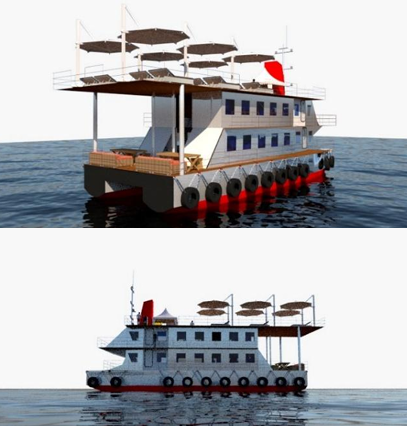
The General Arragement of Water Bus on Mahakam River's
Article Sidebar
Main Article Content
Abstract
Mahakam River has its own place in the hearts of domestic and foreign tourists. The beauty of the Mahakam river can be enjoyed by using a water bus made of wood. Currently, there are 2 (two) water buses available on the Mahakam river to serve tourists who want to explore its beauty. It was found that the water bus did not meet adequate safety and seaworthiness standards. Referring to the mission of the Tourism Office of the city of Samarinda, namely increasing the development of tourist destinations in the city of Samarinda, the renewal of tourist water buses that are adequate and in accordance with the standards of feasibility and safety is something that is really needed. The purpose of this study is to provide an alternative to the existing water bus design as an effort to rejuvenate the tourism fleet operating on the Mahakam river. The research stages include designing a general arragement for a tourism water bus that produces data in the form of main dimensions, hull form coefficients, lines plan, general arrangement, 3D design, and ship accommodation interiors. The results obtained are the main size of the ship with the following details; L = 14.04 m, B = 5 m, H = 1.4 m, T = 1.1 m, Vs = 10 knots, Engine Power = 87.4 HP (For 2 Engines), Number of Passengers and Crew = 80 Persons. Initial stability was found to meet the criteria.
Article Details
Issue
Section

This work is licensed under a Creative Commons Attribution 4.0 International License.
How to Cite
References
[1] Kemenparekraf, “Government Agency Performance Accountability Report (LAKIP) Ministry of Tourism and Creative Economy,” 2012.[In Bahasa]
[2] T.A. Handoko, “Enterprise Architecture Design for Tourism Information Services Using a Service Oriented Architecture Approach Case Study: Ministry of Tourism and Creative Economy,” J. Kepariwisataan Indones., pp. 413–427, 2014. [In Bahasa]
[3] BPS Samarinda, “Data on the Number of Tourists in Samarinda City in 2018,” 2018. [In Bahasa]
[4] N.G. Kumandang, “Design of the Pesut Mahkota River Water Bus Tour Boat, Mahakam River,” Kalimantan Institute of Technology, 2020. [In Bahasa]
[5] Alamsyah & M.D.Nugroho, “Design of Catamaran Ship as Inland Waterways Transportation Mode in Samarinda,” Wave J. Ilm. Teknol. Marit., vol. 12, no. 1, pp. 43–52, 2018.
[6] W. Setiawan et. al., “Design of Hydrofoil Craft for Balikpapan-Penajam Route,” in The 1st International Conference on Industrial Technology, 2020, pp. 64–68.
[7] Alamsyah et. al., “Design of Water Ambulance for Inland Waterways of Regency East Kalimantan,” in The 1st International Conference on Industrial Technology, 2020, pp. 84–93.
[8] Alamsyah et. al., “Design of Fishing Vessel of Catamaran Type In Waterways of East Kalimantan (40 GT),” in Journal of Physics: Conference Series, 2021, p. 012014.
[9] Alamsyah & B.F.Birana, “General Arragement of a Glass Bottom Catamaran for Tourism Facilities in the Derawan Islands, Berau Regency, East Kalimantan,” J. SAINTIS, vol. 19, no. 2, pp. 41–50, 2019. [In Bahasa]
[10] Alamsyah et. al., “Analysis of the Stability of the Catamaran Fishing Vessel in the Waters of East Kalimantan,” JST (Jurnal Sains Ter., vol. 6, no. 2, pp. 74–82, 2020. [In Bahasa]
[11] J. Ding & J. Jiang, “Tunnel flow of planning trimaran and effects on resistance,” Ocean Eng., vol. 237, p. 109458, 2021.
[12] G. Su et. al., “Numerical Prediction of Hydrodinamic performance of planning trimaran with a wave-piercing bow,” J. Mar. Sci. Eng., vol. 8, pp. 1–26, 2020.
[13] J.V.Leer, Sailing Catamaran Research Vessels. Netherlands: Spring, 1982.
[14] E. Muck-Pavic et. al., “alidation Of The CFD CodeFlow-3D For The Free Surface Flow Around The Ship’s Hulls,” 2006.
[15] F. Roshan, “Hydrodynamic Characteristic of tunneled planning hull’s in calm water,” Brodogradnja, vol. 71, pp. 19–38, 2020.
[16] Y. Jiang et. al., “Experimental and Numerical Investigations on hydrodynamic and aerodynamic characteristic of the tunnel of planning trimaran,” Appl. Ocean Res., vol. 63, pp. 1–10, 2017.
[17] W. M. Napitu et. al., “Study on the Design of a Catamaran-Type Water Bus with a Capacity of 100 Passengers to Support Tourism in Lake Toba,” J. Tek. Perkapalan S1 Univ. Diponegoro, vol. 6, no. 1, pp. 65–73, 2018. [In Bahasa]
[18] M. Insel & A.F. Molland, An Investigation Into The Resistance Components of High Speed Displacement Catamarans. London: The Royal Institution of Naval Architects, 1991.
[19] J. Yang et. al., “Experimental Investigations on the resistance performance of a high-speed partial air chusion supported catamaran,” Int. J. Nav. Archit. Ocean Eng., vol. 12, pp. 38–47, 2020.
[20] H. M. R. Amir et. Al., “Partial Air Chusion supported catamaran concept design,” in Prooceeding of 2015 12th International Bhurban Confrence on Applied Science & Technology, 2015, pp. 519–526.
[21] Z. Q. Guo et. al., “A Seakeeping analysis method for a high-speed partial air cushion supported catamaran (PACSCAT),” Ocean Eng., vol. 110, pp. 357–376, 2015.
[22] Z. Q. Guo et. al., “A Study on Hydrodynamics of the air cushion of a high-speed PACSCAT,” Eur. J. Mech. B Fluid, vol. 72, pp. 353–363, 2018.
[23] D. Chrismianto, “The Effect of Variations in the Hull Shape of the Ship Catamaran Against Total Resistance Using CFD,” KAPAL J. Mar. Sci. Technol., vol. 11, no. 2, pp. 99–106, 2014. [In Bahasa]
[24] V. Dubrovsky, Multi-Hull Ships. Backbone Publishing Company, 2001.
[25] M.G. Parson, “Chapter 11 –Ship Design and Construction,” in Parametric Design, SNAME, 2004.
[26] IMO, International Code on Intact Stability, 2008- Part A. 2008.
[27] IMO, International Code of Safety for High-Speed Craft (2000). 2008.
[28] E.V.Lewis, Principles of Naval Architecture Volume II, Resistance, Propulsion and Vibration. NJ: The Society of Naval Architects and Marine Engineers 601 Pavonia Avenue Jersey City, 1988.
[29] N.Soenarta & S. Furuhama, The Multipurpose Motor. Jakarta (ID). Pranandya Paramitha, 1995.