
Probabilistic Evaluation of Seawall Performance Against Wave Run-Up and Overtopping Under Variable Water Levels at Serui Fuel Terminal
Article Sidebar
Main Article Content
Abstract
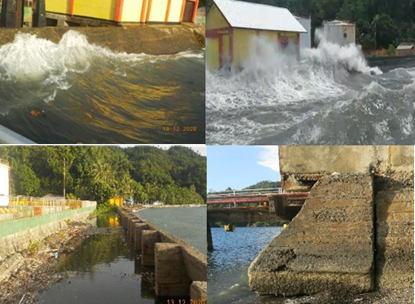
Seawalls are one of the coastal protection structures commonly used to reduce the risk of wave overtopping, especially in critical coastal infrastructure. At the Fuel Terminal in Serui, overtopping events have been recorded causing damage to several facilities, even under moderate wave conditions. This study evaluates the performance of the existing seawall under the combined influence of probabilistic waves (H2%, H10%, H33%) and sea level variations (MSL and HWL). A 20-year wave dataset (2002–2021) obtained from ECMWF was statistically analyzed, followed by theoretical wave transformation toward the shoreline. Wave run-up was calculated based on the Iribarren-type formulation and empirical equations, in which the 2% exceedance run-up (R2%) was estimated using the probabilistic extreme wave height (H2%) following established empirical correlations for smooth seawalls. Overtopping discharge was estimated using an exponential formula and compared with established overtopping impact classifications. Results indicate that under High Water Level (HWL) conditions, all run-up values exceeded the seawall crest elevation (+1.93 m relative to MSL), with R2% reaching 3.3 m and a maximum overtopping discharge of 92 l/s/m, corresponding to a high functional damage risk. Wave overtopping does not compromise the structural integrity of the seawall but can cause significant functional damage to facilities and operation behind the wall. Even under MSL conditions, overtopping still occurred for extreme wave conditions (H2%), These results are consistent with field observations in 2020, confirming that the existing seawall geometry and smooth surface contribute to limited wave energy dissipation. Unlike conventional deterministic assessments, this study introduces a probabilistic and field-validated evaluation framework that integrates run-up and overtopping analysis under varying water levels, providing a more realistic basis for assessing seawall performance for future adaptive redesign strategies.
Article Details
Issue
Section

This work is licensed under a Creative Commons Attribution 4.0 International License.