
Systematic Review of Dangerous Goods Handling in Port Operations: Safety Management Systems, Risk Assessment, and Technological Innovations
Article Sidebar
Main Article Content
Abstract
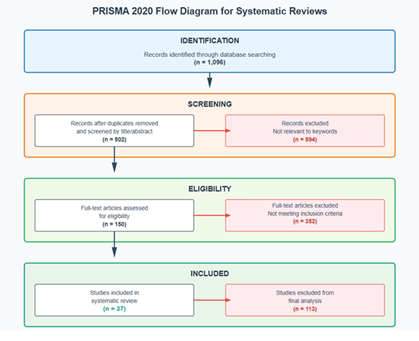
The handling of dangerous goods in port environments represents one of the most critical safety challenges in maritime logistics, necessitating comprehensive risk management approaches and advanced safety protocols. This systematic literature review analyzes current practices, challenges, and innovations in dangerous goods handling at ports, examining safety management systems, risk assessment methodologies, and technological solutions. Following PRISMA guidelines, 37 peer-reviewed articles published between 2014-2024 were systematically analyzed based on their relevance to dangerous goods handling, port operations, safety management, and risk assessment in maritime environments. The analysis reveals five key themes: risk assessment and safety management systems, regulatory frameworks and compliance, technological innovations and automation, human factors and training, and environmental impact and sustainability. Major findings indicate that integrated risk-based approaches, combined with advanced detection capabilities and comprehensive training programs, significantly enhance safety outcomes in dangerous goods handling. The research emphasizes the critical need for holistic safety management systems that integrate technological solutions, regulatory compliance, human factor considerations, and environmental protection measures. Current evidence suggests that ports implementing comprehensive safety management frameworks demonstrate substantial improvements in incident reduction and operational efficiency. Future research directions should prioritize the development of smart port technologies, standardized international protocols for dangerous goods management, and enhanced integration between automated systems and human decision-making processes to address emerging challenges in increasingly complex port environments.
Downloads
Article Details

This work is licensed under a Creative Commons Attribution 4.0 International License.
Accepted 2025-08-14
Published 2025-10-08
References
[1] S. Wang, “Fundamental properties and pseudo-polynomial-time algorithm for network containership sailing speed optimization,” Eur. J. Oper. Res., vol. 250, pp. 46–55, 2016, doi: 10.1016/j.ejor.2015.10.052.
[2] X. Dong, F. Wu, and G. L. & J. Bai, “Research and Application of Ontology-Based Knowledge Model for Dangerous Goods in Port,” Lecture Notes on Data Engineering and Communications Technologies, vol. 88. pp. 924–932, 2021. doi: 10.1007/978-3-030-70665-4_99.
[3] E. Taubert, T. Vairo, M. Pettinato, and B. Fabiano, “Integrated Risk Assessment of a Dangerous Goods Container Terminal. A Bow-Tie Approach,” Chem. Eng. Trans., vol. 104, pp. 145–150, 2023, doi: 10.3303/CET23104025.
[4] S. Chen and D. Yang, “Application of Virtual Reality Technology in Port dangerous goods operation training,” Proceedings of SPIE the International Society for Optical Engineering, vol. 12302. 2022. doi: 10.1117/12.2645454.
[5] L. Monferdini, B. Pini, B. Bigliardi, and E. B, “Implementing Industry 4.0 Technologies for Enhanced Material Flow and Handling Management: A Case Study in Logistics,” Procedia Comput. Sci., vol. 232, pp. 626–634, 2024, doi: https://doi.org/10.1016/j.procs.2024.01.062.
[6] H. Li, H. Jiao, and Z. Yang, “AIS data-driven ship trajectory prediction modelling and analysis based on machine learning and deep learning methods,” Transp. Res. Part E Logist. Transp. Rev., vol. 175, p. 103152, 2023, doi: https://doi.org/10.1016/j.tre.2023.103152.
[7] Ö. Eski and L. Tavacioglu, “Evaluation of port workers’ general awareness of dangerous cargo transport: A turkish port example,” Pomorstvo, vol. 35, no. 2, pp. 231–240, 2021, doi: 10.31217/p.35.2.5.
[8] A. Haidine, A. Aqqal, A. Dahbi, E. Jadida, E. Jadida, and E. Jadida, “NETWORKING LAYER FOR THE EVOLUTION OF MARITIME PORTS INTO A,” Int. Arch. Photogramm. Remote Sens. Spat. Inf. Sci., vol. XLVI, no. October, pp. 27–29, 2021.
[9] M. Hervás-Peralta, “Designing the layout of terminals with dangerous goods for safer and more secure ports and hinterlands,” Case Stud. Transp. Policy, vol. 8, no. 2, pp. 300–310, 2020, doi: 10.1016/j.cstp.2020.01.006.
[10] S. Pfoser and M. Plasch, “Intergenerational differences of consumer’s perception related to the value of green logistics : A focus on transport, packaging, and waste management,” Sustain. Futur., vol. 9, no. December 2024, 2025.
[11] R. Ren, W. Hu, J. Dong, B. Sun, Y. Chen, and Z. Chen, “A Systematic Literature Review of Green and Sustainable Logistics : Bibliometric Analysis , Research Trend and Knowledge Taxonomy,” Int. J. Environ. Res. Public Heal. Rev., vol. 17, p. 261, 2019.
[12] Y. Han and L. Chu, “A systematic review and bibliometric analysis for maritime emergency management,” J. Sea Res., p. 102585, 2025, doi: https://doi.org/10.1016/j.seares.2025.102585.
[13] F. van den Oever, M. Fjeld, and B. Sætrevik, “A Systematic Literature Review of Augmented Reality for Maritime Collaboration,” Int. J. Hum. Comput. Interact., vol. 0, no. 0, pp. 1–16, 2023, doi: 10.1080/10447318.2023.2209838.
[14] N. Shaiful, F. Abdul, N. H. Karim, R. Hanafiah, S. A. Hamid, and A. Mohammed, “Decision analysis of warehouse productivity performance indicators to enhance logistics operational efficiency,” IJPPM, vol. 72, no. 4, pp. 962–985, 2023, doi: 10.1108/IJPPM-06-2021-0373.
[15] E. Surucu-balci, “Blockchain adoption in the maritime supply chain : Examining barriers and salient stakeholders in containerized international trade,” vol. 156, no. November, 2021.
[16] T. Huikkola, M. Kohtamäki, R. Rabetino, H. Makkonen, and P. Holtkamp, “Overcoming the challenges of smart solution development: Co-alignment of processes, routines, and practices to manage product, service, and software integration,” Technovation, vol. 118, p. 102382, 2022, doi: https://doi.org/10.1016/j.technovation.2021.102382.
[17] O. Oloruntobi, K. Mokhtar, A. Gohari, S. Asif, and L. Fatt, “Sustainable transition towards greener and cleaner seaborne shipping industry : Challenges and opportunities,” Clean. Eng. Technol., vol. 13, no. March, p. 100628, 2023, doi: 10.1016/j.clet.2023.100628.
[18] E. Irannezhad, “Is blockchain a solution for logistics and freight transportation problems ?,” Transp. Res. Procedia, vol. 00, no. 2018, 2020.
[19] Z. Mujadida, H. Setiyono, G. Handoyo, and J. Marwoto, “Analisis Dinamika Permukaan Laut di Laut Jawa dengan Recurrent Neural Network Periode 1993 sampai 2019,” Indones. J. Oceanogr., vol. 03, 2021.
[20] R. U. Khan, J. Yin, and F. S. Mustafa, “Accident and pollution risk assessment for hazardous cargo in a port environment,” PLoS One, vol. 16, no. 6, 2021, doi: 10.1371/journal.pone.0252732.
[21] S. Syamsiah et al., “DAN KESELAMATAN KERJA DAN BAGI TENAGA KERJA BONGKAT MUAT ( TKBM ) PELABUHAN MAKASSAR,” NaTeK J. Pengabdi. Kpd. Masy. PIP Makassar, vol. 1, no. 1, pp. 8–15, 2024.
[22] M. Ma and C. Fengyun, “A Study of China’s Regulations and Standards concerning Safety Risk Control of Dangerous Goods in Ports and Waterborne Transport,” Iop Conference Series Earth and Environmental Science, vol. 585, no. 1. 2020. doi: 10.1088/1755-1315/585/1/012070.
[23] N. Esmaeeli, “Critical Analysis of Train Derailments in Canada through Process Safety Techniques and Insights into Enhanced Safety Management Systems,” Transp. Res. Rec., vol. 2676, no. 4, pp. 603–625, 2022, doi: 10.1177/03611981211062893.
[24] W. Yukun, “Safety risk assessment of concealed and false declaration of dangerous goods in port transference,” Proceedings 2021 International Conference on Management Science and Software Engineering Icmsse 2021. pp. 306–309, 2021. doi: 10.1109/ICMSSE53595.2021.00071.
[25] F. Rodero and Á. Marrero, “Fire hazard reduction in ro-ro spaces by means of using a cargo distribution algorithm including fire risk management during the stowage process,” Transp. Res. Procedia, vol. 71, pp. 331–338, 2023, doi: https://doi.org/10.1016/j.trpro.2023.11.092.
[26] D. Darmawan and A. Widayanti, “Analisis Penanganan Bongkar Muat Barang Berbahaya ( B3 ) di Pelabuhan Tanjung Perak Surabaya Analysis of Handling Loading and Unloading of Dangerous,” Mitrans J. Media Publ. Terap. Transp., vol. 2, no. 1, 2024.
[27] B. Rukavina, “Some issues about legal regulation regarding handling dangerous goods in maritime traffic,” Pomorstvo, vol. 34, no. 2, pp. 302–308, 2020, doi: 10.31217/p.34.2.11.
[28] M.-H. Hsieh, Z. Xia, and C.-H. Chen, “Human-centred design and evaluation to enhance safety of maritime systems: A systematic review,” Ocean Eng., vol. 307, p. 118200, 2024, doi: https://doi.org/10.1016/j.oceaneng.2024.118200.
[29] H. Kanj et al., “Agent-based risk analysis model for road transportation of dangerous goods,” Results Eng., vol. 25, p. 103944, 2025, doi: https://doi.org/10.1016/j.rineng.2025.103944.
[30] N. Wu, X. (Ben) Song, R. Yao, Q. Yu, C. Tang, and S. Zhao, “A Bayesian sample selection model based on normal mixture to investigate household car ownership and usage behavior,” Travel Behav. Soc., vol. 20, pp. 36–50, 2020, doi: https://doi.org/10.1016/j.tbs.2020.02.006.
[31] W. Chen, “A calculation model of explosion power of dangerous goods stacked in container yards based on the Monte Carlo method,” Zhendong Yu Chongji J. Vib. Shock, vol. 38, no. 16, pp. 233–252, 2019, doi: 10.13465/j.cnki.jvs.2019.16.033.
[32] T. Vairo, M. Pettinato, E. Taubert, A. M. Tahir, and B. Fabiano, “Automation in Port Areas and Industry for Safe and Effective Management of Dangerous Goods,” Comput. Aided Chem. Eng., vol. 53, pp. 3049–3054, 2024, doi: 10.1016/B978-0-443-28824-1.50509-3.
[33] A. Farina, “Design of an evacuation and addressing system in case of emergency or accident in the port area of Bastia,” European Modeling and Simulation Symposium Emss. 2022. doi: 10.46354/i3m.2022.emss.046.
[34] M. Muhsin, M. Ali, A. Zakaria, A. M. Arof, and M. A. Din, “Hazardous Cargo Practices Toward Green Port Performance: Evidence from Port of Tanjung Pelepas, Malaysia,” Springerbriefs in Applied Sciences and Technology. pp. 89–95, 2024. doi: 10.1007/978-3-031-68751-8_11.
[35] A. Ristaa and O. Llaha, “The integration of albanian seaports towards smart ports,” CEUR Workshop Proc., vol. 2872, pp. 146–157, 2021.
[36] R. Pastorino, “Area risk analysis in an urban port: Personnel and major accident risk issues,” Chem. Eng. Trans., vol. 36, pp. 343–348, 2014, doi: 10.3303/CET1436058.
[37] B. Lin, F. Xu, S. Xu, N. Wu, and Z. Liu, “LRPBFT-Algorithm-Based Consortium Blockchain Traceability Scheme of Dangerous Goods in Commercial Ports,” 13th Int. Conf. Wirel. Commun. Signal Process. Wcsp 2021, pp. 1–6, 2021, doi: 10.1109/WCSP52459.2021.9613185.
[38] J. Geng and Y. Hu, “Research of 3D simulation of dangerous goods accident in port,” Iop Conference Series Earth and Environmental Science, vol. 693, no. 1. 2021. doi: 10.1088/1755-1315/693/1/012101.
[39] H. Lei, “Dangerous Goods Container Allocation in Ship Stowage Planning,” International Conference on Operations Research and Enterprise Systems. pp. 241–246, 2020. doi: 10.5220/0009160602410246.
[40] H. Lei, “Dangerous goods container allocation in ship stowage planning,” Icores 2020 Proceedings of the 9th International Conference on Operations Research and Enterprise Systems. pp. 241–246, 2020. [Online]. Available: https://www.scopus.com/inward/record.uri?partnerID=HzOxMe3b&scp=85082995459&origin=inward