
A Minimum Break Load Analysis of Smith Bracket Using Finite Element Method (FEM)
Article Sidebar
Main Article Content
Abstract
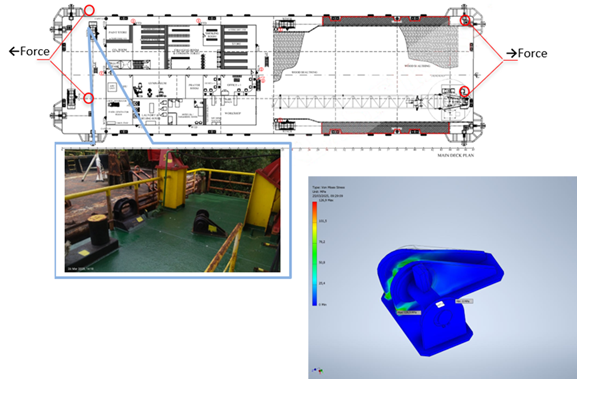
The study on the use of the Smith Bracket in towing operations highlights its critical role in securing towing connections, requiring strong structural integrity as mandated by IMO safety regulations. Using Finite Element Method (FEM) analysis, the stress distribution under various tensile loads was examined, and the simulation results indicate that the bracket design can safely withstand operational forces, making it suitable for towing applications.From the calculations: The Minimum Break Load (MBL) of the Smith Bracket is determined to be ±69 tons, Applying a Safety Factor (SF) of 4, The Safe Working Load (SWL) is calculated at 17.5 tons. These values indicate that the bracket meets safety requirements and is capable of withstanding operational loads without failure. The combination of IMO regulations, FEM simulations, and theoretical analysis ensures that the Smith Bracket is designed for safe and reliable towing operations.
Article Details
Issue
Section

This work is licensed under a Creative Commons Attribution 4.0 International License.
How to Cite
References
[1] R. Awwalin, S. Nugroho, and T. Achmadi, “Design of Lighter Aboard Ship (LASH) for distribution of goods in small islands: Case study of Kangean archipelago,” IOP Conf. Ser. Earth Environ. Sci., vol. 649, no. 1, 2021, doi: 10.1088/1755-1315/649/1/012049.
[2] R. Awwalin, “Desain Konseptual Perencanaan Transportasi Laut Waterbus,” Wave J. Ilm. Teknol. Marit., vol. 16, no. 2, pp. 51–58, 2022, doi: 10.29122/jurnalwave.v16i2.5471.
[3] IMO, “Classifications Register Rules and Regulations,” in Rules and Regulations for the Classification of Ships, IMO Rules, 2022, ch. Chapter 5, p. Part 4 Ship Structures (Ship Types).
[4] M. U. Pawara et al., “A Finite Element Analysis of Bottom Structure of LCT Converted from SPOB,” Marit. Park J. Marit. Technol. Soc., vol. 2, no. February, pp. 9–15, 2023, doi: 10.62012/mp.v2i1.25130.
[5] N. S. Aulia, “Comparative Numerical Analysis Fatigue Damage Based On Variation In Quantities Mooring Line On Aker Smart 2 FPSO,” Marit. Park J. Marit. Technol. Soc., vol. 3, no. February, pp. 21–32, 2024, doi: 10.62012/mp.v3i1.32980.
[6] R. Ahmad, F. Husain, and M. Z. M. Alie, “Stiffened Plate Analysis by Considering Follow-up Plates in the Effect of One-Way Axial Load on FPSO Vessels,” Zo. Laut J. Inov. Sains Dan Teknol. Kelaut., vol. 2, no. October, pp. 248–252, 2023, doi: 10.62012/zl.v4i3.30106.
[7] E. T. A Zein,I Agustiawan, “Perencanaan Sistem Lifting Menggunakan Single Crane dan Multi Crane,” Eproceeding.Itenas.Ac.Id, vol. 1, pp. 1–12, 2022.