Determinants of Operational Performance in Maritime Livestock Transport: A Mixed-Methods SEM–PLS Study from Indonesia
Article Sidebar
Main Article Content
Abstract
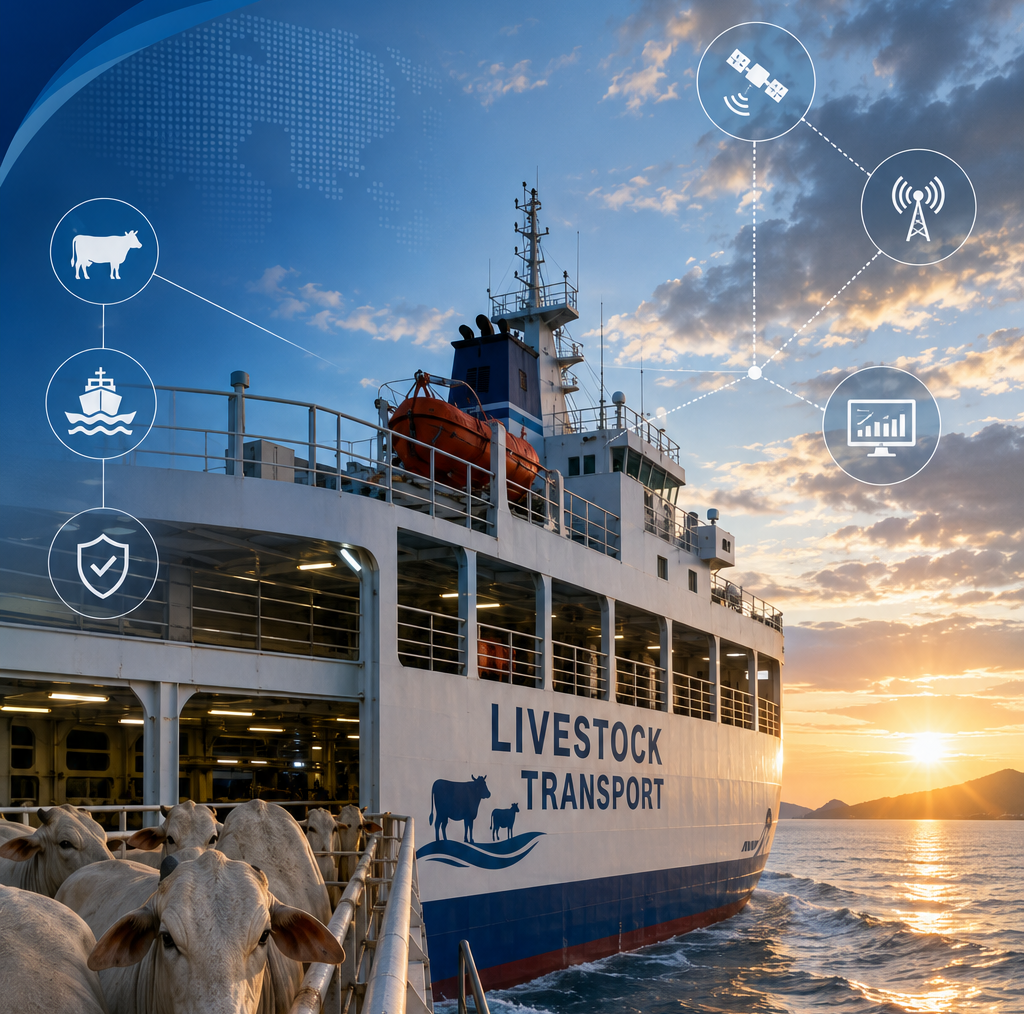
Livestock transportation by sea plays an important role in Indonesia's national cattle supply chain, but to date, it still faces challenges in the form of variability in service quality, driver competence, and the lack of digital monitoring technology on board ships. This study aims to identify the factors that influence the operational performance of government-owned livestock ships (Camara Nusantara 1 to 6) by integrating service quality, technological readiness (based on perception), and the role of crew members/kleder into a single integrated analytical model. A mixed-methods approach was used in this study. The quantitative stage used Structural Equation Modelling–Partial Least Squares (SEM–PLS) with 34 respondents, while the qualitative stage was conducted through in-depth interviews with officials from the Directorate of Traffic and Sea Transportation, Ministry of Transportation. Regulatory variables were measured but excluded from the structural model due to multicollinearity with service variables. The results showed that service quality had a significant effect on operational performance. At the same time, technology, although not yet implemented on livestock ships was the strongest predictor, reflecting stakeholders' expectations for future digitalisation. The role of kleders did not have a statistically significant effect, even though they played a major role in manually monitoring livestock conditions. Qualitative findings reinforce these results by demonstrating inconsistencies in kleders' competencies, limitations in technological infrastructure, and variations in operational implementation between regions. This study contributes to the development of marine livestock logistics systems in Indonesia, while also providing policy recommendations to improve efficiency, safety, and livestock welfare.
Article Details
Issue
Section

This work is licensed under a Creative Commons Attribution 4.0 International License.
How to Cite
References
[1] B. Winarso, “Peran angkutan laut dalam meningkatkan distribusi ternak sapi potong dari daerah produsen ke wilayah konsumen,” Jurnal Penelitian Pertanian Terapan, vol. 14, no. 2, 2014.
[2] A. I. Hasibuan and S. Mulatsih, “Covid-19 dan disparitas harga daging sapi Indonesia,” Policy Brief Pertanian, Kelautan, dan Biosains Tropika, vol. 4, no. 1, pp. 175–178, 2022.
[3] A. Ishak et al., “Analisis struktur jaringan distribusi perdagangan komoditas peternakan antarwilayah di Indonesia,” Pangan, vol. 31, no. 3, pp. 249–258, 2022.
[4] J. H. Jaman, A. Buono, D. A. Astuti, S. H. Wijaya, Burhanuddin, and H. Rahmi, “Classification of large ruminant carriers as an effort in selecting the feasibility of livestock drivers with the Naive Bayes Algorithm,” IOP Conference Series: Earth and Environmental Science, vol. 1020, no. 1, 2022, doi: 10.1088/1755-1315/1020/1/012031.
[5] R. M. Dalimunthe, S. Lubis, and S. I. Kesuma, “Strategic development of beef cattle farming based on regional potential to enhance food security: Evidence from Deli Serdang Regency, Indonesia,” South Asian Journal of Social Studies and Economics, vol. 22, no. 7, pp. 125–134, 2025.
[6] L. Zhang and H. Chen, “Design of an intelligent livestock transport vehicle to improve livestock welfare,” Highlights in Science, Engineering and Technology, vol. 89, pp. 78–82, 2024, doi: 10.54097/42vn4z90.
[7] A. Higgins et al., “Enhancing farmer linkages to markets in developing countries through mapping of supply chains and optimising transport,” Case Studies on Transport Policy, vol. 11, p. 100952, 2023, doi: 10.1016/j.cstp.2023.100952.
[8] A. A. Wakaso, Y. Y. Mummed, and Y. K. Yesuf, “Examining Ethiopia’s live animal and meat value chain,” Heliyon, vol. 11, no. 1, 2025.
[9] A. Budzik and T. Budzik, “Management of animal transport with special attention to animal welfare,” Humanities and Social Sciences, p. 147, 2019.
[10] M. Alende, “El bienestar animal en el transporte de bovinos para faena,” Revista Argentina de Producción Animal, vol. 30, no. 1, pp. 117–129, 2010.
[11] L. Faucitano and S. Goumon, “Transport of pigs to slaughter and associated handling,” in Advances in Pig Welfare, Elsevier, 2018, pp. 261–293.
[12] C. J. C. Phillips and E. Santurtun, “The welfare of livestock transported by ship,” The Veterinary Journal, vol. 196, no. 3, pp. 309–314, 2013.
[13] L. F. Hidayati, Nahrowi, and L. Abdullah, “Efektivitas Kapal KM Camara Nusantara dalam pelayanan angkutan ternak,” Jurnal Ilmu Pertanian Indonesia, vol. 28, no. 3, pp. 370–376, 2023, doi: 10.18343/jipi.28.3.370.
[14] M. Sinel and T. Weis, “Ventilation shutdown and the breath-taking violence of infectious disease emergency management in industrial livestock production,” Environment and Planning E: Nature and Space, vol. 7, no. 3, pp. 1076–1097, 2024.
[15] S. Kim and B. Chiang, “Sustainability practices to achieve sustainability in international port operations,” Journal of Korea Port Economic Association, vol. 30, no. 3, pp. 15–37, 2014.
[16] S. Neethirajan, “Artificial intelligence and sensor technologies in dairy livestock export: Charting a digital transformation,” Sensors, vol. 23, no. 16, 2023, doi: 10.3390/s23167045.
[17] D. W. Kammel, K. Burgi, and J. Lewis, “Design and management of proper handling systems for dairy cows,” Veterinary Clinics of North America: Food Animal Practice, vol. 35, no. 1, pp. 195–227, 2019.
[18] A. M. Fuah, L. Cyrilla, and Y. Triyonggo, “Job design of the Kleder in cattle distribution chain on the Camara Nusantara cattle ship,” pp. 117–122, 2019.
[19] “Gomal University,” vol. 41, no. 3, 2025.
[20] M. M. Parast and A. Safari, “Improving quality and operational performance of service organizations: An empirical analysis using repeated cross-sectional data of US firms,” IEEE Transactions on Engineering Management, vol. 71, pp. 656–670, 2022.
[21] J. Park, B. K. Lee, and S. Lim, “Quality-driven profitability analysis in service operations,” Journal of the Operational Research Society, vol. 72, no. 7, pp. 1578–1590, 2021.
[22] F. C. Rioja-Lang, J. A. Brown, E. J. Brockhoff, and L. Faucitano, “A review of swine transportation research on priority welfare issues: A Canadian perspective,” Frontiers in Veterinary Science, vol. 6, p. 36, 2019.
[23] A. Sathiyamurthy and S. G. S. Naidu, “Designing edge computing solutions for real-time vessel tracking and collision avoidance.”
[24] C. Spandonidis, Z. Tzioridis, A. Petsa, and N. Charanas, “Maritime operational intelligence: AR-IoT synergies for energy efficiency and emissions control,” Sustainability, vol. 17, no. 17, p. 7982, 2025.
[25] T. Li, X. Xiong, G. Zheng, Y. Li, and A. Tolba, “A blockchain-based shared bus service scheduling and management system,” Sustainability, vol. 15, no. 16, p. 12516, 2023.
[26] H. Omrany, K. M. Al-Obaidi, A. Husain, and A. Ghaffarianhoseini, “Digital twins in the construction industry: A comprehensive review of current implementations, enabling technologies, and future directions,” Sustainability, vol. 15, no. 14, p. 10908, 2023.
[27] A. M. Khan, K. A. Alrasheed, A. Waqar, H. Almujibah, and O. Benjeddou, “Internet of things (IoT) for safety and efficiency in construction building site operations,” Scientific Reports, vol. 14, no. 1, p. 28914, 2024.
[28] S. Qureshi, “Digital transformation for development: A human capital key or system of oppression?,” Information Technology for Development, vol. 29, no. 4, pp. 423–434, 2023.
[29] S. Alexopoulou, “Paradigm shift: Exploring the impact of digital technologies on the welfare state through a systematic literature review,” Social Policy & Administration, vol. 59, no. 1, pp. 135–157, 2025.
[30] R. Mansell, “The mediation of hope: Communication technologies and inequality in perspective,” International Journal of Communication, vol. 11, pp. 4285–4304, 2017.
[31] E. Dunston-Clarke, R. S. Willis, P. A. Fleming, A. L. Barnes, D. W. Miller, and T. Collins, “Developing an animal welfare assessment protocol for livestock transported by sea,” Animals, vol. 10, no. 4, p. 705, 2020.
[32] G. D. Menzies, “Regulatory independence: It’s not just about institutions,” CIFR Paper, no. 050, 2015.