Maritime-Based Ecotourism: A Simple Educational Model for Yacht Passengers to Enhance Marine Environment Sustainability
Article Sidebar
Main Article Content
Abstract
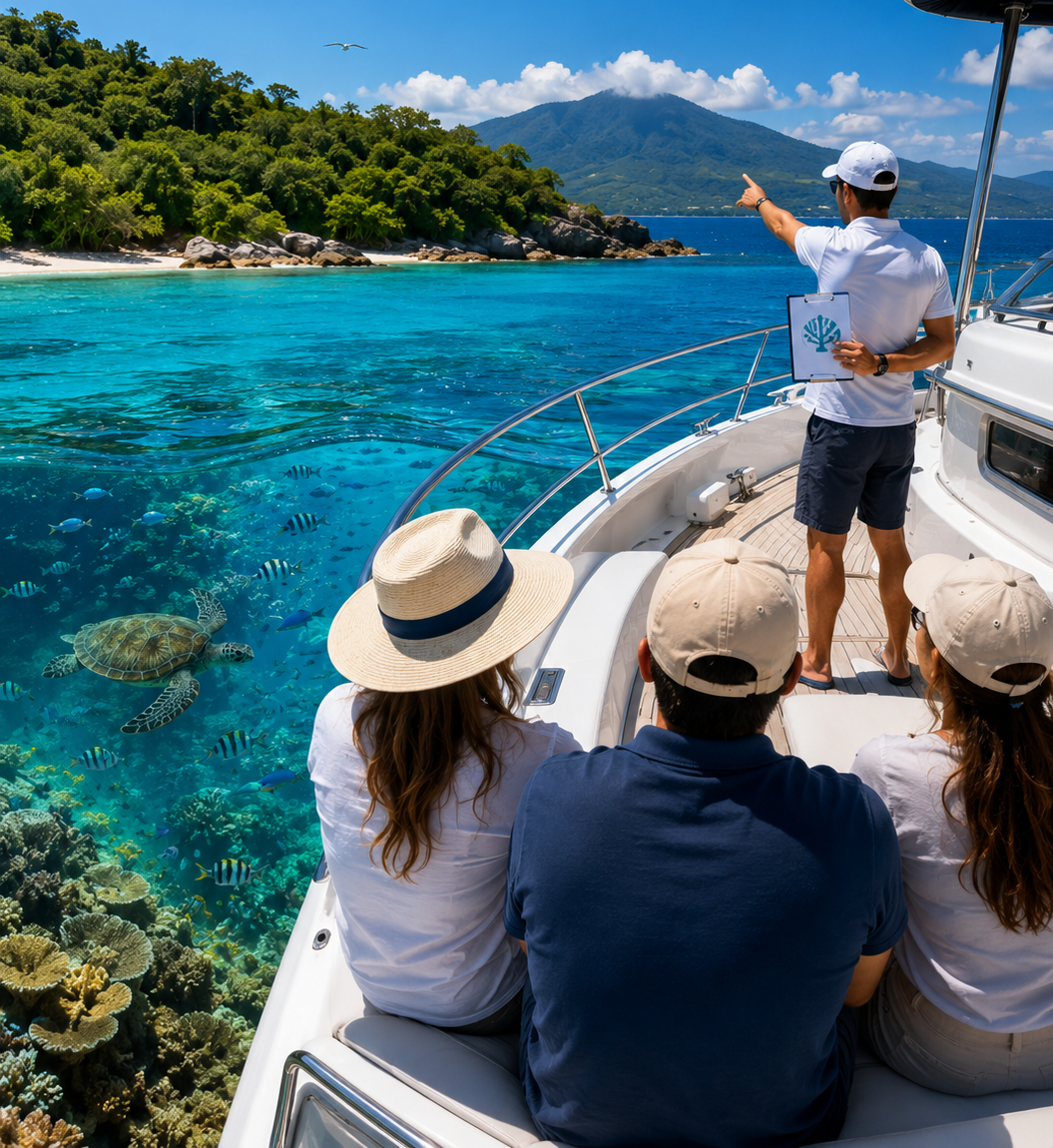
The rapid growth of maritime tourism in Banyuwangi, Indonesia, presents both significant economic opportunities and increasing pressure on fragile marine ecosystems. This article is framed as a conceptual and experiential case study that examines the role of passenger education in promoting marine environmental sustainability within yacht tourism operations. Drawing on participatory observation grounded in the author’s professional experience as a yacht captain, the study identifies recurring patterns of environmentally detrimental passenger behaviour and develops a simple educational intervention embedded within routine operational practices. The proposed 5-Minute Pre-Sail Briefing model integrates concise sustainability messages into standard operating procedures, with emphasis on waste prevention, coral reef protection, and respectful interaction with marine life. The findings represent observational insights rather than empirical validation, suggesting that brief, context-specific educational communication has the potential to encourage pro-environmental behaviour among yacht passengers. Although the model is not intended to be generalisable, it demonstrates potential transferability to comparable small-scale maritime tourism contexts. Overall, this study underscores the importance of behavioural and educational strategies as complementary elements of sustainable maritime transport.
Article Details
Issue
Section

This work is licensed under a Creative Commons Attribution 4.0 International License.
How to Cite
References
[1] E. Baltranaitė et al., “Tourism impacts on marine and coastal ecosystem services: A systematic review,” Geography and Sustainability, vol. 6, no. 2, p. 100277, 2025, doi: 10.1016/j.geosus.2025.100277.
[2] M. Brito, L. Silveira, and M. Kovačić, “Greenwashing or sustainable environmental practices? The case of cruise tourism,” Pomorstvo, vol. 39, no. 1, pp. 5–21, 2025, doi: 10.31217/p.39.1.1.
[3] H. Kurokawa et al., “Improvement impact of nudges incorporated in environmental education on students’ environmental knowledge, attitudes, and behaviors,” Journal of Environmental Management, vol. 325, 2023, doi: 10.1016/j.jenvman.2022.116612.
[4] K. P. Kumalasari, A. Aprilia, E. K. Aini, Y. Fajar, and A. Prasasti, “Interpretive paradigm: Disclosure of local community concern for the environment,” HABITAT, vol. 34, no. 2, pp. 141–153, 2023.
[5] T. N. Pham et al., “Application of hybrid fuzzy-TOPSIS approach in enhancing green logistics towards sustainable maritime,” Polish Maritime Research, vol. 32, no. 2, pp. 156–174, 2025, doi: 10.2478/pomr-2025-0030.
[6] J. Huang and X. Duan, “A comprehensive review of emission reduction technologies for marine transportation,” Journal of Renewable and Sustainable Energy, vol. 15, no. 3, 2023, doi: 10.1063/5.0150010.
[7] O. I. Vaganova, Z. V. Smirnova, S. N. Kaznacheeva, L. I. Kutepova, and M. M. Kutepov, “Practically-oriented technologies in professional education,” in Advances in Intelligent Systems and Computing, vol. 73, 2020, doi: 10.1007/978-3-030-15160-7_44.
[8] M. Råbu and P.-E. Binder, “The single case study is a crucial bridge between research and practice,” Journal of Contemporary Psychotherapy, vol. 55, no. 2, pp. 119–126, 2025, doi: 10.1007/s10879-024-09658-2.
[9] Y. Dong, “The impact of tourists on the marine environment: A review and managerial implications,” Regional Environmental Change, vol. 25, no. 2, 2025, doi: 10.1007/s10113-025-02385-x.
[10] M. Sultana, P. P. Paul, and M. Gavrilova, “A concept of social behavioral biometrics: Motivation, current developments, and future trends,” in Proc. 2014 International Conference on Cyberworlds (CW), 2014, pp. 271–278, doi: 10.1109/CW.2014.44.
[11] R. G. Amballoor and S. B. Naik, “Enhancing sustainable tourism through education for sustainability,” in Education for Sustainability, 2020, doi: 10.4324/9781003497011-25.
[12] A. Munitic, V. Viducic, and A. Proloscic, “A model approach to the development of small tourist ship operators in the Republic of Croatia,” in Annals of DAAAM and Proceedings of the International DAAAM Symposium, 2007, pp. 489–490.