Application of the Vendor Managed Inventory (VMI) Model Based on Total Distribution Cost Optimization
Article Sidebar
Main Article Content
Abstract
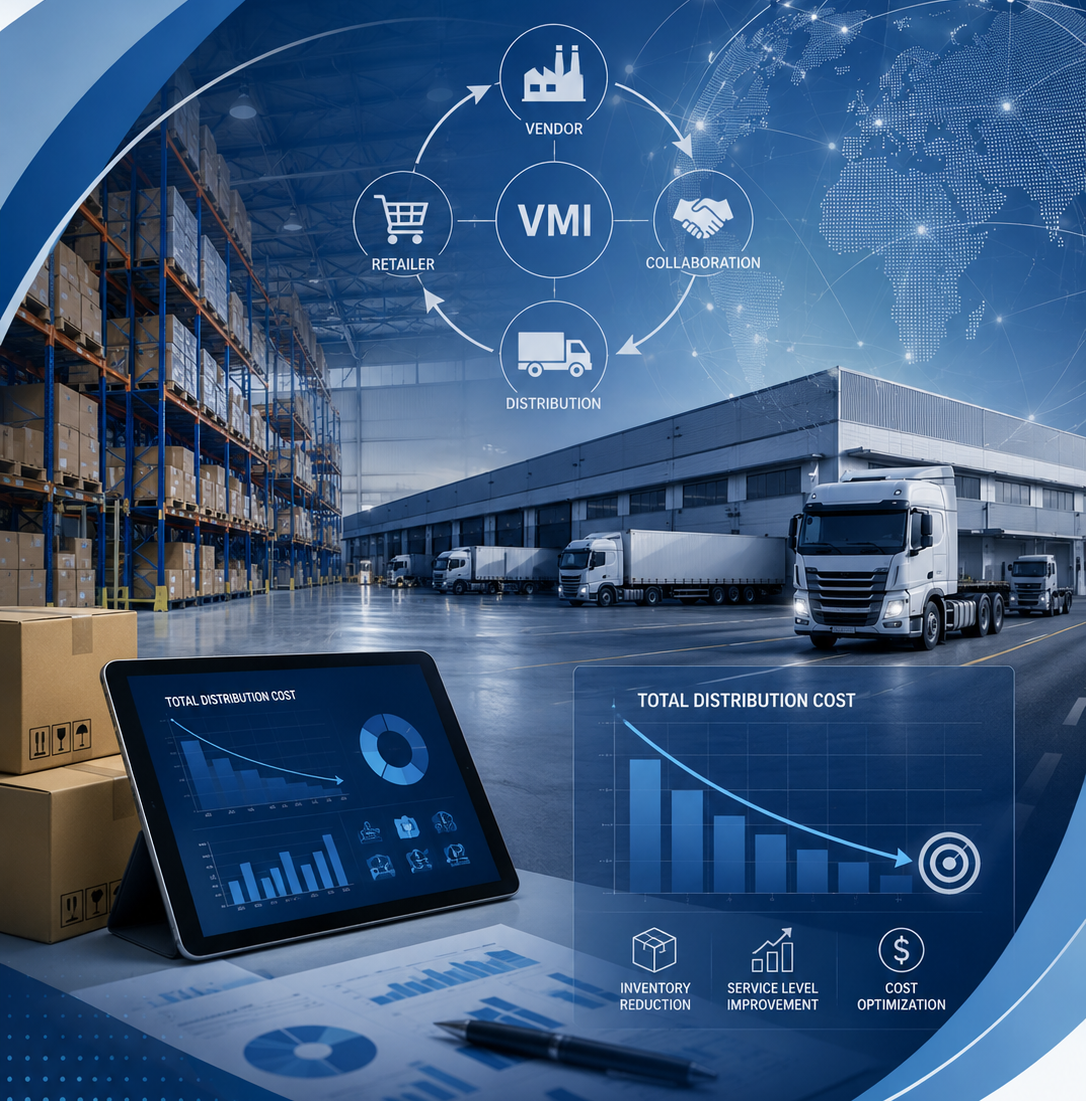
This study develops an optimization-based Vendor-Managed Inventory (VMI) model to improve coordination between inventory and transportation decisions in an upstream automotive distribution network in West Java. The problem is formulated as a multi-period Inventory Routing Problem (IRP) and solved using AMPL with CPLEX. The model minimizes total logistics cost, including transportation and inventory holding costs. A benchmark comparison with the company’s existing decentralized replenishment policy is conducted. Results show that the proposed VMI model reduces total monthly logistics cost by 10.66%, from IDR 2.74 billion to IDR 2.44 billion. In addition, service performance improves significantly, with demand fulfilment increasing from 91.3% to 99.2% and stock-out occurrences eliminated. The findings highlight the importance of integrated decision-making in freight distribution systems and provide practical insights for transport capacity planning and inventory positioning.
Article Details
Issue
Section

This work is licensed under a Creative Commons Attribution 4.0 International License.
How to Cite
References
[1] Chatra, P. Stie, S. A. Kerinci, A. Syamil, M. Munizu, and M. A. Fahmi, “Manajemen Rantai Pasok,” 2023. [Online]. Available: https://www.researchgate.net/publication/371984461
[2] D. J. Thomas and P. M. Griffin, “Coordinated supply chain management,” Eur J Oper Res, vol. 94, no. 1, 1996, doi: 10.1016/0377-2217(96)00098-7.
[3] X. Xu, Z. Liang, and W. Han, “Coordinating supply chain distribution in the presence of production disruption risks,” International Journal of Engineering Business Management, vol. 2, no. 2, pp. 41–46, 2010, doi: 10.5772/9721.
[4] Carles Sitompul, Optimasi Rantai Pasok: Formulasi dan Solusi, 1st ed. Yogyakarta: Deepublish, 2019.
[5] G. Alberto, “Model Matematis untuk Multi-product Multi-warehouse Inventory Routing Problem,” Jurnal Rekayasa Sistem Industri, vol. 12, no. 1, pp. 27–34, Apr. 2023, doi: 10.26593/jrsi.v12i1.6371.27-34.
[6] B. Kim and C. Park, “Coordinating decisions by supply chain partners in a vendor-managed inventory relationship,” J Manuf Syst, vol. 29, no. 2–3, 2010, doi: 10.1016/j.jmsy.2010.09.002.
[7] S. M. Disney and D. R. Towill, “The effect of vendor managed inventory (VMI) dynamics on the Bullwhip Effect in supply chains,” in International Journal of Production Economics, 2003. doi: 10.1016/S0925-5273(03)00110-5.
[8] J. Cao, J. Gao, B. Li, and X. Wang, “The Inventory Routing Problem: A Review,” 2020.
[9] M. S. Pishvaee, R. Z. Farahani, and W. Dullaert, “A memetic algorithm for bi-objective integrated forward/reverse logistics network design,” Comput Oper Res, vol. 37, no. 6, 2010, doi: 10.1016/j.cor.2009.09.018.
[10] M. Hewitt, G. Nemhauser, M. Savelsbergh, and J. H. Song, “A branch-and-price guided search approach to maritime inventory routing,” Comput Oper Res, vol. 40, no. 5, pp. 1410–1419, Mar. 2013, doi: 10.1016/j.cor.2012.09.010.
[11] Y. Wang, “A collaborative approach based on Shapley value for carriers in the supply chain distribution,” Heliyon, vol. 9, no. 7, 2023, doi: 10.1016/j.heliyon.2023.e17967.E. Behmanesh and J. Pannek, “Taguchi Analysis for Improving Optimization of Integrated Forward/Reverse Logistics,” Journal of the Operations Research Society of China, vol. 11, no. 3, 2023, doi: 10.1007/s40305-021-00380-7.