
The Effect of Receiver Tube Design with a Tube Length of 85 mm on COP and Electrical Power Consumption in Air Conditioning Units for Ship Accommodation Spaces
Article Sidebar
Main Article Content
Abstract
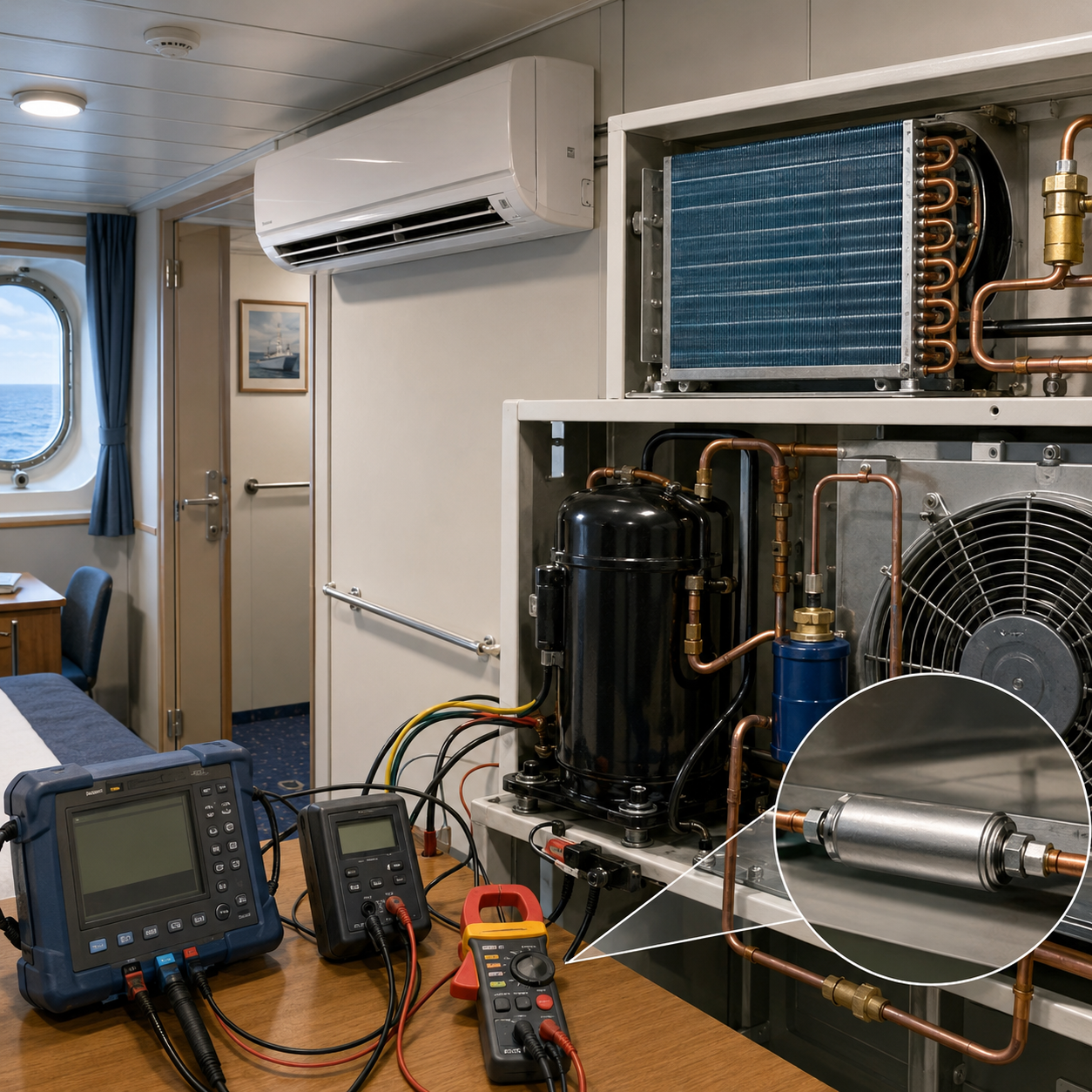
The high temperature on ships reduces crew comfort, making air conditioning essential to maintain a suitable environment. To optimize cooling and minimize energy use, this study examines the design and construction of a receiver tube aimed at reducing the compressor workload of the ship’s air conditioning (AC) system. The research employs an experimental method, testing the AC performance before and after installing a receiver tube. Parameters observed include the Coefficient of Performance (COP), electric power consumption, and electricity costs. Results show that the receiver tube with an 85 mm length variation produced the best performance. During a 60-minute test, it achieved the highest COP value of 30.8 and the lowest electric power consumption of 242 watts. Based on electricity cost calculations, the 85 mm receiver tube requires IDR 251,700 for one month of continuous operation (24 hours daily). When applied to the OKI 004 ship, the use of this receiver tube reduces AC operational costs by IDR 549,240 per month. These findings demonstrate that the receiver tube not only maintains effective cooling performance but also significantly lowers energy consumption and operating expenses. The implementation of this design contributes to efficiency in ship accommodation cooling systems, providing both economic and practical benefits for maritime operations.
Downloads
Article Details

This work is licensed under a Creative Commons Attribution 4.0 International License.
Allow anyone to modify, improve, and make derivative works, even for commercial purposes, as long as they credit to you for the original work.
Accepted 2026-04-26
Published 2026-07-21
References
[1] Bai, T., et al. (2022). Optimization Analysis of Ventilation Parameters in Crew Cabin. Journal of
Marine Engineering & Technology.
[2] Barone, G., et al. (2025). Towards Sustainable Ships: Advancing Energy Efficiency of Shipboard
Systems. Applied Energy.
[3] Brækken, A., Gabrielii, C., & Nord, N. (2023). Energy Use and Energy Efficiency in Cruise Ship Hotel
Systems in a Nordic Climate. Energy Conversion & Management, 288, 117121.
[4] Buonomano, A., et al. (2023). Advancing Sustainability in the Maritime Sector: Energy and HVAC
Systems for Ships. Energy Reports.
[5] Cheung, H. Y. W., et al. (2024). Monitoring of Indoor Air Quality at a Large Sailing Cruise Ship.
Science of the Total Environment, 962, 178286.
[6] Credence Research. (2024). Marine HVAC Market Report. Credence Research, Inc.
[7] Guo, L., et al. (2024). Effects of Different Ventilation Modes on Thermal Comfort and Contaminant
Removal Efficiency in Ship Cabins. SPIE Proceedings, 13279, 132793C.
[8] Kan, A., Zhu, W., & Wu, Y. (2022). Evaluation on Human Thermal Comfort in the Cabin Environment
of a Shanghai Passenger Ship. ES Energy & Environment, 17, 74–85.
[9] Koja Marine. (2023, December 29). Koja Marine Champions Energy-Saving HVAC Systems Onboard
(Also for Retrofit Projects). Seatec.fi.
[10] Lehtio, T. (2023). Improving Cruise Ship Passenger Cabin Ventilation Energy and Space Efficiency.
Master’s Thesis, LUT University.
[11] Liu, C., et al. (2023). Optimal Control Strategy for Ship Cabin’s Active Chilled Beam (ACB) Systems.
Journal of Marine Science and Engineering, 11(7), 1396.
[12] Liu, H., et al. (2024). Study of Comprehensive Comfort Evaluation Based on Fuzzy Method in Ship
Cabins. ScienceDirect.
[13] Liu, L., Chen, Y., Yan, H., Tao, Q., & Fan, Y. (2024). Study on Operational Characteristics of a Hybrid
Air-Conditioning System for Marine Ships. Energy Proceedings, 38, 2024.
[14] Xie, D., et al. (2022). Comprehensive Evaluation of Thermal Comfort in Ship Cabins. Buildings,
12(10), 1766.
[15] Zhao, X., & Shinoda, T. (2024). Development of Ventilation System for Ship Accommodation Space
Considering the Thermal Comfort Index. Journal of the Japan Institute of Navigation, 150, 56–65