
Revealing the Multilevel Actors Power Network in Mangrove Forest Governance - Insights from the Sundarbans, Bangladesh
DOI:
https://doi.org/10.24259/fs.v8i2.32924Keywords:
Power network analysis, Mangrove forest policy, Actor-centred power, Multilevel governance, Sundarbans Mangrove ForestAbstract
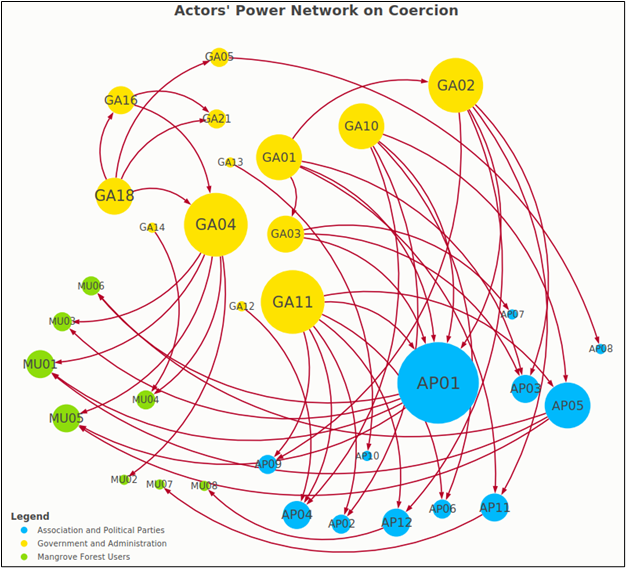
Having diversified ecological and socio-economic function of the Sundarbans Mangrove Forests (SMF), its governance significantly relies on the power relations among multidisciplinary actors present at the multiple level of jurisdictions from national to local level. The analysis elicits the identification of actors and the extraction of their interrelationships based on different power resources, which frame power interaction of the multilevel mangrove governance for the SMF of Bangladesh. Actors were identified by snowball approach and then qualitative interviews to them were carried out. A web-based mapping tool was used for extracting social network analysis of multilevel power relations for the Sundarbans’ governance. The revealed power network indicated that the national level state actors (e.g., actors from government and administration category) were driving all sorts of power sources; coercion, dominant information and (dis-)incentives over the actors at local level emphasizing cross-cutting policy issues and multifunction of the mangroves. The local level non-state actors’ (mostly NGOs) proactive and participatory approaches delineated as bridging role in mangrove governance between national level state actors and local level user actors based on coercive, (dis-)incentives and dominant information power elements. The actors at the local level user category didn’t show any substantial effects on policy decisions. To analyse the effects of policy implementation and growing competitiveness on the ground, in regard of subsidies amongst the different actor groups further research is needed.
References
Adger, W. N., Brown, K., Fairbrass, J., Jordan, A., Paavola, J., Rosendo, S., & Seyfang, G. (2003). Governance for sustainability: towards a ‘thick’analysis of environmental decisionmaking. Environment and Planning A, 35(6), 1095-1110. https://doi.org/ 10.1068/a35289
Agrawal, A., & Yadama, G. (1997). How do local institutions mediate market and population pressures on resources? Forest Panchayats in Kumaon, India. Development and change, 28(3), 435-465. https://doi.org/10.1111/1467-7660.00050
Agrawal, A., Chhatre, A., & Hardin, R. (2008). Changing governance of the world's forests. Science, 320(5882), 1460-1462. https://doi.org/10.1126/science.115 5369
Alcantara, C., & Morden, M. (2019). Indigenous multilevel governance and power relations. Territory, Politics, Governance, 7(2), 250-264. https://doi.org/10.1080/ 21622671.2017.1360197
Alcantara, C., Broschek, J., & Nelles, J. (2016). Rethinking multilevel governance as an instance of multilevel politics: a conceptual strategy. Territory, politics, governance, 4(1), 33-51. https://doi.org/10.1080/21622671.2015.1047897
Ansell, C. (2000). The networked polity: Regional development in Western Europe. Governance, 13(2), 279-291. https://doi.org/10.1111/0952-1895.00136
Arnold, J. E. M. (1998). Managing forests as common property. FAO Forestry Paper No. 136. FAO.
Arts, B. (2014). Assessing forest governance from a ‘Triple G’perspective: Government, governance, governmentality. Forest Policy and Economics, 49, 17-22. https:// doi.org/10.1016/j.forpol.2014.05.008
Arts, B., & Van Tatenhove, J. (2004). Policy and power: A conceptual framework between the ‘old’and ‘new’policy idioms. Policy sciences, 37(3), 339-356. https://doi.org/ 10.1007/s11077-005-0156-9
Asihing, K. (2014). Actor, interest and conflict in sustainable mangrove forest management—a case from Indonesia. International Journal of Marine Science, 4(16), 150-159. https://doi.org/10.5376/ijms.2014.04.0016
Aurenhammer, P. (2012). Development cooperation policy in forestry from an analytical perspective (Vol. 13). Springer.
Bebbington, A. (2004). NGOs and uneven development: geographies of development intervention. Progress in human geography, 28(6), 725-745. https://doi.org/ 10.1191/0309132504ph516oa
Begum, F., de Bruyn, L. L., Kristiansen, P., & Islam, M. A. (2023). Development pathways for co-management in the Sundarban mangrove forest: A multiple stakeholder perspective. Forest Policy and Economics, 148, 102918. https://doi.org/10.1016/ j.forpol.2023.102918
BFD (2021). Natural Mangrove Forest (Sundarbans). Accessed 27.06.2021 from http://www.bforest.gov.bd/site/page/19d63ffe-01e1-4351-b85b-3b60811b87f7/
Biswas, S. R., Choudhury, J. K., Nishat, A., & Rahman, M. M. (2007). Do invasive plants threaten the Sundarbans mangrove forest of Bangladesh?. Forest Ecology and Management, 245(1-3), 1-9. https://doi.org/10.1016/j.foreco.2007.02.011
Böcher, M. (2012). A theoretical framework for explaining the choice of instruments in environmental policy. Forest Policy and Economics, 16, 14-22. https://doi.org/ 10.1016/j.forpol.2011.03.012
Böcher, M., & Töller, A. E. (2012). Umweltpolitik in Deutschland: eine politikfeldanalytische Einführung (Vol. 50). Springer.
Bodin, Ö., Crona, B., & Ernstson, H. (2006). Social networks in natural resource management: what is there to learn from a structural perspective?. Ecology and society, 11(2). http://www.ecologyandsociety.org/vol11/iss2/resp2/
Boer, H. J. (2020). Power, REDD+ and reforming forest governance in Indonesia. Third World Quarterly, 41(5), 783-800. https://doi.org/10.1080/01436597.2019.170 3178
Börzel, T. A., & Heard-Lauréote, K. (2009). Networks in EU multi-level governance: concepts and contributions. Journal of Public Policy, 29(2), 135-151. https://doi.org/10.1017/S0143814X09001044
Brass, D. J. (1984). Being in the right place: A structural analysis of individual influence in an organization. Administrative science quarterly, 29(4), 518-539. https://doi.org/10.2307/2392937
Brockhaus, M., Obidzinski, K., Dermawan, A., Laumonier, Y., & Luttrell, C. (2012). An overview of forest and land allocation policies in Indonesia: Is the current framework sufficient to meet the needs of REDD+?. Forest policy and economics, 18, 30-37. https://doi.org/10.1016/j.forpol.2011.09.004
Brukas, V., & Hjortsø, C. N. (2004). A power analysis of international assistance to Lithuanian forestry. Scandinavian Journal of Forest Research, 19(S4), 166-176. https://doi.org/10.1080/14004080410034254
Bruna-Garcia, X., & Marey-Pérez, M. F. (2014). Public participation: a need of forest planning. iForest-Biogeosciences and Forestry, 7(4), 216. https://doi.org/10. 3832/ifor0979-007
Bryson, J.M., Patton, M.Q., 2015. Analyzing and engaging stakeholders. In Newcomer, K.E., Hatry, H.P., & Wholey, J.S. (Eds.), Handbook of Practical Program Evaluation (pp. 36–61). WILEY. https://doi.org/10.1002/9781119171386.ch2
Burns, S. L., Krott, M., Sayadyan, H., & Giessen, L. (2017). The World Bank improving environmental and natural resource policies: Power, deregulation, and privatization in (post-Soviet) Armenia. World Development, 92, 215-224. https://doi.org/10.1016/j.worlddev.2016.12.030
Capistrano, D., & Colfer, C. P. (2005). Decentralization: Issues, lessons and reflections. In Colfer, C. P. & Capistrano, D. (Eds.), The politics of decentralization: Forests, power and people (pp. 296-313). Routledge.
Chuvileva, I. M., Reef, L., Wilt, G. E., Shriber, J., Aleman, M., & Smith, B. (2017). Impact of a participatory analysis of a campus sustainability social network: A case study of Emory University. Sustainability: The Journal of Record, 10(3), 193-203. https://doi.org/10.1089/sus.2017.29104.iec
Corburn, J. (2009). Cities, climate change and urban heat island mitigation: localising global environmental science. Urban studies, 46(2), 413-427. https://doi.org/ 10.1177/0042098008099361
Coston, J. M. (1998). A model and typology of government-NGO relationships. Nonprofit and voluntary sector quarterly, 27(3), 358-382. https://doi.org/10.1177/0899764 098273006
Crum, B. (2018). Parliamentary accountability in multilevel governance: what role for parliaments in post-crisis EU economic governance? Journal of European Public Policy, 25(2), 268-286. https://doi.org/10.1080/13501763.2017.1363270
Curry, D. (2015). Network approaches to multi-level governance: Structures, relations and understanding power between levels. Palgrave Macmillan.
De Moor, A. (2015, June). Towards a participatory community mapping method: the Tilburg urban farming community case. In Proceeding of the Work-In-Progress Track of the 7th International Conference on Communities and Technologies, Limerick, Ireland (pp. 27-30).
Edwards, M., & Hulme, D. (1996). Too close for comfort? The impact of official aid on nongovernmental organizations. World development, 24(6), 961-973. https://doi.org/10.1016/0305-750X(96)00019-8
Emerson, R. M., Fretz, R. I., & Shaw, L. L. (2001). Participant observation and Fieldnotes. In Atkinson, T. P., Coffey, A., Delamont, S., Lofland J., & Lofland, L. (Eds.), Handbook of Ethnography. SAGE Publications Ltd.
Enserink, B., Kwakkel, J., Bots, P., Hermans, L., Thissen, W., & Koppenjan, J. (2010). Policy analysis of multi-actor systems. Eleven.
Espada, A. L. V., & Kainer, K. A. (2024). Decision making processes and power dynamics in timber production co-management: A comparative analysis of seven Brazilian Amazonian community-based projects. Forest Policy and Economics, 159, 103121. https://doi.org/10.1016/j.forpol.2023.103121
Etzioni, A. (1975). A Comparative Analysis of Complex Organizations: On Power, Involvement, and Their Correlates. Free Press.
FAO (2007). The World’s Mangroves, 1980-2005. A thematic study prepared in the framework of the Global Forest Resources Assessment 2005. FAO Forestry Paper 153. FAO.
Fatem, S. M., Awang, S. A., Pudyatmoko, S., Sahide, M. A., Pratama, A. A., & Maryudi, A. (2018). Camouflaging economic development agendas with forest conservation narratives: A strategy of lower governments for gaining authority in the re-centralising Indonesia. Land use policy, 78, 699-710. https://doi.org/10.1016/ j.landusepol.2018.07.018
Funtowicz, S. O., & Ravetz, J. R. (1993). Science for the post-normal age. Futures, 25(7), 739-755. https://doi.org/10.1016/0016-3287(93)90022-L
Getzner, M., & Islam, M. S. (2013). Natural resources, livelihoods, and reserve management: a case study from Sundarbans mangrove forests, Bangladesh. International Journal of Sustainable Development and Planning, 8(1), 75-87. https://doi.org/10.2495/SDP-V8-N1-75-87
Giessen, L., & Buttoud, G. (2014). Assessing forest governance-analytical concepts and their application. Forest Policy and Economics, 49, 1-71. https://doi.org/10.1016/ j.forpol.2014.11.009
Giessen, L., & Krott, M. (2009). Forestry Joining Integrated Programmes? A question of willingness, ability and opportunities. Allgemeine Forst-und Jagdzeitung, 180(5-6), 94-100.
Giessen, L., Kleinschmit, D., & Böcher, M. (2009). Between power and legitimacy—discourse and expertise in forest and environmental governance. Forest policy and economics 11(5-6), 452-453. http://dx.doi.org/10.1016/j.forpol.2009.08. 002
Giessen, L., Sarker, P. K., & Rahman, M. S. (2016). International and domestic sustainable forest management policies: Distributive effects on power among state agencies in Bangladesh. Sustainability, 8(4), 335. https://doi.org/ 10.3390/su8040335
Gnansounou, S. C., Salako, K. V., Visée, C., Dahdouh-Guebas, F., Kakaï, R. G., Kestemont, P., & Henry, S. (2024). The role of local deities and traditional beliefs in promoting the sustainable use of mangrove ecosystems. Forest Policy and Economics, 160, 103145. https://doi.org/10.1016/j.forpol.2023.103145
Ha, T. T. P., van Dijk, H., & Visser, L. (2014). Impacts of changes in mangrove forest management practices on forest accessibility and livelihood: A case study in mangrove-shrimp farming system in Ca Mau Province, Mekong Delta, Vietnam. Land Use Policy, 36, 89-101. https://doi.org/10.1016/j.landusepol.2013.07.002
Haque, M.S., 1997. Incongruity between bureaucracy and society in developing nations: a critique. Peace Change 22 (4), 432–462
Haque, M. S. (2002). The changing balance of power between the government and NGOs in Bangladesh. International Political Science Review, 23(4), 411-435. https://doi.org/10.1177/0192512102023004006
Harmes, A. (2006). Neoliberalism and multilevel governance. Review of International Political Economy, 13(5), 725-749. https://doi.org/10.1080/096922906009 50621
Hawkins, C. V., Kwon, S. W., & Bae, J. (2016). Balance between local economic development and environmental sustainability: A multi-level governance perspective. International Journal of Public Administration, 39(11), 803-811. https://doi.org/10.1080/01900692.2015.1035787
Homsy, G. C., & Warner, M. E. (2013). Climate change and the co‐production of knowledge and policy in rural USA communities. Sociologia Ruralis, 53(3), 291-310. https://doi.org/10.1111/soru.12013
Homsy, G. C., Liu, Z., & Warner, M. E. (2019). Multilevel governance: Framing the integration of top-down and bottom-up policymaking. International Journal of Public Administration, 42(7), 572-582. https://doi.org/10.1080/01900692.2018. 1491597
Hooghe, L., & Marks, G. (2003). Unraveling the central state, but how? Types of multi-level governance. American political science review, 97(2), 233-243. https://doi.org/10.1017/S0003055403000649
Hooghe, L., & Marks, G. (2016). Community, scale, and regional governance: a postfunctionalist theory of governance (Volume 2). Oxford University Press.
Hoole, A. (2009). Place-power-prognosis: Community-based conservation, partnerships, and ecotourism enterprises in Namibia. International Journal of the Commons, 4(1), 78-99. https://doi.org/10.18352/ijc.112
Hussain, Z. & Karim, A. 1994., Introduction. In Hussain, Z. & Acharya, G. (Eds.), Mangroves of the Sundarban (Vol. 2). IUCN.
Ircha, M. C., & Young, R. A. (Eds.). (2013). Federal Property Policy in Canadian Municipalities (Vol. 5). McGill-Queen's Press-MQUP.
Islam, S. S. (2004). Status of forest genetic resources conservation and management in Bangladesh. In Forest Genetic Resources Conservation and Management: Proceedings of the Asia Pacific Forest Genetic Resources Programme (APFORGEN) Inception Workshop, Kepong, Kuala Lumpur, Malaysia, 15-18 July, 2003 (p. 27). Bioversity International.
Kabir, D. M. H., & Hossain, J. (2008). Resuscitating the Sundarbans: Customary Use of Biodiversity & Traditional Cultural Practices in Bangladesh. Unnayan Onneshan-The Innovators.
Kaiser, W., Leucht, B., & Rasmussen, M. (Eds.). (2008). The history of the European Union: origins of a trans-and supranational polity 1950-72 (Vol. 7). Routledge.
Kazepov, Y. (2017). Rescaling social policies towards multilevel governance in Europe: Some reflections on processes at stake and actors involved. In Kazepov, Y. (Ed.), Rescaling social policies: Towards multilevel governance in Europe (pp. 35-72). Routledge.
Khan, M. F. A., & Giessen, L. (2021). Exceptional bureaucratic rivalry in mangrove forest policy: Explanations from the Sundarbans, Bangladesh. Ocean & Coastal Management, 203, 105510. https://doi.org/10.1016/j.ocecoaman.2020.105510
Khan, M. F. A., Rahman, M. S., & Giessen, L. (2020). Mangrove forest policy and management: Prevailing policy issues, actors’ public claims and informal interests in the Sundarbans of Bangladesh. Ocean & coastal management, 186, 105090. https://doi.org/10.1016/j.ocecoaman.2019.105090
Khan, M. F. A., Uddin, M. S., & Giessen, L. (2021). Microcredit expansion and informal donor interests: Experiences from local NGOs in the Sundarbans Mangrove Forest, Bangladesh. World Development Perspectives, 21, 100295. https://doi.org/ 10.1016/j.wdp.2021.100295
Kleine, M. (2014). Informal governance in the European Union. Journal of European Public Policy, 21(2), 303-314. https://doi.org/10.1080/13501763.2013.870023
Kohler‐Koch, B. (1996). Catching up with change: the transformation of governance in the European Union. Journal of european public policy, 3(3), 359-380. https://doi.org/10.1080/13501769608407039
Kosorukoff, A., (2011). Social network analysis. In Passmore, D.L. (Ed.), Theory and Applications. Passmore.
Krott, M., 2005. Forest Policy Analysis. Springer Science & Business Media.
Krott, M., Bader, A., Schusser, C., Devkota, R., Maryudi, A., Giessen, L., & Aurenhammer, H. (2014). Actor-centred power: The driving force in decentralised community based forest governance. Forest policy and economics, 49, 34-42. https://doi.org/10.1016/j.forpol.2013.04.012
Kull, M. (2016). European integration and rural development: Actors, institutions and power. Routledge.
Laraswati, D., Krott, M., Soraya, E., Rahayu, S., Fisher, M. R., Giessen, L., & Maryudi, A. (2022). Nongovernmental organizations as interest groups and their roles in policy processes: Insights from Indonesian forest and environmental governance. Forest and Society, 6(2), 570-589. https://doi.org/10.24259/fs.v6i2.19125
Leuffen, D., Rittberger, B., & Schimmelfennig, F. (2012). Differentiated integration: Explaining variation in the European Union. Macmillan International Higher Education.
Leuprecht, C., & Lazar, H. (2007). From multilevel to “multi-order” governance. In Leuprecht, C., & Lazar, H. (Eds.), Spheres of Governance: Comparative Studies of Cities in Multi-order Governance Systems (pp. 1-22). McGill-Queen's University Press.
Lund, J. F., & Treue, T. (2008). Are we getting there? Evidence of decentralized forest management from the Tanzanian Miombo woodlands. World development, 36(12), 2780-2800. https://doi.org/10.1016/j.worlddev.2008. 01.014
Maggetti, M., & Trein, P. (2019). Multilevel governance and problem‐solving: Towards a dynamic theory of multilevel policy‐making?. Public Administration, 97(2), 355-369. https://doi.org/10.1111/padm.12573
Marks, G. (1993). Structural policy and multilevel governance in the EC. In Cafruny, A. W., & Rosenthal, G. G. (Eds.), The State of the European Community: The Maastricht Debates and Beyond (pp. 391-410). Lynne Rienner Publishers.
Marques, M., Juerges, N., & Borges, J. G. (2020). Appraisal framework for actor interest and power analysis in forest management-Insights from Northern Portugal. Forest Policy and Economics, 111, 102049. https://doi.org/10.1016/j.forpol.2019. 102049
Marsland, R. (2006). Community participation the Tanzanian way: conceptual contiguity or power struggle?. Oxford Development Studies, 34(1), 65-79. https://doi.org/10.1080/13600810500496053
Martins, H., & Borges, J. G. (2007). Addressing collaborative planning methods and tools in forest management. Forest ecology and management, 248(1-2), 107-118. https://doi.org/10.1016/j.foreco.2007.02.039
Maryudi, A. (2012). Restoring state control over forest resources through administrative procedures: Evidence from a community forestry programme in Central Java, Indonesia. ASEAS-Austrian Journal of South-East Asian Studies, 5(2), 229-242. https://doi.org/10.4232/10.ASEAS-5.2-3
Maryudi, A., & Sahide, M. A. K. (2017). Research trend: power analyses in polycentric and multi-level forest governance. Forest Policy and Economics, 81, 65-68. https://doi.org/10.1016/j.forpol.2017.05.003
Mattocks, D. M., & Steele, R. (1994). NGO-government paradigms in agricultural development: A relationship of competition or collaboration. Journal of International Agricultural and Extension Education, 1(1), 54-61.
Mayers, J. (2005). Stakeholder power analysis. International institute for environment and development.
McCarroll, L., O’Connor, E., & Garlough, J. (2018). Breaking Barriers: Using Open Data to Strengthen Pathways in Community-Campus Engagement for Community Action on Environmental Sustainability. Engaged Scholar Journal: Community-Engaged Research, Teaching, and Learning, 4(2), 87-94. https://doi.org/10. 15402/esj.v4i2.61749
Mohammed, A. J., & Inoue, M. (2014). Linking outputs and outcomes from devolved forest governance using a Modified Actor-Power-Accountability Framework (MAPAF): Case study from Chilimo forest, Ethiopia. Forest Policy and Economics, 39, 21-31. https://doi.org/10.1016/j.forpol.2013.11.005
Mollah, M.A.H., 2011. Growth and development of civil service and bureaucracy in Bangladesh: an overview. S. Asian Surv. 18 (1), 137–156.
Mursyid, H., Daulay, M. H., Pratama, A. A., Laraswati, D., Novita, N., Malik, A., & Maryudi, A. (2021). Governance issues related to the management and conservation of mangrove ecosystems to support climate change mitigation actions in Indonesia. Forest Policy and Economics, 133, 102622. https://doi.org/10.1016/j.forpol. 2021.102622
Mwangi, E., & Wardell, A. (2012). Multi-level governance of forest resources (Editorial to the special feature). International journal of the Commons, 6(2), 79-103. https://doi.org/10.18352/ijc.374
Newell, P. (2006). Climate for change: Non-state actors and the global politics of the greenhouse. Cambridge University Press.
Paletto, A., Balest, J., Demeo, I., Giacovelli, G., & Grilli, G. (2016). Power of forest stakeholders in the participatory decision making process: A case study in northern Italy. Acta Silvatica et Lignaria Hungarica, 12(1), 9-22. http://dx.doi.org/ 10.1515/aslh-2016-0002
Peters, G. B. (2005). The problem of policy problems. Journal of Comparative Policy Analysis, 7(4), 349-370. https://doi.org/10.1080/13876980500319204
Prabowo, D., Maryudi, A., & Imron, M. A. (2017). Conversion of forests into oil palm plantations in West Kalimantan, Indonesia: Insights from actors' power and its dynamics. Forest Policy and Economics, 78, 32-39. https://doi.org/10.1016/ j.forpol.2017.01.004
Prell, C., Hubacek, K., & Reed, M. (2009). Stakeholder analysis and social network analysis in natural resource management. Society and natural resources, 22(6), 501-518. https://doi.org/10.1080/08941920802199202
Rahman, L. M. (2000). The Sundarbans: a unique wilderness of the world. USDA Forest Service Proceedings RMRS-P-15-VOL-2, 143-148.
Rahman, M. S., & Giessen, L. (2017). Formal and informal interests of donors to allocate aid: spending patterns of USAID, GIZ, and EU forest development policy in Bangladesh. World Development, 94, 250-267. https://doi.org/10.1016/j. worlddev.2017.01.012
Rahman, M. S., Miah, S., & Giessen, L. (2018). A new model of development coalition building: USAID achieving legitimate access and dominant information in Bangladesh’s forest policy. World Development, 105, 248-261. https://doi.org/ 10.1016/j.worlddev.2017.12.029
Rahman, M. S., Sarker, P. K., & Giessen, L. (2016). Power players in biodiversity policy: Insights from international and domestic forest biodiversity initiatives in Bangladesh from 1992 to 2013. Land Use Policy, 59, 386-401. https://doi.org/ 10.1016/j.landusepol.2016.09.013
Rahman, M. S., Sarker, P. K., & Giessen, L. (2021). Super-bureaucracy in climate adaptation governance in Bangladesh. Climate and Development, 14(5), 1-13. https://doi.org/10.1080/17565529.2021.1937029
Ramanath, R., & Ebrahim, A. (2010). Strategies and tactics in NGO–government relations: insights from slum housing in Mumbai. Nonprofit Management and Leadership, 21(1), 21-42. https://doi.org/10.1002/nml.20010
Rayner, J. (2009). Understanding policy change as a historical problem. Journal of Comparative Policy Analysis, 11(1), 83-96. https://doi.org/10.1080/1387698080 2648326
Rayner, J., Buck, A., & Katila, P. (2010). Embracing complexity: meeting the challenges of international forest governance. A global assessment report (Vol. 28). IUFRO (International Union of Forestry Research Organizations).
Reed, M. S., Graves, A., Dandy, N., Posthumus, H., Hubacek, K., Morris, J., ... & Stringer, L. C. (2009). Who's in and why? A typology of stakeholder analysis methods for natural resource management. Journal of environmental management, 90(5), 1933-1949. https://doi.org/10.1016/j.jenvman.2009.01.001
Roy, A. K. D. (2017). An investigation into the major environment and climate change policy issues in southwest coastal Bangladesh. International Journal of Climate Change Strategies and Management, 9(1), 123-136. https://doi.org/10.1108/ IJCCSM-03-2016-0028
Roy, A. K. D., Alam, K., & Gow, J. (2012). A review of the role of property rights and forest policies in the management of the Sundarbans Mangrove Forest in Bangladesh. Forest Policy and Economics, 15, 46-53. https://doi.org/10.1016/j.forpol.2011. 08.009
Sahide, M. A. K., Supratman, S., Maryudi, A., Kim, Y. S., & Giessen, L. (2016). Decentralisation policy as recentralisation strategy: forest management units and community forestry in Indonesia. International Forestry Review, 18(1), 78-95. https://doi.org/10.1505/146554816818206168
Sarker, P. K., Rahman, M. D., & Giessen, L. (2017). Empowering state agencies through national and international community forestry policies in Bangladesh. International Forestry Review, 19(1), 79-101. https://doi.org/10.1505/14655481 7820888618
Sayer, J. A., & Collins, M. (2012). Forest governance in a changing world: reconciling local and global values. The Round Table, 101(2), 137-146. https://doi.org/ 10.1080/00358533.2012.661531
Scheba, A., & Mustalahti, I. (2015). Rethinking ‘expert’knowledge in community forest management in Tanzania. Forest Policy and Economics, 60, 7-18. https://doi.org/ 10.1016/j.forpol.2014.12.007
Schout, A., & Jordan, A. (2005). Coordinated European governance: Self‐organizing or centrally steered?. Public Administration, 83(1), 201-220. https://doi.org/ 10.1111/j.0033-3298.2005.00444.x
Schusser, C. (2013). Who determines biodiversity? An analysis of actors' power and interests in community forestry in Namibia. Forest Policy and Economics, 36, 42-51. https://doi.org/10.1016/j.forpol.2012.06.005
Schusser, C., Krott, M., Movuh, M. C. Y., Logmani, J., Devkota, R. R., Maryudi, A., ... & Bach, N. D. (2015). Powerful stakeholders as drivers of community forestry—Results of an international study. Forest Policy and Economics, 58, 92-101. https://doi.org/10.1016/j.forpol.2015.05.011
Schusser, C., Krott, M., Movuh, M. C. Y., Logmani, J., Devkota, R. R., Maryudi, A., & Salla, M. (2016). Comparing community forestry actors in cameroon, indonesia, namibia, nepal and germany. Forest Policy and Economics, 68, 81-87. https://doi.org/10.1016/j.forpol.2016.03.001
Scott, J. (1988). Social network analysis. Sociology, 22(1), 109-127. https://doi.org/ 10.1177/0038038588022001007
Siddiqi, N. A. (2001). Mangrove forestry in Bangladesh, Institute of Forestry and Environmental Sciences. University of Chittagong.
Silva, E. (1997). The politics of sustainable development: native forest policy in Chile, Venezuela, Costa Rica and Mexico. Journal of Latin American Studies, 29(2), 457-493. https://doi.org/10.1017/S0022216X97004756
Thomann, E. (2018). Food safety policy: Transnational, hybrid, wicked. In Peters, B. G. (Ed.), Oxford Research Encyclopedia of Politics. Oxford University Press.
Thomann, E., Trein, P., & Maggetti, M. (2019). What's the problem? Multilevel governance and problem‐solving. European Policy Analysis, 5(1), 37-57. https://doi.org/10.1002/epa2.1062
Trein, P. (2017). Coevolution of policy sectors: A comparative analysis of healthcare and public health. Public Administration, 95(3), 744-758. https://doi.org/10.1111/ padm.12323
Wang, W., Zhai, D., Li, X., Fang, H., & Yang, Y. (2024). Conflicts in mangrove protected areas through the actor-centred power framework-Insights from China. Forest Policy and Economics, 158, 103122. https://doi.org/10.1016/j.forpol.2023.10 3122
Wasserman, S., & Faust, K. (1994). Social network analysis: Methods and applications. Cambridge University Press.
Wellman, B., & Gulia, M. (1999). Virtual Communities as Communities: Net Surfers Don’t Ride Alone. In M. A. Smith, & P. Kollock (Eds.), Communities in Cyberspace (pp. 167-194). Routledge
Winkel, G., & Sotirov, M. (2011). An obituary for national forest programmes? Analyzing and learning from the strategic use of “new modes of governance” in Germany and Bulgaria. Forest Policy and Economics, 13(2), 143-154. https://doi.org/10.1016/ j.forpol.2010.06.005
Yusran, Y., Sahide, M.A.K., Supratman, S., Sabar, A., Krott, M., Giessen, L., 2017. The empirical visibility of land use conflicts: from latent to manifest conflict through law
enforcement in a national park in Indonesia. Land Use Pol. 62, 302–315
Zérah, M. H. (2009). Participatory governance in urban management and the shifting geometry of power in Mumbai. Development and Change, 40(5), 853-877. https://doi.org/10.1111/j.1467-7660.2009.01586.x
Additional Files
Published
Issue
Section
Categories
License
Copyright (c) 2024 Forest and Society

This work is licensed under a Creative Commons Attribution 4.0 International License.
This is an open access journal which means that all contents is freely available without charge to the user or his/her institution. Users are allowed to read, download, copy, distribute, print, search, or link to the full texts of the articles in this journal without asking prior permission from the publisher or the author. This is in accordance with the BOAI definition of open access.
Submission of an article implies that the work described has not been published previously (except in the form of an abstract or as part of a published lecture or academic thesis), that it is not under consideration for publication elsewhere, that its publication is approved by all authors and tacitly or explicitly by the responsible authorities where the work was carried out, and that, if accepted, will not be published elsewhere in the same form, in English or in any other language, without the written consent of the Publisher. An article based on a section from a completed graduate dissertation may be published in Forest and Society, but only if this is allowed by author's(s') university rules. The Editors reserve the right to edit or otherwise alter all contributions, but authors will receive proofs for approval before publication.
Forest and Society operates a CC-BY 4.0 © license for journal papers. Copyright remains with the author, but Forest and Society is licensed to publish the paper, and the author agrees to make the article available with the CC-BY 4.0 license. Reproduction as another journal article in whole or in part would be plagiarism. Forest and Society reserves all rights except those granted in this copyright notice