
How Much and Why? Conservation Behavior and Valuation in Katunggan Coastal Ecopark, Mindanao Island, Philippines
Additional Files
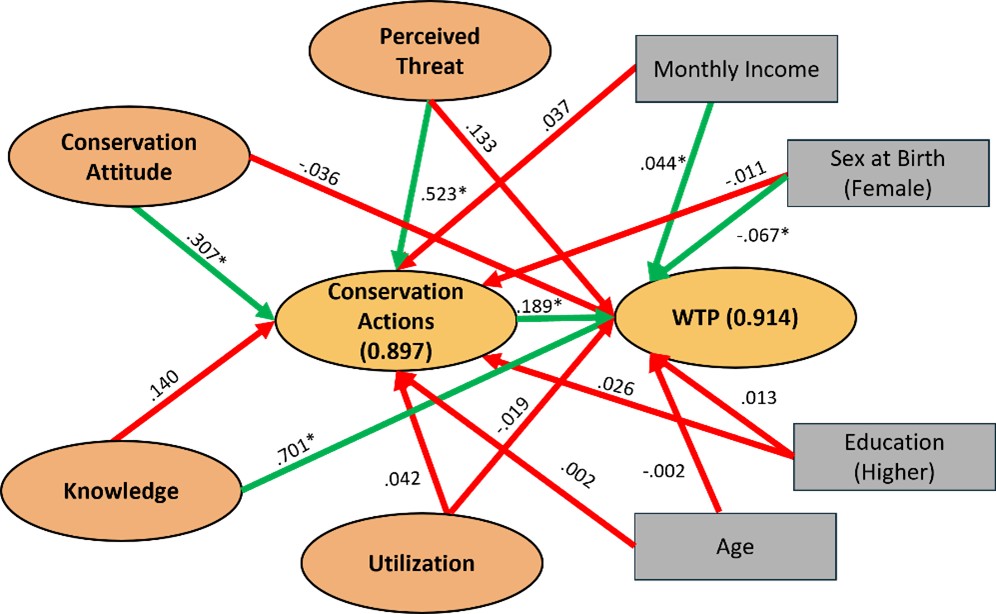
Mangrove forests are among the most productive and valuable ecosystems, providing critical services such as shoreline protection, fisheries support, and carbon sequestration. Despite their ecological and economic significance, mangrove forests continue to decline at an alarming rate due to land conversion for aquaculture, urban expansion, overharvesting, and climate-related impacts. Although national and community-based conservation programs exist in the Philippines, many of these efforts have struggled due to limited public participation and a lack of insight into how local communities perceive and value mangrove ecosystems. This study surveyed 503 residents living near the Katunggan Coastal Ecopark in Mindanao Island, Philippines, to examine how conservation attitudes, perceived threats, knowledge, utilization, and sociodemographic factors shape conservation action and willingness-to-pay (WTP) for mangrove protection. Respondents generally exhibited high knowledge of mangroves, with strong recognition of climate and human-induced threats, as well as high conservation attitudes and actions, and a low reliance on mangroves for their livelihood. Most expressed support for conservation through monetary contributions (82.4%), although some cited financial constraints, skepticism toward fund use, or preference for non-monetary participation. Structural equation modeling (SEM) revealed that perceived threat and conservation attitude significantly influenced conservation actions, while knowledge, conservation actions, monthly income, and sex at birth predicted WTP. The log-normal interval regression model estimated a mean annual WTP of USD 12.29 (₱703.53) and a median of USD 1.59 (₱91.01), indicating a right-skewed distribution. These findings offer critical insight into the cognitive and behavioral drivers of mangrove conservation support. They can inform inclusive, flexible payment mechanisms that ensure greater community participation in sustainable mangrove ecosystem management.
Acharya, R. P., Maraseni, T. N., & Cockfield, G. (2021). Estimating the willingness to pay for regulating and cultural ecosystem services from forested Siwalik landscapes: Perspectives of disaggregated users. Annals of Forest Science, 78(2), 51. https://doi.org/10.1007/s13595-021-01046-3
Ajzen, I. (1991). The theory of planned behavior. Organizational Behavior and Human Decision Processes, 50, 179–211. https://doi.org/10.1016/0749-5978(91)90 020-T
Al Furqon, M. R., & Hak, M. B. (2025). Visitors’ Willingness to Pay for Mangrove Conservation: Case Bale Mangrove Ecotourism. Jurnal Ekuilnomi, 7(1), 25–33. https://doi.org/10.36985/dc70b058
Allegretti, A. M. (2010). Acceptability, conflict, and support for coastal resource management policies and initiatives in Cebu, Philippines. [Master's Thesis]. Colorado State University.
Alimbon, J. A. & Manseguiao, M. R. S. (2021). Community Knowledge and Utilization of Mangroves in Panabo Mangrove Park, Panabo City, Davao del Norte, Philippines. International Journal of Bonorowo Wetlands, 11(2), 51-57. https://doi.org/10.13 057/bonorowo/w110201
Ampaso, A. M., Buncag, M. J. J., Magarin, R. P., & Arreza, K. P. (2024). Contingent Valuation on Residents’ Willingness to Pay for Mangrove Rehabilitation in Baroy, Lanao Del Norte, Philippines. Journal of Environmental & Earth Sciences, 6(2), 52–63. https://doi.org/10.30564/jees.v6i2.6405
Badola, R., Barthwal, S., & Hussain, S. A. (2012). Attitudes of local communities towards conservation of mangrove forests: A case study from the east coast of India. Estuarine, Coastal and Shelf Science, 96, 188–196. https://doi.org/10.1016/j.ecs s.2011.11.016
Bennett, N. J. (2016). Using perceptions as evidence to improve conservation and environmental management. Conservation Biology, 30(3), 582–592. https://doi. org/10.1111/cobi.12681
Bennett, N. J., Di Franco, A., Calò, A., Nethery, E., Niccolini, F., Milazzo, M., & Guidetti, P. (2019). Local support for conservation is associated with perceptions of good governance, social impacts, and ecological effectiveness. Conservation Letters, 12(4), e12640. https://doi.org/10.1111/conl.12640
Broberg, T., & Brännlund, R. (2008). On the value of large predators in Sweden: A regional stratified contingent valuation analysis. Journal of Environmental Management, 88(4), 1066–1077. https://doi.org/10.1016/j.jenvman.2007.0 5.016
Camacho, L. D., Gevaña, D. T., Sabino, L. L., Ruzol, C. D., Garcia, J. E., Camacho, A. C. D., ... & Takeuchi, K. (2020). Sustainable mangrove rehabilitation: Lessons and insights from community-based management in the Philippines and Myanmar. APN Science Bulletin, 10(1), 18–25. https://doi.org/10.30852/sb.202 0.983
Cañada, M. C. B., Velasco, C. R., & Lota, M. M. (2022). Gender Roles in the Utilization and Challenges in the Management of Mangrove Forests in Casiguran, Aurora, Philippines. Open Journal of Ecology, 12(04), 257–270. https://doi.org/10.4236/ oje.2022.124015
Carandang, A. P., Camacho, L. D., Gevaña, D. T., Dizon, J. T., Camacho, S. C., de Luna, C. C., ... & Rebugio, L. L. (2013). Economic valuation for sustainable mangrove ecosystems management in Bohol and Palawan, Philippines. Forest science and technology, 9(3), 118-125. https://doi.org/10.1080/21580103.2013.801149
Carson, R. T., & Hanemann, W. M. (2005). Chapter 17 Contingent Valuation. In Mäler, K. G., & Vincent, J. R. (Eds.). Handbook of environmental economics (Vol. 2: Valuing environmental changes. (pp. 821–936). Elsevier. https://doi.org/10.1016/S1574-0099(05)02017-6
Carugati, L., Gatto, B., Rastelli, E., Lo Martire, M., Coral, C., Greco, S., & Danovaro, R. (2018). Impact of mangrove forests degradation on biodiversity and ecosystem functioning. Scientific Reports, 8(1), 13298. https://doi.org/10.1038/s41598-018-31683-0
Clough, B. F. (2013). Continuing the journey amongst mangroves. The International Society for Mangrove Ecosystems (ISME) and International Tropical Timber Organization (ITTO).
Creencia, G. B. A., & Querijero, B. V. (2018). Gender-Based Difference in the Knowledge, Awareness, Economic Valuation, and Conservation Roles in Calatagan Mangroves Forest Conservation Park (CMFCP) in Batangas, Philippines. SDSSU Multidisciplinary Research Journal (SRMJ), 6, 18-23.
Cummings, R. G., & Taylor, L. O. (1999). Unbiased Value Estimates for Environmental Goods: A Cheap Talk Design for the Contingent Valuation Method. American Economic Review, 89(3), 649–665. https://doi.org/10.1257/aer.89.3.649
Dat, L. Q., Chou, S.-Y., Tam, P. M., Hue, N. T., & Thuy, P. T. (2024). Factors Influencing Residents’ Willingness to Pay for Mangrove Forest Environmental Services in Phu Long, Vietnam. Sage Open, 14(3), 21582440241264604. https://doi.org/10.1177/21582440241264604
De Lange, E., Sze, J. S., Allan, J., Atkinson, S., Booth, H., Fletcher, R., Khanyari, M., & Saif, O. (2023). A global conservation basic income to safeguard biodiversity. Nature Sustainability, 6(8), 1016–1023. https://doi.org/10.1038/s41893-023-01115-7
De Leon, E. G. (n.d.). Barriers in scaled climate change adaptation policy in the Philippines. Peace and Progress-The United Nations University Graduate Student Journal, 3(1), 32-44. https://postgraduate.ias.unu.edu/upp/wp-content/upload s/2016/07/4_De-Leon_article.pdf
Department of Environment and Natural Resources Executive Order No. 26 (2011). Declaring an Interdepartmental Convergence Initiative for a National Greening Program. Accessed from https://www.officialgazette.gov.ph/2011/02/24/execu tive-order-no-26-s-2011/ on April 1, 2025.
Department of Environment and Natural Resources- Forest Management Bureau- (DENR-FMB) (2023). Philippine Forestry Statistics: 2023. Retrieved from https://drive.google.com/file/d/1uYMd6FJosiT-12ltzZM8veYujjK_u3t3/preview on April 1, 2025.
De Vera, P. J. D., Alombro, N. C., Patadon, S. M., & Catipay, J. P. A. (2023). Factors Affecting the Intention to Implement Pro-environmental Behaviors: A Case of Riverside Communities in Cotabato City Rivers, Mindanao Island, Philippines. Journal of Marine and Island Cultures, 12(3). https://doi.org/10.21463/jmic.202 3.12.3.10
De Vera, P. J. D., Catipay, J. P. A., Kontsiotis, V. J., & Liordos, V. (2024). Snake Conservation Attitudes in The Philippines, A Global Biodiversity Hotspot. Human Ecology, 52(4), 771–784. https://doi.org/10.1007/s10745-024-00523-3
Domingo, S. N., Manejar, A. J. A., & Ocbina, J. J. S. (2022). Looking at Payments for Ecosystem Services in the Philippines. PIDS Discussion Paper Series, No. 2022-49. Philippine Institute for Development Studies (PIDS).
Drupp, M. A., Turk, Z. M., Groom, B., & Heckenhahn, J. (2024). Global evidence on the income elasticity of willingness to pay, relative price changes and public natural capital values. arXiv, 2308-04400. https://doi.org/10.48550/arXiv.2308.04400
Firdaus, F. (2023). Green product purchase decision: the role of environmental consciousness and willingness to pay. Jurnal Aplikasi Manajemen, 21(4), 1045-1060. https://doi.org/10.21776/ub.jam.2023.021.04.14
Faccioli, M., Czajkowski, M., Glenk, K., & Martin-Ortega, J. (2020). Environmental attitudes and place identity as determinants of preferences for ecosystem services. Ecological Economics, 174, 106600. https://doi.org/10.1016/j.ecoleco n.2020.106600
Farley, J. (2010). Conservation Through the Economics Lens. Environmental Management, 45(1), 26–38. https://doi.org/10.1007/s00267-008-9232-1
Firdaus, M., Hatanaka, K., & Saville, R. (2021). Mangrove Forest Restoration by Fisheries Communities in Lampung Bay: A study based on perceptions, willingness to pay, and management strategy. Forest and Society, 5(2), 224–244. https://doi.org/10. 24259/fs.v5i2.12008
Fornell, C., & Larcker, D. F. (1981). Evaluating structural equation models with unobservable variables and measurement error. Journal of Marketing Research, 18(1), 39–50. https://doi.org/10.2307/3151312
Gagarin, W., Eslava, D. F., Ancog, R., Tiburan Jr, C. L., & Ramos, N. (2022). Willingness to Pay for Mangroves’ Coastal Protection: A Case Study in Santo Angel, Calauag, Quezon, Philippines. Forest and Society, 6(1), 436–449. https://doi.org/10.24259 /fs.v6i1.18129
Gefen, D., Straub, D., & Boudreau, M. C. (2000). Structural equation modeling and regression: Guidelines for research practice. Communications of the Association for Information Systems, 4(1), 7. https://doi.org/10.17705/1CAIS.00407
Gkargkavouzi, A., & Halkos, G. (2024). Environmentalism in the light of Behavioral Economics. MPRA Paper No. 120752. MPRA. Retrieved from https://mpra.ub.uni-muenchen.de/120752/
Gorris, P., & Koch, L. (2024). Building trust in environmental co-management: Social embeddedness in a contested German biodiversity conservation governance process. Environmental Science & Policy, 154, 103695. https://doi.org/10.1016 /j.envsci.2024.103695
Hair, J., Black, W., Babin, B., & Anderson, R. (2013). Multivariate Data Analysis: Pearson New International Edition (7th Edition). Pearson Education.
Hanemann, M., Loomis, J., & Kanninen, B. (1991). Statistical Efficiency of Double‐Bounded Dichotomous Choice Contingent Valuation. American Journal of Agricultural Economics, 73(4), 1255–1263. https://doi.org/10.2307/1242453
Harvard Humanitarian Initiative. (n.d.). KoboToolbox. Available online: https://www.kobotoolbox.org/
Hernando, A. M. V., Tirasol, M. A. B., & Rosete, M. A. L. (2024). Contingent Valuation Study: Understanding Filipinos’ Support for Mangrove Forest Restoration and Conservation in Ipil, Zamboanga Sibugay, Philippines. Journal of Environment, 4(5). https://doi.org/10.47941/je.2433
Hoffmann, R., & Muttarak, R. (2020). Greening through schooling: Understanding the link between education and pro-environmental behavior in the Philippines. Environmental Research Letters, 15(1), 014009. https://doi.org/10.1088/1748-9326/ab5ea0
Hooper, D., Coughlan, J., & Mullen, M. R. (2008). Structural equation modelling: Guidelines for determining model fit. The Electronic Journal of Business Research Methods, 6(1), 53–60.
Hu, L. T., & Bentler, P. M. (1999). Cutoff criteria for fit indexes in covariance structure analysis: Conventional criteria versus new alternatives. Structural Equation Modeling: A Multidisciplinary Journal, 6(1), 1–55. https://doi.org/10.1080/10705 519909540118
Jaafar, K. J. D., Vera, P. J. D. D., Catipay, J. P. A., Kontsiotis, V. J., & Liordos, V. (2024). Endemic and Threatened: The Conservation Value of the Philippine Duck. Diversity, 16(10), 602. https://doi.org/10.3390/d16100602
Jorgensen, T. D., Pornprasertmanit, S., Schoemann, A. M., & Rosseel, Y. (2025). semTools: Useful tools for structural equation modeling. R package version 0.5-7. Available online: https://CRAN.R-project.org/package=semTools
Kassahun, H. T., Jacobsen, J. B., & Nicholson, C. F. (2020). Revisiting money and labor for valuing environmental goods and services in developing countries. Ecological Economics, 177, 106771. https://doi.org/10.1016/j.ecolecon.2020.106771
Kollmuss, A., & Agyeman, J. (2002). Mind the Gap: Why do people act environmentally and what are the barriers to pro-environmental behavior? Environmental Education Research, 8(3), 239–260. https://doi.org/10.1080/1350462022014 5401
Lamsal, P., Atreya, K., Pant, K. P., & Kumar, L. (2015). An analysis of willingness to pay for community-based conservation activities at the Ghodaghodi Lake Complex, Nepal. International Journal of Biodiversity Science, Ecosystem Services & Management, 11(4), 341–348. https://doi.org/10.1080/21513732.2015.105 5338
Limbaro, G. R. A., Villareal, J. F., Poclis-Villareal, C. E., Santillan, R. D. S., & Jan D. De Vera, P. (2024). Understanding attitudes to urban tree conservation in Mindanao Island, Philippines. Arboricultural Journal, 1–21. https://doi.org/10.1080/0307 1375.2024.2426418
Long, J. B., & Giri, C. (2011). Mapping the Philippines’ Mangrove Forests Using Landsat Imagery. Sensors, 11(3), 2972–2981. https://doi.org/10.3390/s110302972
Long, J., Napton, D., Giri, C., & Graesser, J. (2014). A Mapping and Monitoring Assessment of the Philippines’ Mangrove Forests from 1990 to 2010. Journal of Coastal Research, 294, 260–271. https://doi.org/10.2112/JCOASTRES-D-13-00 057.1
López-Portillo, J., Lewis III, R. R., Saenger, P., Rovai, A., Koedam, N., Dahdouh-Guebas, F., ... & Rivera-Monroy, V. H. (2017). Mangrove forest restoration and rehabilitation. In Rivera-Monroy, V. H., Lee, S. Y., Kristensen, E., & Twilley, R. R. (Eds.), Mangrove Ecosystems: A Global Biogeographic Perspective (pp. 301–345). Springer International Publishing. https://doi.org/10.1007/978-3-319-62206-4_10
Makwinja, R., Kosamu, I. B. M., & Kaonga, C. C. (2019). Determinants and Values of Willingness to Pay for Water Quality Improvement: Insights from Chia Lagoon, Malawi. Sustainability, 11(17), 4690. https://doi.org/10.3390/su11174690
Maliao, R. J., & Polohan, B. B. (2008). Evaluating the Impacts of Mangrove Rehabilitation in Cogtong Bay, Philippines. Environmental Management, 41(3), 414–424. https://doi.org/10.1007/s00267-007-9021-2
Mangaoang, C. C. & Flores, A. B. (2019). Inventory of mangroves in Katunggan Coastal Eco-Park, Sultan Kudarat Province, the Philippines. Bonorowo Wetlands, 9(2). https://doi.org/10.13057/bonorowo/w90202
Millennium Ecosystem Assessment. (2005). Ecosystems and Human Well-Being: Synthesis. Island Press.
Musa, F., Mohd Fozi, N., & Mohd Hamdan, D. D. (2020). Coastal Communities’ Willingness to Pay for Mangrove Ecotourism at Marudu Bay, Sabah, Malaysia. Journal of Sustainability Science and Management, 15(4), 130–140. https://doi.org/10.46754/jssm.2020.06.013
Neri, M. P., Baloloy, A. B., & Blanco, A. C. (2021). Limitation Assessment And Workflow Refinement of the Mangrove Vegetation Index (Mvi)-Based Mapping Methodology Using Sentinel-2 Imagery. The International Archives of the Photogrammetry, Remote Sensing and Spatial Information Sciences, XLVI-4/W6-2021, 235–242. https://doi.org/10.5194/isprs-archives-XLVI-4-W6-2021-235-2021
Nguyen, T. V., Simioni, M., & Vo, H. T. (2022). Valuing Mangrove Conservation Attributes in Red River Delta, Vietnam: A Choice Experiment Approach. Marine Resource Economics, 37(3), 349–368. https://doi.org/10.1086/720468
Nyangon, L., Zainal, A. N. S., Pazi, A. M. M., & Gandaseca, S. (2019). Heavy metals in mangrove sediments along the Selangor River, Malaysia. Forest and Society, 3(2), 278. https://doi.org/10.24259/fs.v3i2.6345
Nyein, L. T., Karthe, D., Giessen, L., Babel, M. S., & Schusser, C. (2025). Reviewing Mangrove Degradation, Conservation, and Restoration: A Sustainability Nexus Assessment on Myanmar Using the DPSIR Framework. Forest and Society, 9(1), 164–185. https://doi.org/10.24259/fs.v9i1.35303
Ottinger, M., Clauss, K., & Kuenzer, C. (2016). Aquaculture: Relevance, distribution, impacts and spatial assessments – A review. Ocean & Coastal Management, 119, 244–266. https://doi.org/10.1016/j.ocecoaman.2015.10.015
Pacyao, J. P. (2025). Community-Based Mangrove Nursery as Production Support System for Mangrove Rehabilitation Efforts in Davao Occidental, Philippines. SSRN. https://doi.org/10.2139/ssrn.5020631
Palanca-Tan, R. (2020). Willingness to Pay of Urban Households for the Conservation of Natural Resources and Cultural Heritage in a Neighboring Rural Area: A CVM Study. Philippine Journal of Science, 149(2). https://doi.org/10.56899/149.02.14
Philippine Statistics Authority (PSA). (2020). Highlights of the results of the 2020 census of population and housing. Retrieved from https://rsso12.psa.gov.ph/sys tem/files/attachment-dir/65R12-SR2021-19_Highlights%2520of%2520the%2 520Results%2520of%2520the%25202020%2520Census%2520of%2520Population%2520and%2520Housing%2520%25282020%2520CPH%2529.pdf on April 1, 2025.
Philippine Statistics Authority (PSA) (2023). Fisherfolks and Farmers Remain to Have the Highest Poverty Incidences Among the Basic Sectors in 2021. Accessed from https://psa.gov.ph/content/fisherfolks-and-farmers-remain-have-highest-poverty-incidences-among-basic-sectors-2021
Polidoro, B. A., Carpenter, K. E., Collins, L., Duke, N. C., Ellison, A. M., Ellison, J. C., ... & Yong, J. W. H. (2010). The loss of species: mangrove extinction risk and geographic areas of global concern. PloS one, 5(4), e10095. https://doi.org/10.1371/journal. pone.0010095
Primavera, J. H. (1995). Mangroves and brackishwater pond culture in the Philippines. Hydrobiologia, 295(1-3), 303–309. https://doi.org/10.1007/bf00029137
Primavera, J. H., Rollon, R. N., & Samson, M. S. (2011). The Pressing Challenges of Mangrove Rehabilitation. In Wolanski. E., & McLusky, D. (Eds.), Treatise on Estuarine and Coastal Science (pp. 217–244). Elsevier. https://doi.org/10.1016/ B978-0-12-374711-2.01010-X
Pulhin, J. M., Sajise, A. J. U., Predo, C. D., Anders, C. S., Tatlonghari, R. V., Mendoza, M. D., ... & Sevilla, F. Y. (2024). Catalysts and barriers in the development and implementation of payment for water ecosystem services in the Philippines: Retrospects and prospects. Science and Engineering Journal, Special Issue, 281-303. https://doi.org/10.54645/202417SupTBM-28
Quevedo, J. M. D., Uchiyama, Y., & Kohsaka, R. (2020). Perceptions of local communities on mangrove forests, their services and management: Implications for Eco-DRR and blue carbon management for Eastern Samar, Philippines. Journal of Forest Research, 25(1), 1–11. https://doi.org/10.1080/13416979.2019.1696441
R Core Team (2025). R: A Language and Environment for Statistical Computing. R Foundation for Statistical Computing.
Rosenstock, I. M. (1974). The Health Belief Model and Preventive Health Behavior. Health Education Monographs, 2(4), 354–386. https://doi.org/10.1177/1090198 17400200405
Rosseel, Y. (2012). lavaan: An R package for structural equation modeling. Journal of Statistical Software, 48(2), 1–36. https://doi.org/10.18637/jss.v048.i02
Ruiz-Guevara, S. M., Quintero-Castañeda, C. Y., Hernández-Angulo, L. R., & Sierra-Carrillo, M. M. (2025). Environmental Psychology and Mangrove Reforestation in the Ciénaga Grande de Santa Marta, Colombia: An Approach to Ecosystem Restoration. World, 6(1), 24. https://doi.org/10.3390/world6010024
Salampessy, M. L., Febryano, I. G., & Ichsan, A. C. (2021). Community knowledge and involvement in mangrove ecosystem management in the coastal of Muara Gembong Bekasi. IOP Conference Series: Earth and Environmental Science, 891(1), 012024. https://doi.org/10.1088/1755-1315/891/1/012024
Sarker, A. H. M. R., Nobi, M. N., Roskaft, E., Chivers, D. J., & Suza, M. (2020). Value of the Storm-Protection Function of Sundarban Mangroves in Bangladesh. Journal of Sustainable Development, 13(3), 128. https://doi.org/10.5539/jsd.v13n3p128
Savari, M., Damaneh, H. E., & Damaneh, H. E. (2024). Conservation behaviors of local communities towards mangrove forests in Iran. Global Ecology and Conservation, 56, e03311. https://doi.org/10.1016/j.gecco.2024.e03311
Schultz, P. W., Gouveia, V. V., Cameron, L. D., Tankha, G., Schmuck, P., & Franěk, M. (2005). Values and their Relationship to Environmental Concern and Conservation Behavior. Journal of Cross-Cultural Psychology, 36(4), 457–475. https://doi.org/10.1177/0022022105275962
Seriño, M. N., Ureta, J. C., Baldesco, J., Galvez, K. J., Predo, C., & Seriño, E. K. (2017). Valuing the Protection Service Provided by Mangroves in Typhoon-hit Areas in the Philippines. Economy and Environment Program for Southeast Asia (EEPSEA).
Simpao, A. C., & Yabut, H. (2022). Conservation Behavior Among Students in a University in Metro Manila: The Moderating Role of Attitudes on the Impact of Environmental Knowledge. Asia-Pacific Social Science Review, 22(3), 95-108. https://doi.org/10.59588/2350-8329.1466
Susilo, H., Takahashi, Y., & Yabe, M. (2017). Evidence for Mangrove Restoration in the Mahakam Delta, Indonesia, Based on Households’ Willingness to Pay. Journal of Agricultural Science, 9(3), 30. https://doi.org/10.5539/jas.v9n3p30
Tahir, H. (2023). Local People’s Attitudes Towards Mangrove Conservation Effort in East Kalimantan, Indonesia. Interdisciplinary Social Studies, 2(11), 2517–2536. https://doi.org/10.55324/iss.v2i11.519
Tejada, U. A. & Cauilan, A. M. C. (2019). Knowledge, attitude and practice of coastal communities on mangrove benefits, conservation and rehabilitation. International Journal of Biosciences, 14(3), 446-462. http://dx.doi.org/10.1269 2/ijb/14.3.446-462
Therneau, T. M. (2024). A package for survival analysis in R. Available online: https://cran.r-project.org/web/packages/survival/vignettes/survival.pdf
Thomas, N., Lucas, R., Bunting, P., Hardy, A., Rosenqvist, A., & Simard, M. (2017). Distribution and drivers of global mangrove forest change, 1996–2010. PLOS ONE, 12(6), e0179302. https://doi.org/10.1371/journal.pone.0179302
Tianyu, J., & Meng, L. (2020). Does education increase pro-environmental willingness to pay? Evidence from Chinese household survey. Journal of Cleaner Production, 275, 122713. https://doi.org/10.1016/j.jclepro.2020.122713
Ting, M., Qingwen, M., Kun, X., & Weiguo, S. (2021). Resident Willingness to Pay for Ecotourism Resources and Associated Factors in Sanjiangyuan National Park, China. Journal of Resources and Ecology, 12(5). https://doi.org/10.5814/j.issn. 1674-764x.2021.05.012
Ureta, J. C. P., Abueg, L. C., & Inocencio, A. B. (2021). Towards Establishment of a Payment for Ecosystem Services (PES) in Protected Areas: The Case of Mounts Banahaw and San Cristobal in Quezon Province, Philippines. DLSU Business & Economics Review, 31(1), 1-15.
Valenzuela, R., Yeo-Chang, Y., Park, M. S., & Chun, J.-N. (2020). Local People’s Participation in Mangrove Restoration Projects and Impacts on Social Capital and Livelihood: A Case Study in the Philippines. Forests, 11(5), 580. https://doi.org/ 10.3390/f11050580
Van Hespen, R., Hu, Z., Borsje, B., De Dominicis, M., Friess, D. A., Jevrejeva, S., ... & Bouma, T. J. (2023). Mangrove forests as a nature-based solution for coastal flood protection: Biophysical and ecological considerations. Water Science and Engineering, 16(1), 1-13. https://doi.org/10.1016/j.wse.2022.10.004
Vaske, J. J. (2008). Survey Research and Analysis (2nd Edition). Venture.
Vo Trung, H., Viet Nguyen, T., & Simioni, M. (2020). Willingness to pay for mangrove preservation in Xuan Thuy National Park, Vietnam: Do household knowledge and interest play a role? Journal of Environmental Economics and Policy, 9(4), 402–420. https://doi.org/10.1080/21606544.2020.1716854
Ward, R. D., Friess, D. A., Day, R. H., & Mackenzie, R. A. (2016). Impacts of climate change on mangrove ecosystems: A region by region overview. Ecosystem Health and Sustainability, 2(4), e01211. https://doi.org/10.1002/ehs2.1211
Welsh, M. P., & Poe, G. L. (1998). Elicitation Effects in Contingent Valuation: Comparisons to a Multiple Bounded Discrete Choice Approach. Journal of Environmental Economics and Management, 36(2), 170–185. https://doi.org/10. 1006/jeem.1998.1043
Wyss, A. M., Knoch, D., & Berger, S. (2022). When and how pro-environmental attitudes turn into behavior: The role of costs, benefits, and self-control. Journal of Environmental Psychology, 79, 101748. https://doi.org/10.1016/j.jenvp.2021.10 1748
Zech, S. T., Eastin, J., & Bonotti, M. (2023). Policy implementation in crisis: Lessons from the Philippines. Asia & the Pacific Policy Studies, 10(1–3), 28–45. https://doi.org/ 10.1002/app5.378
Copyright (c) 2025 Forest and Society

This work is licensed under a Creative Commons Attribution 4.0 International License.
This is an open access journal which means that all contents is freely available without charge to the user or his/her institution. Users are allowed to read, download, copy, distribute, print, search, or link to the full texts of the articles in this journal without asking prior permission from the publisher or the author. This is in accordance with the BOAI definition of open access.
Submission of an article implies that the work described has not been published previously (except in the form of an abstract or as part of a published lecture or academic thesis), that it is not under consideration for publication elsewhere, that its publication is approved by all authors and tacitly or explicitly by the responsible authorities where the work was carried out, and that, if accepted, will not be published elsewhere in the same form, in English or in any other language, without the written consent of the Publisher. An article based on a section from a completed graduate dissertation may be published in Forest and Society, but only if this is allowed by author's(s') university rules. The Editors reserve the right to edit or otherwise alter all contributions, but authors will receive proofs for approval before publication.
Forest and Society operates a CC-BY 4.0 © license for journal papers. Copyright remains with the author, but Forest and Society is licensed to publish the paper, and the author agrees to make the article available with the CC-BY 4.0 license. Reproduction as another journal article in whole or in part would be plagiarism. Forest and Society reserves all rights except those granted in this copyright notice
