
Uprooting the Mosalaki: Changing institutions and livelihood impacts at Kelimutu National Park
DOI:
https://doi.org/10.24259/fs.v7i2.26464Keywords:
Kelimutu National Park, Mosalaki, traditional institutions, local authority, livelihoodAbstract
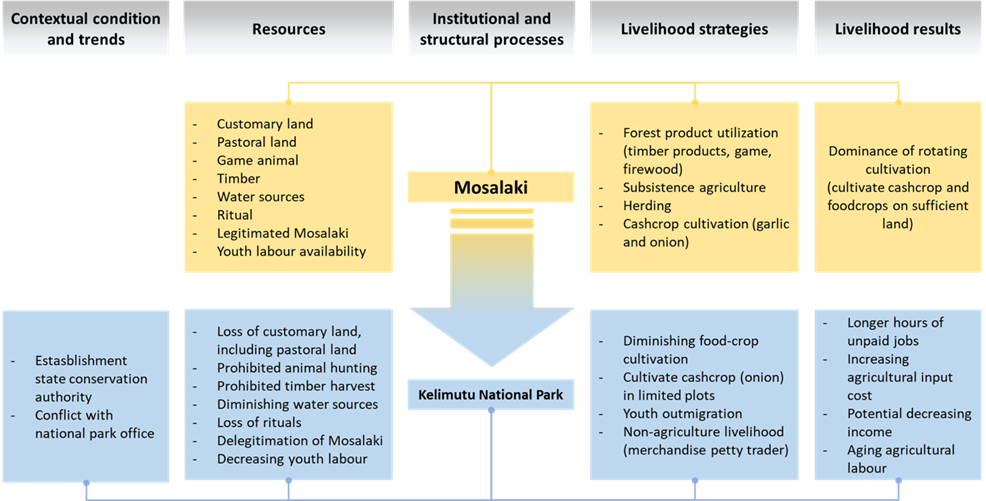
Studies on interactions between national parks and Indigenous Peoples in Indonesia have gained much attention in recent years, which mainly examine eviction, boundary disputes, and remediation. This research focuses on changing institutions since the establishment of Kelimutu National Park, foregrounding socio-cultural and livelihood impacts over time. This study involves in-depth interviews, FGDs, and observations from April to May 2019 and revisiting in November 2021. Findings highlight changing traditional institutions (Mosalaki) uprooted by the formal National Park governing authority. Such transitions also shift governing authority over natural resources access and control in ways that negatively affect the livelihoods of the Lio people of Kelimutu.
References
Acciaioli, G. (2008). Environmentality reconsidered: Indigenous to Lindu conservation strategies and the reclaiming of the commons in Central Sulawesi, Indonesia. People, Protected Areas and Global Change, 401–430.
Acciaioli, G. (2009). Conservation and community in the Lore Lindu National Park (Sulawesi). In Warren, C. & McCarthy, J. F. (Eds.), Community, Environment and Local Governance in Indonesia: Locating the Commonweal (pp. 89-120). Routledge.
Adams, W. B., & Mulligan, M. (2012). Decolonizing nature: strategies for conservation in a post-colonial era. Routledge.
Adams, W. M., & Hutton, J. (2007). People, parks and poverty: political ecology and biodiversity conservation. Conservation and Society, 5(2), 147–183. https://www.jstor.org/stable/26392879
Afiff, S., & Lowe, C. (2007). Claiming Indigenous Community: Political Discourse and Natural Resource Rights in Indonesia. Alternatives to Laboratory Animals: ATLA, 32(1), 73–97. https://doi.org/10.1177/030437540703200104
Anshari, G. Z. (2006). Dapatkah Pengelolaan Kolaboratif Menyelamatkan Taman Nasional Danau Sentarum. CIFOR.
Anugrahsari, I., Sardjono, M. A., Fitriyah, N., & Golar, G. (2020). Social Contracts: Pillars of Community Conservation Partnerships in Lore Lindu National Park, Indonesia. Forest and Society, 4(1), 115-126. https://doi.org/10.24259/fs.v4i1.8682
Badan Pusat Statistik Kabupaten Ende. (2019a). Banyaknya Pengunjung Di Danau Kelimutu 2016-2018. Badan Pusat Statistik Kabupaten Ende.
Badan Pusat Statistik Kabupaten Ende. (2019b). Kecamatan Kelimutu Dalam Angka 2019.
Badan Pusat Statistik Kabupaten Ende. (2020). Kecamatan Detusoko Dalam Angka 2020.
Bakker, L., & Moniaga, S. (2010). The Space Between: Land Claims and the Law in Indonesia. Southeast Asian Journal of Social Science, 38(2), 187–203. https://doi.org/10.1163/156853110X490890
Batiran, K., & Salim, I. (2020). A Tale of Two Kewangs: A comparative study of traditional institutions and their effect on conservation in Maluku. Forest and Society, 4(1), 81. https://doi.org/10.24259/fs.v4i1.8186
Clifton, J., & Majors, C. (2012). Culture, Conservation, and Conflict: Perspectives on Marine Protection Among the Bajau of Southeast Asia. Society & Natural Resources, 25(7), 716–725. https://doi.org/10.1080/08941920.2011.618487
Dhiaulhaq, A., De Bruyn, T., & Gritten, D. (2015). The use and effectiveness of mediation in forest and land conflict transformation in Southeast Asia: Case studies from Cambodia, Indonesia and Thailand. Environmental Science & Policy, 45, 132–145. https://doi.org/10.1016/j.envsci.2014.10.009
Direktorat Jenderal Konservasi Sumber Daya Alam dan Ekosistem. (2017). Statistik Direktorat Jenderal Konservasi Sumber Daya Alam dan Ekosistem Tahun 2017. Direktorat Jenderal Konservasi Sumber Daya Alam dan Ekosistem
Eghenter, C., Wulandari, C., Hanif, F., & Setiyaningrum, R. (2006). Collaborative management of national parks in Indonesia: an effective model for regulating the commons of conservation? Conference: Survival of the Commons: Mounting Challenges and New Realities, the Eleventh Conference of the International Association for the Study of Common Property. Indiana University.
Fatimah, A. H. P., & Sahide, M. A. K. (2019). What conflicts possible: A new social forestry partnership policy in a National Park in Indonesia. IOP Conference Series: Earth and Environmental Science, 343(1), 012050. https://doi.org/10.1088/1755-1315/343/1/012050
Fisher, L., Moeliono, I., & Wodicka, S. (1999). Nusa Tenggara Uplands, Indonesia: multiple-site lessons in conflict management. In Buckles, D. (Ed.), Cultivating peace: Conflict and collaboration in natural resource management (pp. 61-80). International Development Research Centre.
Fisher, M. R., & van der Muur, W. (2020). Misleading Icons of Communal Lands in Indonesia: Implications of Adat Forest Recognition From a Model Site in Kajang, Sulawesi. The Asia Pacific Journal of Anthropology, 21(1), 55–76. https://doi.org/ 10.1080/14442213.2019.1670244
Hall, D., Hirsch, P., & Li, T. (2011). Powers of Exclusion Land Dilemmas in Southeast Asia. NUS Press.
Hall, R., Edelman, M., Borras, S. M., Jr, Scoones, I., White, B., & Wolford, W. (2015). Resistance, acquiescence or incorporation? An introduction to land grabbing and political reactions ‘from below.’ The Journal of Peasant Studies, 42(3–4), 467–488. https://doi.org/10.1080/03066150.2015.1036746
Hecht, S. B., & Cockburn, A. (2010). The Fate of the Forest: Developers, Destroyers, and Defenders of the Amazon, Updated Edition. Chicago: University of Chicago Press.
Indrawan, M., Lowe, C., Sundjaya, Hutabarat, C., & Black, A. (2014). Co-management and the creation of national parks in Indonesia: positive lessons learned from the Togean Islands National Park. Journal of Environmental Planning and Management, 57(8), 1183–1199. https://doi.org/10.1080/09640568.2013. 788834
Lund, C. (2021). Nine-Tenths of the Law: Enduring Dispossession in Indonesia. Yale University Press.
Lund, C., & Rachman, N. F. (2018). Indirect Recognition. Frontiers and Territorialization around Mount Halimun-Salak National Park, Indonesia. World Development, 101, 417–428. https://doi.org/10.1016/j.worlddev.2017.04.003
McCarthy, J. F., & Robinson, K. (2016). Land and Development in Indonesia: Searching for the People’s Sovereignty. ISEAS-Yusof Ishak Institute.
Mendoza, E. N., Ponce, R. G., Soria, S. M. A., & Amoroso, V. B. (2020). Protected Areas’ Latent Functions and Social Consequences: A Case from Mount Hamiguitan, Philippines. Forest and Society, 4(2), 405-418. https://doi.org/10.24259/fs. v4i2.10485
Myers, R., Intarini, D., Sirait, M. T., & Maryudi, A. (2017). Claiming the forest: Inclusions and exclusions under Indonesia’s ‘new’ forest policies on customary forests. Land Use Policy, 66, 205–213. https://doi.org/10.1016/j.landusepol.2017.04.039
Myers, R., & Muhajir, M. (2015). Searching for justice: rights vs ‘benefits’ in Bukit Baka Bukit Raya national park, Indonesia. Conservation and Society, 13(4), 370–381. https://www.jstor.org/stable/26393217
Nistyantara, L. A. (2011). Strategi Pengelolaan Taman Nasional Kelimutu Melalui Pendekatan Co-Management [Master thesis]. Institut Pertanian Bogor.
Ping, H. O. S. (2007). Partners in conservation?-Communities, Contestation and Conflict in Komodo National Park, Indonesia (Master thesis). National University of Singapore
Putri, A. A. (2017). Akses Masyarakat Pada Sumberdaya Air Terhadap Kondisi Sosial Ekonomi Masyarakat di Taman Nasional Gunung Halimun Salak (TNGHS). Studi Pustaka.
Ribot, J. C., & Peluso, N. L. (2009). A theory of access. Rural Sociology, 68(2), 153–181. https://doi.org/10.1111/j.1549-0831.2003.tb00133.x
Roslinda, E. M. I. (2018). Social capital of the community in the management of Danau Sentarum National Park, West Kalimantan, Indonesia. Biodiversitas: Journal of Biological Diversity, 19(4), 1249-1257. https://doi.org/10.13057/biodiv/d190410
Schlager, E., & Ostrom, E. (1992). Property-Rights Regimes and Natural Resources: A Conceptual Analysis. Land Economics, 68(3), 249–262. https://doi.org/10. 2307/3146375
Scoones, I. (2015). Sustainable livelihoods and rural development. Practical Action Publishing.
Sikor, T., & Lund, C. (2009). Access and property: A question of power and authority. Development and Change, 40(1), 1–22. https://doi.org/10.1111/j.1467-7660.2009.01503.x
Sirimorok, N., & Asfriyanto, A. (2020). The return of the muro: Institutional bricolage, customary institutions, and protection of the commons in Lembata Island, Nusa Tenggara. Forest and Society, 4(1), 61-80. https://doi.org/10.24259/fs.v4i1.7676
van der Muur, W. (2018). Forest conflicts and the informal nature of realizing indigenous land rights in Indonesia. Citizenship Studies, 22(2), 160–174. https://doi.org/10.1080/13621025.2018.1445495
Wood, P., Sheil, D., Syaf, R., & Warta, Z. (2014). The Implementation and Sustainability of Village Conservation Agreements Around Kerinci Seblat National Park, Indonesia. Society & Natural Resources, 27(6), 602–620. https://doi.org/ 10.1080/08941920.2014.901464
Wright, E. O. (2011). Commentary 2: Sociologists and economists on “the commons”. In Bardhan, P. & Ray, I. (Eds.), The contested commons: Conversations between economists and antropologists. Oxford University Press.
Yamauchi, M. (2005). Conflict resolution mechanism in sustainable forest management: from case studies in Thailand, Indonesia and Malaysia. Proceeding of the 3rd IGES International Workshop
Yasmi, Y., Colfer, C. J. P., Yuliani, L., Indriatmoko, Y., & Heri, V. (2007). Conflict management approaches under unclear boundaries of the commons: experiences from Danau Sentarum National Park, Indonesia. International Forestry Review, 9(2), 597–609. https://doi.org/10.1505/ifor.9.2.597
Yusran, Y., Sahide, M. A. K., Supratman, S., Sabar, A., Krott, M., & Giessen, L. (2017). The empirical visibility of land use conflicts: From latent to manifest conflict through law enforcement in a national park in Indonesia. Land Use Policy, 62, 302–315. https://doi.org/10.1016/j.landusepol.2016.12.033
Additional Files
Published
Issue
Section
Categories
License
Copyright (c) 2023 Forest and Society

This work is licensed under a Creative Commons Attribution 4.0 International License.
This is an open access journal which means that all contents is freely available without charge to the user or his/her institution. Users are allowed to read, download, copy, distribute, print, search, or link to the full texts of the articles in this journal without asking prior permission from the publisher or the author. This is in accordance with the BOAI definition of open access.
Submission of an article implies that the work described has not been published previously (except in the form of an abstract or as part of a published lecture or academic thesis), that it is not under consideration for publication elsewhere, that its publication is approved by all authors and tacitly or explicitly by the responsible authorities where the work was carried out, and that, if accepted, will not be published elsewhere in the same form, in English or in any other language, without the written consent of the Publisher. An article based on a section from a completed graduate dissertation may be published in Forest and Society, but only if this is allowed by author's(s') university rules. The Editors reserve the right to edit or otherwise alter all contributions, but authors will receive proofs for approval before publication.
Forest and Society operates a CC-BY 4.0 © license for journal papers. Copyright remains with the author, but Forest and Society is licensed to publish the paper, and the author agrees to make the article available with the CC-BY 4.0 license. Reproduction as another journal article in whole or in part would be plagiarism. Forest and Society reserves all rights except those granted in this copyright notice

