Sustainable Value Chain Mapping of Downstream Aquaculture Fishery Products Based on Blue Economy
Article Sidebar
Main Article Content
Abstract
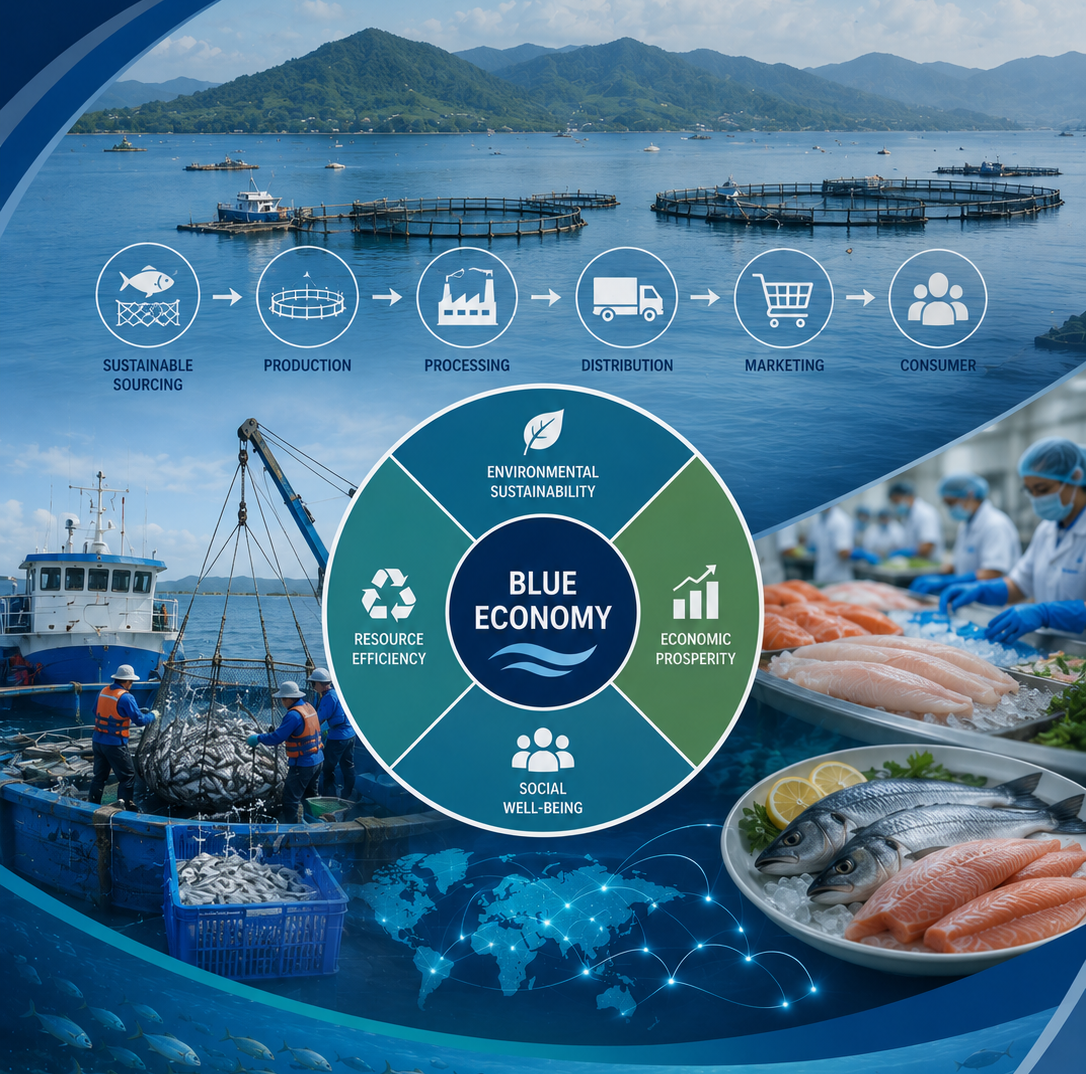
Indonesia demonstrates considerable maritime potential; however, exploitation of the blue economy remains inadequate, particularly for aquaculture-derived products in Cirebon's coastal areas. As a central aquaculture hub in West Java, Cirebon faces persistent challenges in establishing sustainable value chains, characterized by insufficient value addition, fragmented stakeholder relationships, and incomplete adoption of the blue economy. This investigation pursues three objectives: (1) examining current value chain structures, (2) determining sustainability determinants, and (3) developing enhancement strategies. A mixed-methods analysis involving 190 participants from four sub-districts indicates promising opportunities but is constrained by economic, social, and environmental sustainability challenges. Processing stages yielded the highest value addition (42.4%), while aggregate sustainability was rated 2.67 (Moderately Sustainable), with social factors scoring highest (3.12) and having a positive impact on welfare. Economic-technological dimensions exhibited the strongest interdependence (r=0.675), which directly contributes to improving the economic performance of value chain actors. Establishing integrated fisheries industrial clusters emerged as the foremost strategic imperative for advancing blue-economy-oriented aquaculture downstream activities across Cirebon's coastal territories.
Article Details
Issue
Section

This work is licensed under a Creative Commons Attribution 4.0 International License.
How to Cite
References
[1] World Bank, "Oceans, Fisheries, and the Coastal Economies," 21 April 2025. [Online]. [Accessed 11 June 2025].
[2] ARISE+ Indonesia, "Navigating Prosperity: Indonesia's Blue Economy Roadmap Sails Towards Sustainable Growth and Marine Preservation for Current and Future Generations," 21 August 2023. [Online]. [Accessed 11 June 2025].
[3] FAO, "The State of World Fisheries and Aquaculture 2024 - Blue Transformation in action," 2024. [Online]. [Accessed 11 June 2025].
[4] U. I. Ujianti et al., "Blue Economic Analysis in Coastal Areas of the Indonesian Java Sea Based on Fisheries," Advances in Agriculture, vol. 2024, p. 5550622, 2024.
[5] Y. N. Rahmat and J. Neilson, "The ebb and flow of capital in Indonesian coastal production systems," Singapore Journal of Tropical Geography, vol. 44, no. 2, pp. 294-316, 2023.
[6] World Economic Forum, "Why sustainable aquaculture is essential to feed the world," 3 June 2025. [Online]. [Accessed 11 June 2025].
[7] N. I. Arvitrida et al., "Fishery Supply Chains in Indonesia: Improvement Opportunities on The Downstream Side," Atlantis Press, pp. 253-257, 2019.
[8] T. M. Garlock et al., "Environmental, economic, and social sustainability in aquaculture: the aquaculture performance indicators," Nature Communications, vol. 15, p. 5216, 2024.
[9] J. Aarstad, S. -E. Jakobsen, A. Fløysand and O. A. Kvitastein, "Sustainability and innovation across the aquaculture value chain," Frontiers in Aquaculture, vol. 3, p. 1384722, 2024.
[10] D. C. Love et al., "The socio-ecological resilience and sustainability implications of seafood supply chain disruption," Reviews in Fish Biology and Fisheries, vol. 33, pp. 817-833, 2023.
[11] J. Silva et al., "Environmental sustainability of future aquaculture production: Analysis of Singaporean and Norwegian policies," Aquaculture, vol. 545, p. 737225, 2022.
[12] F. G. Acién et al., "Empowering blue economy: From underrated ecosystem to sustainable industry," Journal of Environmental Management, vol. 301, p. 113825, 2021.
[13] M. Troell et al., "Perspectives on aquaculture's contribution to the Sustainable Development Goals for improved human and planetary health," Journal of the World Aquaculture Society, vol. 54, no. 2, pp. 251-342, 2023.
[14] E. M. Finkbeiner et al., "From Blue Economy to Blue Communities: reorienting aquaculture expansion for community wellbeing," Marine Policy, vol. 124, p. 104337, 2021.
[15] F. Mendes et al., "Mapping fisheries value chains to facilitate their sustainability assessment: Case studies in The Gambia and Mali," Marine Policy, vol. 135, p. 104656, 2022.
[16] A. Silva et al., "The role of certifications and eco-labels in fisheries: a systematic literature review of their benefits and challenges," Environmental Sciences Europe, vol. 36, p. 65, 2024.
[17] L. Silva et al., "Bibliometric insights into fisheries value chain research," Fisheries Research, vol. 283, p. 107235, 2025.
[18] M. E. Porter, Competitive Advantage: Creating and Sustaining Superior Performance, New York: Free Press (Simon & Schuster), 1985.
[19] J. Elkington, Cannibals with Forks: The Triple Bottom Line of 21st Century Business, Oxford, UK: Capstone Publishing (Wiley), 1997.
[20] J. W. Creswell and V. L. P. Clark, Designing and Conducting Mixed Methods Research, Thousand Oaks, California: SAGE Publications, 2017.
[21] J. M. Morse, "Approaches to Qualitative-Quantitative Methodological Triangulation," Nursing Research, vol. 40, no. 2, pp. 120-123, 1991.
[22] M. Q. Patton, Qualitative Research & Evaluation Methods: Integrating Theory and Practice, Thousand Oaks, California: SAGE Publications, 2015.
[23] G. Guest, A. Bunce and L. Johnson, "How Many Interviews Are Enough? An Experiment with Data Saturation and Variability," Field Methods, vol. 18, no. 1, pp. 59-82, 2006.
[24] C. Eden and F. Ackermann, Making Strategy: The Journey of Strategic Management, London, UK: SAGE Publications, 1998.
[25] N. Nurdin et al., "Multi-tier captive relations in the global value chain of tuna: The case of Fair Trade certification of small-scale tuna fishery in Indonesia," Marine Policy, vol. 170, p. 106383, 2024.
[26] C. Brugère, J. Aguilar-Manjarrez, M. C. M. Beveridge and D. Soto, "The ecosystem approach to aquaculture 10 years on – a critical review and consideration of its future role in blue growth," Reviews in Aquaculture, vol. 11, no. 3, pp. 493-514, 2018.