
Community Perspectives on Engaging Stakeholders for Human-Sumatran Tiger Coexistence in the Bukit Barisan Selatan Landscape
DOI:
https://doi.org/10.24259/fs.v9i2.36879Keywords:
Community-based conservation, Conservation policy, Human-wildlife conflict, Stakeholder prioritization for coexistence, Wildlife conservation governanceAbstract
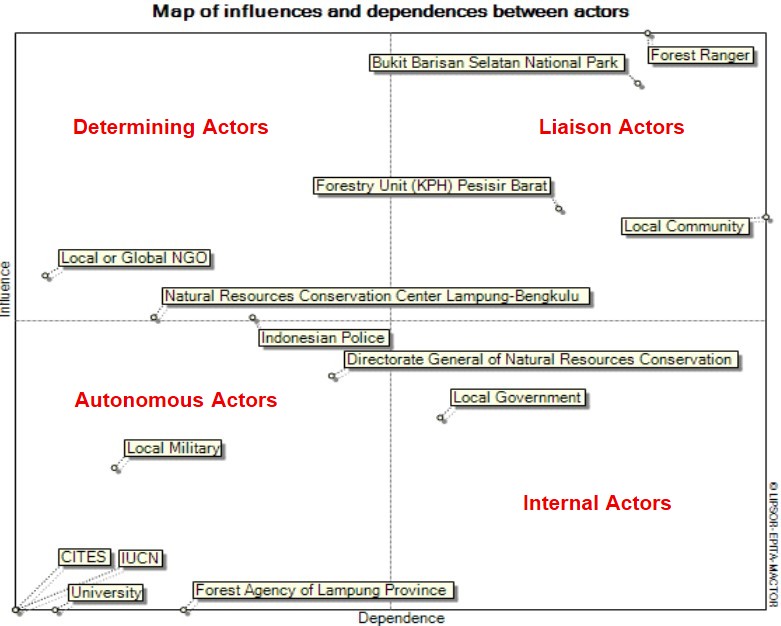
The Bukit Barisan Selatan (BBS) landscape, a vital habitat for the Sumatran tiger (Panthera tigris sumatrae), is increasingly degraded and fragmented by plantation and agricultural expansion, driving tigers into human-dominated areas and creating conflict zones beyond conservation boundaries. However, despite global frameworks like the Kunming-Montreal 2050 Biodiversity Framework and IUCN advocating coexistence by integrating ecological and socio-economic priorities, the practical implementation at the site level remains uncertain, particularly regarding local perspectives on coexistence and their alignment with competing stakeholder interests. This study analyzes the alignment of parties in the context of the potential coexistence of human-tiger conflicts in the landscape based on local community perspectives. The BBS landscape in this study includes Bukit Barisan Selatan National Park (BBSNP), Pesisir Barat Forest Management Unit (KPH Pesisir Barat), and surrounding villages. We employed literature reviews, interviews, and the MACTOR analysis tool in our analysis. Findings reveal that forest managers (BBSNP, FMU Pesisir Barat) and local communities are key stakeholders, with Forest Rangers as crucial links between conservation policy and communities. Effective communication and coordination by rangers and extension officers foster local compliance, but coexistence remains challenging due to frequent human-tiger conflicts in open areas and mixed-tree plantations, including within conservation zones. Divergence of objectives exists between ecological actors prioritizing tiger population enhancement and socio-economic actors prioritizing human security and land access, necessitating a more balanced and holistic approach to ensure long-term sustainability. The study concludes that integrating ecological and socio-economic objectives through stakeholder collaboration, meeting the needs of local communities, and considering their land rights and access in conservation planning is critical to ensure communities are direct beneficiaries and prevent conflicts of interest in sustainable human-tiger conservation efforts.
References
Aasoglenang, T. A., Bonye, S. Z., & Nsiah, V. (2024). Where do we go for our livelihoods? Conflicts over access, ownership and control of natural resources in the Mole National Park, Ghana. GeoJournal, 89(4), 134. https://doi.org/10.1007/s10708-024-11138-y
Arts, B., Behagel, J., de Koning, J., & van der Zon, M. (2023). Community Forest Management: Weak States or Strong Communities? Politics and Governance, 11(2), 336–345. https://doi.org/10.17645/pag.v11i2.6325
Bakri, S., Wulandari, C., Kurniasari, N., Safei, R., Ramdani, D., & Anshory. (2023). Effects of Characteristics and Perceptions of Collectors of Non-Timber Forest Products to be Members of the Partnership Program: A Case Study at Bukit Barisan Selatan National Park, Indonesia. Jurnal Manajemen Hutan Tropika, 29(2), 109–118. https://doi.org/10.7226/jtfm.29.2.109
Bendahan, S., Camponovo, G., & Pigneur, Y. (2004). Multi-issue actor analysis: Tools and models for assessing technology environments. Journal of Decision Systems, 13(2), 223–253. https://doi.org/10.3166/jds.13.223-253
Berbés-Blázquez, M., González, J. A., & Pascual, U. (2016). Towards an ecosystem services approach that addresses social power relations. Current Opinion in Environmental Sustainability, 19, 134–143. https://doi.org/10.1016/j.cosust.201 6.02.003
Boudoukha, A., & Kachef, S. (2022). Actors’ Strategy in Urban Project using MACTOR Tool: Case of Setif Tramway, Algeria. International Journal of Innovative Studies in Sociology and Humanities, 7(11), 162–178. https://doi.org/10.20431/2456-49 31.071115
Boumaour, A., Grimes, S., Brigand, L., & Larid, M. (2018). Integration process and stakeholders’ interactions analysis around a protection project: Case of the National park of Gouraya, Algeria (South-western Mediterranean). Ocean and Coastal Management, 153, 215–230. https://doi.org/10.1016/j.ocecoaman.201 7.12.031
Braczkowski, A. R., O’Bryan, C. J., Lessmann, C., Rondinini, C., Crysell, A. P., Gilbert, S., ... & Biggs, D. (2023). The unequal burden of human-wildlife conflict. Communications Biology, 6(1), 1–9. https://doi.org/10.1038/s42003-02 3-04493-y
Castillo-Huitrón, N. M., Naranjo, E. J., Enríquez, P., Santos-Fita, D., Estrada-Lugo, E., & González-García, J. M. (2024). Feelings, conflicts, and use: wildlife-human interactions in El Triunfo Biosphere Reserve, Mexico. Human Dimensions of Wildlife, 29(4), 416–431. https://doi.org/10.1080/10871209.2023.2263471
Cummings, A. R. (2022). An exploratory analysis of stakeholders and their influence on human–Jaguar conflict in Guyana. Human Dimensions of Wildlife, 27(6), 571–579. https://doi.org/10.1080/10871209.2021.1967524
Dash, S. K., Ghosh, S., Das, R., Das, D., Nandy, S., Das, T., & Sonker, G. (2025). Human-elephant conflict: attitudes of local people toward elephants and the conflict management authority in a shared landscape of India. Human Dimensions of Wildlife, 30(3), 304-319. https://doi.org/10.1080/10871209.2024.2372106
Dua, H. S., Dua, A. S., & Singh, A. D. (2010). The eye of the tiger. British Journal of Ophthalmology, 94(2), 166. https://doi.org/10.1136/bjo.2009.178251
Ekarini, D. F., Setiawati, S., & Gawi, J. M. (2022). Enabling sustainable community-based human-tiger conflict management in Seluma, Bengkulu, Indonesia. Biodiversitas, 23(12), 6404–6412. https://doi.org/10.13057/biodiv/d231238
Fiasco, V., & Massarella, K. (2022). Human-Wildlife Coexistence: Business as Usual Conservation or an Opportunity for Transformative Change? Conservation and Society, 20(2), 167–178. https://doi.org/10.4103/cs.cs_26_21
Figel, J. J., Safriansyah, R., Baabud, S. F., & Herman, Z. (2023). Clustered conflicts in disturbed lowlands characterize human–tiger interactions in Aceh, Indonesia. Wildlife Letters, 1(2), 83–91. https://doi.org/10.1002/wll2.12016
Galley, W., & Anthony, B. P. (2024). Beyond Crop-Raiding: Unravelling the Broader Impacts of Human-Wildlife Conflict on Rural Communities. Environmental Management, 74, 590–608. https://doi.org/10.1007/s00267-024-02018-9
Gardiner, R., Hamer, R., Leos-Barajas, V., Peñaherrera-Palma, C., Jones, M. E., & Johnson, C. (2019). State-space modeling reveals habitat perception of a small terrestrial mammal in a fragmented landscape. Ecology and Evolution, 9(17), 9804–9814. https://doi.org/10.1002/ece3.5519
German, L. A. (2022). Power/Knowledge/Land: Contested Ontologies of Land and Its Governance in Africa. University of Michigan Press. https://doi.org/10.3998/mpu b.12071412
Goodrich, J. M. (2010). Human-tiger conflict: A review and call for comprehensive plans. Integrative Zoology, 5(4), 300–312. https://doi.org/10.1111/j.1749-4877.2010.0 0218.x
Gordon, C. (1980). Power/Knowledge: Selected Interviews and Other Writings 1972-1977 Michel Foucault. Pantheon Books. https://doi.org/10.2307/jj.3079041.7
Hidayat, H., Acciaioli, G., Jafar, T. B., Rachmawan, D., Sianipar, C. P. M., Sundary, L. V., ... & Utomo, M. B. (2024). Evaluating a forestry partnership between a private company and local people in East Kalimantan, Indonesia: a political ecology approach. International Forestry Review, 26(2), 212-223. https://doi.org/10.150 5/146554824838819923
Inskip, C., Ridout, M., Fahad, Z., Tully, R., Barlow, A., Barlow, C. G., Islam, M. A., Roberts, T., & MacMillan, D. (2013). Human-Tiger Conflict in Context: Risks to Lives and Livelihoods in the Bangladesh Sundarbans. Human Ecology, 41(2), 169–186. https://doi.org/10.1007/s10745-012-9556-6
Jaleta, M., & Tekalign, W. (2025). Human-wild mammal interaction and the local people’s attitudes towards the mammals in Gara Bilita (Belete Gera) forest, South-West Ethiopia. Human Dimensions of Wildlife, 30(3), 362-369. https://doi.org/10.1080/10871209.2024.2372098
Janssen, M. A. (2013). Governance of Common-Pool Resources. In Shogren, J. F. (Ed.), Encyclopedia of Energy, Natural Resource, and Environmental Economics (1st Edition) (pp. 38-44). Elsevier. https://doi.org/10.1016/B978-0-12-375067-9.0 0105-4
Kannan, P., Salaria, S., Khan, S., Mark, T., Baberwal, N., Bhatnagar, A., ... & Chanchani, P. (2022). Assessing carnivore occurrence and community attitudes towards wildlife in a multi-use arid landscape corridor. Frontiers in Conservation Science, 2, 787431. https://doi.org/10.3389/fcosc.2021.787431
Karanth, K. K., & Kudalkar, S. (2017). History, Location, and Species Matter: Insights for Human–Wildlife Conflict Mitigation From India. Human Dimensions of Wildlife, 22(4), 331–346. https://doi.org/10.1080/10871209.2017.1334106
Kurmala, A., G, R., & Nasution, R. (2024). West Lampung resident survives Sumatran tiger’s attack: Police. Antaranews.Com. Accessed from https://en.antaranews.co m/news/308196/west-lampung-resident-survives-sumatran-tigers-attack-police
Kuswanda, W., Harahap, R. H., Alikodra, H. S., & Sibarani, R. (2021). Characteristics of the Tapanuli Orangutan Habitat in the Conflict Area of Batang Toru Landscape, North Sumatra, Indonesia. Forest and Society, 5(1), 90–108. https://doi.org/10.2 4259/fs.v5i1.11155
Linkie, M., Dinata, Y., Nofrianto, A., & Leader-Williams, N. (2007). Patterns and perceptions of wildlife crop raiding in and around Kerinci Seblat National Park, Sumatra. Animal Conservation, 10, 127–135. https://doi.org/10.1111/j.1469-1795.2006.00083.x
Mafruhah, I., Supriyono, S., Mulyani, N. S., & Istiqomah, N. (2020). Causality between tourism industry development and the ecological sustainability in marine environment: A convergence and divergence among stakeholder with mactor analysis. International Journal of Energy Economics and Policy, 10(4), 85-92.
Malviya, M., Kalyanasundaram, S., & Krishnamurthy, R. (2022). Paradox of success-mediated conflicts: analysing attitudes of local communities towards successfully reintroduced tigers in India. Frontiers in Conservation Science, 2, 783467. https://doi.org/10.3389/fcosc.2021.783467
Matseketsa, G., Muboko, N., Gandiwa, E., Kombora, D. M., & Chibememe, G. (2019). An assessment of human-wildlife conflicts in local communities bordering the western part of Save Valley Conservancy, Zimbabwe. Global Ecology and Conservation, 20, e00737. https://doi.org/10.1016/j.gecco.2019.e00737
Nagendra, H., & Ostrom, E. (2012). Polycentric governance of multifunctional forested landscapes. International Journal of the Commons, 6(2), 104–133. https://doi. org/10.18352/ijc.321
Pennington, M. (2013). Elinor Ostrom and the robust political economy of common-pool resources. Journal of Institutional Economics, 9(4), 449–468. https://doi.org/10. 1017/S1744137413000258
Ranjan, R. (2016). Exploring Inter-Relationships among Human-Tiger Conflicts, Human Capital Outcomes for Forest Dependent Communities and the Sustainability of Tiger Habitats. Human Ecology, 44(5), 617–631. https://doi.org/10.1007/s1074 5-016-9854-5
Rees, G. H., & MacDonell, S. (2017). Data gathering for actor analyses: A research note on the collection and aggregation of individual respondent data for MACTOR. Future Studies Research Journal: Trends and Strategies, 9(1), 115–137. https://doi.org/10.24023/futurejournal/2175-5825/2017.v9i1.256
Sayer, J., Campbell, B., Petheram, L., Aldrich, M., Perez, M. R., Endamana, D., ... & Burgess, N. (2007). Assessing environment and development outcomes in conservation landscapes. Biodiversity and Conservation, 16(9), 2677-2694. https://doi.org/10.1007/s10531-006-9079-9
Sayer, J., Sunderland, T., Ghazoul, J., Pfund, J. L., Sheil, D., Meijaard, E., ... & Buck, L. E. (2013). Ten principles for a landscape approach to reconciling agriculture, conservation, and other competing land uses. Proceedings of the national academy of sciences, 110(21), 8349-8356. https://doi.org/https://doi.org/10.10 73/pnas.1210595110
Scharf, A. K., Belant, J. L., Beyer, D. E., Wikelski, M., & Safi, K. (2018). Habitat suitability does not capture the essence of animal-defined corridors. Movement Ecology, 6(1), 1–12. https://doi.org/10.1186/s40462-018-0136-2
Sillero-Zubiri, C., Caruso, F., Chen, Y., Christidi, D., Eshete, G., Sanjeewani, N., ... & Pierre, M. A. (2023). From conflict to coexistence: the challenges of the expanding human–wildlife interface. Oryx, 57(4), 409-410. https://doi.org/10.1017/S00306 05323000698
Singh, R., Nigam, P., Qureshi, Q., Sankar, K., Krausman, P. R., Goyal, S. P., & Nicholoson, K. L. (2015). Characterizing human–tiger conflict in and around Ranthambhore Tiger Reserve, western India. European Journal of Wildlife Research, 61(2), 255–261. https://doi.org/10.1007/s10344-014-0895-z
Sunarto, S., Kelly, M. J., Parakkasi, K., Klenzendorf, S., Septayuda, E., & Kurniawan, H. (2012). Tigers need cover: Multi-scale occupancy study of the big cat in Sumatran forest and plantation landscapes. PLoS ONE, 7(1). https://doi.org/10.1371/journ al.pone.0030859
Syawal, A., Pudyatmoko, S., Faida, L. R. W., Sirami, E. V., Setyadi, E. G., Puradyatmika, P., Suwandi, R.E., & Imron, M. A. (2023). Ethno-conservation of New Guinea Singing Dog among Tribes in Pegunungan Tengah, Papua, Indonesia. Forest and Society, 7(1), 135–149. https://doi.org/10.24259/fs.v7i1.24022
Valente, J. J., Rivers, J. W., Yang, Z., Nelson, S. K., Northrup, J. M., Roby, D. D., ... & Betts, M. G. (2023). Fragmentation effects on an endangered species across a gradient from the interior to edge of its range. Conservation Biology, 37(5), e14091. https://doi.org/10.1111/cobi.14091
Velho, N., Srinivasan, U., Singh, P., & Laurance, W. F. (2016). Large mammal use of protected and community-managed lands in a biodiversity hotspot. Animal Conservation, 19(2), 199–208. https://doi.org/10.1111/acv.12234
Additional Files
Published
Issue
Section
Categories
License
Copyright (c) 2025 Forest and Society

This work is licensed under a Creative Commons Attribution 4.0 International License.
This is an open access journal which means that all contents is freely available without charge to the user or his/her institution. Users are allowed to read, download, copy, distribute, print, search, or link to the full texts of the articles in this journal without asking prior permission from the publisher or the author. This is in accordance with the BOAI definition of open access.
Submission of an article implies that the work described has not been published previously (except in the form of an abstract or as part of a published lecture or academic thesis), that it is not under consideration for publication elsewhere, that its publication is approved by all authors and tacitly or explicitly by the responsible authorities where the work was carried out, and that, if accepted, will not be published elsewhere in the same form, in English or in any other language, without the written consent of the Publisher. An article based on a section from a completed graduate dissertation may be published in Forest and Society, but only if this is allowed by author's(s') university rules. The Editors reserve the right to edit or otherwise alter all contributions, but authors will receive proofs for approval before publication.
Forest and Society operates a CC-BY 4.0 © license for journal papers. Copyright remains with the author, but Forest and Society is licensed to publish the paper, and the author agrees to make the article available with the CC-BY 4.0 license. Reproduction as another journal article in whole or in part would be plagiarism. Forest and Society reserves all rights except those granted in this copyright notice

