
Analysis of the Relationship between Chlorophyll-a Concentration Variability and Sea Surface Temperature on ENSO and IOD Phenomena in the Waters of Sumenep, Madura Island
Article Sidebar
Main Article Content
Abstract
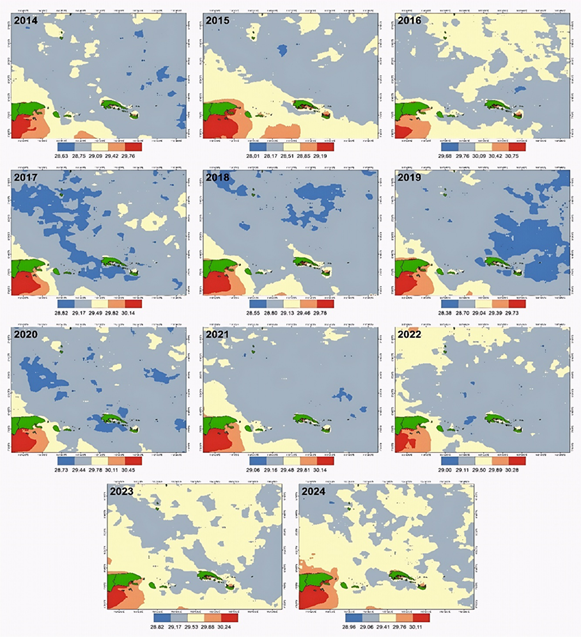
Indonesia’s marine environment is highly sensitive to global climate variability, particularly El Niño–Southern Oscillation (ENSO) and the Indian Ocean Dipole (IOD). This study analyzes the spatial and temporal variability of sea surface temperature (SST) and chlorophyll-a concentration and their relationship with ENSO and IOD in Sumenep waters, Madura Island. SST and chlorophyll-a data were derived from Aqua MODIS satellite observations for the period 2014–2024, while ENSO and IOD were represented by the Oceanic Niño Index (ONI) and Dipole Mode Index (DMI). Data were analyzed using temporal trend analysis, spatial mapping, and Pearson correlation. The results show that SST fluctuated between 28.01 and 30.75 °C, with higher temperatures during El Niño phases and lower temperatures during La Niña phases. Chlorophyll-a exhibited relatively stable minimum values (0.178–0.217 mg/m³), while maximum values varied between 0.499 and 0.782 mg/m³, peaking in 2020. Pearson correlation analysis indicates a strong relationship between ENSO and SST (r = 0.791) and a very strong relationship with chlorophyll-a (r = 0.898). In contrast, IOD shows very weak correlations with SST (r = 0.074) and chlorophyll-a (r = 0.211). These findings confirm that ENSO is the dominant driver of SST and chlorophyll-a variability in Sumenep waters, with important implications for regional marine productivity.
Article Details
Issue
Section

This work is licensed under a Creative Commons Attribution 4.0 International License.