
Welder Qualification Requirements for Midship Block Assembly of a 3702 GT Barge
Article Sidebar
Main Article Content
Abstract
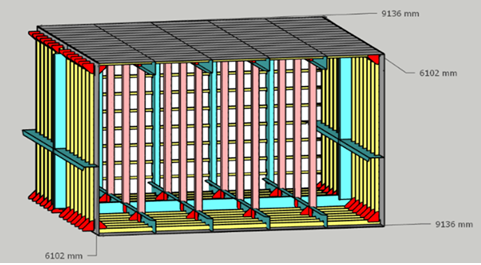
Precise and efficient welding is required in the assembly and erection of the 3702 GT barge block system. A mismatch between the number of welders available and actual needs in the field can affect production time and cost efficiency. The purpose of this study is to determine the number of welders and electrodes required in the assembly of the 3702 GT midship barge block, which is expected to serve as a reference in the planning and management of welders and materials in the shipbuilding process. A quantitative approach was taken by collecting technical data, namely welding length, fillet volume, welder productivity, and work efficiency. The data was obtained from technical documents, field measurements, and three-dimensional modeling of the 3702 GT midship barge block. The analysis results show that the total welding length in fabrication reaches 1.361 meters, while in erection it reaches 126 meters. with a welding volume of 31,184 cm³ and an electrode requirement of 326.39 kg. With the application of 35% work efficiency of welders in the field, the requirement for welders for the assembly of the midship barge block was eight welders with a duration of seven days.
Article Details
Issue
Section

This work is licensed under a Creative Commons Attribution 4.0 International License.
How to Cite
References
[ 1] Syaban and E. A. Mokodompit, “Strategi manajemen pengembangan industri kapal dalam menghadapi persaingan global: Studi kasus pelabuhan,” Jurnal Pelabuhan, vol. 5, no. 2, pp. 236–242, 2024.
[ 2] F. R. Berlian and I. Baroroh, “Pengaruh tenaga kerja subcontractor terhadap waktu dan biaya pembangunan konstruksi badan kapal perintis,” Jurnal Teknik Perkapalan, pp. 79–86, 2000.
[ 3] J. Jafar, “Desain blok kapal berdasarkan variasi ukuran pelat (Studi kasus: Kapal SPOB 5000 DWT),” Undergraduate Thesis, Departemen Teknik Perkapalan, Fakultas Teknik, Universitas Hasanuddin, 2020.
[ 4] Purnama and T. Rachman, “Techniques for handling deformation welding of shipbuilding construction supporting elements,” Zona Laut: Jurnal Inovasi Sains dan Teknologi Kelautan, vol. 5, no. 1, pp. 112–118, 2024, doi: 10.62012/zl.v5i1.31599.
[ 5] Siregar, “Analisis proses perakitan kapal berbasis sistem blok di galangan kapal,” Jurnal Teknik Perkapalan, pp. 45–52, 2021.
[ 6] B. Andrianto et al., “Dinamika ketersediaan tenaga kerja di industri galangan kapal Indonesia,” Cakrawala Maritim, pp. 55–64, 2022.
A. Salim, “Halaman sampul,” Math Didactic: Jurnal Pendidikan Matematika, vol. 4, no. 3, 2018, doi: 10.33654/math.v4i3.272.
[ 7] Ministry of Manpower and Transmigration of the Republic of Indonesia, Regulation on Welder Qualification in the Workplace, 1982.
[ 8] S. P. P. Warman, “Analisis faktor penyebab cacat pengelasan pada pipa (Studi kasus pada pipa distribusi PDAM Kabupaten Kutai Barat),” Jurnal Mekanikal, vol. 8, no. 2, pp. 730–736, 2017.
[ 9] B. Triatmodjo, Perencanaan Pelabuhan. Yogyakarta, Indonesia: Beta Offset, 2009.
A. Djamaluddin, Port and Terminal Management. Makassar, Indonesia: UNHAS Press, 2023.
[ 10] R. Salim and D. Budianto, Manajemen Pelabuhan dan Transportasi Maritim. Jakarta, Indonesia: Salemba Empat, 2014.
A. Nurhadi, Keselamatan dan Kesehatan Kerja. Yogyakarta, Indonesia: Graha Ilmu, 2018.
[ 11] J. Piątkowski and P. Kamiński, “Risk assessment of defect occurrences in engine piston castings by FMEA method,” Archives of Foundry Engineering, vol. 17, no. 1, pp. 107–110, 2017, doi: 10.1515/afe-2017-0100.
[ 12] R. J. Rakesh, “FMEA analysis for reducing breakdowns of a subsystem in the life care product manufacturing industry,” International Journal of Engineering Science and Innovative Technology, vol. 2, no. 2, pp. 218–225, 2013.