Enhancing Seafarers’ Self-Awareness and Emergency Decisions through Bridge Simulator Training
Article Sidebar
Main Article Content
Abstract
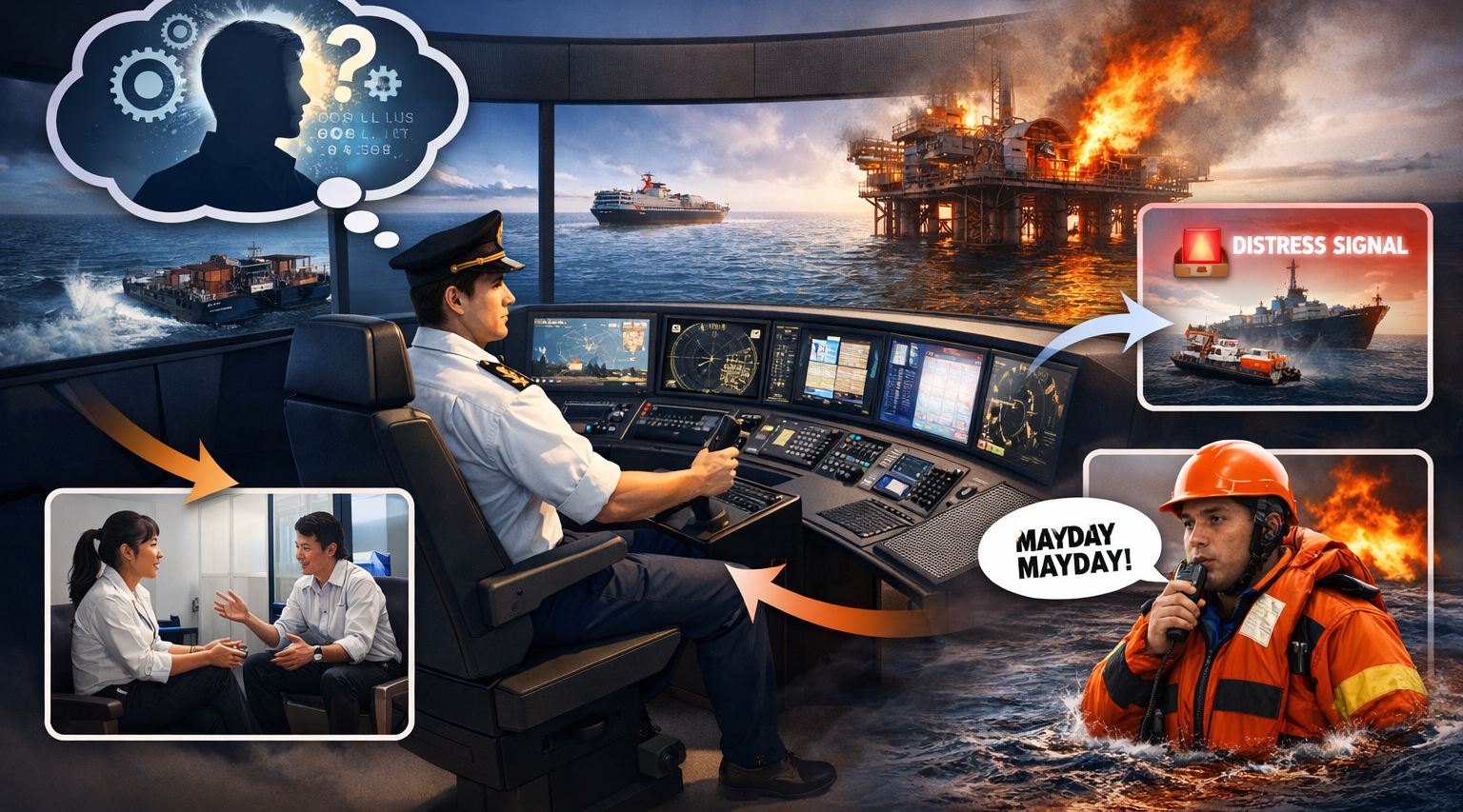
This study examines the association between Bridge Simulator training, seafarers’ self-awareness, and emergency decision-making performance. A quantitative correlational design was employed involving 105 active seafarers who had participated in certified bridge simulator training. Data were collected using a structured questionnaire measuring perceived training quality, self-awareness, and emergency decision-making performance. Spearman’s rho correlation analysis revealed a strong positive association between Bridge Simulator training and self-awareness (ρ = 0.764), as well as between Bridge Simulator training and emergency decision-making performance (ρ = 0.744). These findings indicate that higher perceived quality of simulator training is associated with higher levels of self-awareness and decision-making performance in emergency contexts. The study contributes empirical evidence on the psychological and cognitive dimensions associated with simulator-based maritime training and highlights implications for maritime education and safety training.
Downloads
Article Details

This work is licensed under a Creative Commons Attribution 4.0 International License.
Accepted 2026-02-11
Published 2026-02-16
References
[ 1] Rini, H. F. A. Setiawati, and H. F. A. Setyawati, “Kepemimpinan di atas Kapal (Leadership on a Ship),” Jurnal Manajemen Transportasi & Logistik, vol. 5, no. 3, pp. 237–248, 2018.
[ 2] D. H. Pasolong, Teori Pengambilan Keputusan. Bandung, Indonesia, 2023.
[ 3] S. A. Puteri and A. Rozana, “Pelatihan berbasis self-awareness untuk meningkatkan kemampuan pengambilan keputusan karir,” Plakat: Jurnal Pelayanan Kepada Masyarakat, vol. 4, no. 1, p. 121, 2022, doi: 10.30872/plakat.v4i1.7834.
[ 4] R. Hafizha, “Profil self-awareness remaja,” Journal of Education and Counseling, vol. 2, no. 1, pp. 159–166, 2022, doi: 10.32627/jeco.v2i1.416.
[ 5] K. Hjelmervik, S. Nazir, and A. Myhrvold, “Simulator training for maritime complex tasks: An experimental study,” WMU Journal of Maritime Affairs, vol. 17, no. 1, pp. 17–30, 2018, doi: 10.1007/s13437-017-0133-0.
[ 6] S. Shanta and J. G. Wells, “T/E design-based learning: Assessing student critical thinking and problem-solving abilities,” International Journal of Technology and Design Education, 2020, doi: 10.1007/s10798-020-09608-8.
[ 7] L. G. Evidente, K. Kannan, V. A. Loginovsky, Y. Mori, and A. R. Shoshin, “The effect of preparatory bridge simulator training on development of situation awareness skills of watchkeepers,” Russian Journal of Water Transport, vol. 73, no. 3, pp. 226–242, 2022, doi: 10.37890/jwt.vi73.325.
[ 8] Kuncowati, N. A. Listriyawati, E. Febriana, and A. Maulino, “Penggunaan bridge simulator dan komunikasi untuk keselamatan pelayaran di era new normal,” Jurnal Saintek Maritim, vol. 23, pp. 151–158, 2023.
[ 9] N. J. S. and R. D. K., “Optimalisasi pemanfaatan full mission ship handling simulator dalam meningkatkan kompetensi bernavigasi taruna,” vol. 21, no. 2, pp. 79–85, 2019.
[ 10] R. Alkadri, B. Mustari, and A. Setiawan, “Pengaruh bridge simulator karya PT LEN sebagai industri pertahanan dalam negeri untuk meningkatkan kompetensi taruna AAL korps pelaut,” Rekayasa, vol. 15, no. 2, pp. 199–203, 2022, doi: 10.21107/rekayasa.v15i2.14155.
A. Novianto and D. Riana, “Integrative factors of bridge simulator laboratory adaption: Based project model,” Journal TAM (Technology Acceptance Model), vol. 14, no. 1, p. 36, 2023, doi: 10.56327/jurnaltam.v14i1.1519.
[ 11] S. M. Dilawar, D. K. Durrani, X. Li, and M. A. Anjum, “Decision-making in highly stressful emergencies: The interactive effects of trait emotional intelligence,” Current Psychology, vol. 40, no. 6, pp. 2988–3005, 2021, doi: 10.1007/s12144-019-00231-y.
[ 12] J. W. Creswell and J. D. Creswell, Research Design: Qualitative, Quantitative, and Mixed Methods Approaches. Los Angeles, CA, USA: SAGE, 2018.
[ 13] W. G. Cochran, Sampling Techniques. New York, NY, USA: John Wiley & Sons, 1977.
[ 14] A. Kuzu, E. Başar, and Doğru, “Effectiveness of bridge simulator training in improving maritime students’ situational awareness,” WMU Journal of Maritime Affairs, vol. 19, no. 1, pp. 23–45, 2020, doi: 10.1007/s13437-019-00182-9.
[ 15] C. Chauvin, S. Lardjane, G. Morel, B. Clostermann, and J. P. Langard, “Human and organisational factors in maritime accidents: Analysis of collisions at sea using the HFACS,” Accident Analysis & Prevention, vol. 59, pp. 26–37, 2013, doi: 10.1016/j.aap.2013.05.006.
[ 16] A. H. Purwantomo, Prosedur Darurat dan SAR. Semarang, Indonesia: PIP Semarang, 2018.
[ 17] R. P. Sumarta, D. Widarbowo, D. Haryanto, M. Kendek, and I. K. H. P. Adiputra, “Meningkatkan pengetahuan navigasi kapal dengan bridge simulator,” Jurnal Inovasi Hasil Pengabdian Masyarakat, vol. 7, no. 2, pp. 271–282, 2024, doi: 10.33474/jipemas.v7i2.20710.